 Free1:43:00
Jamyang LondonFree
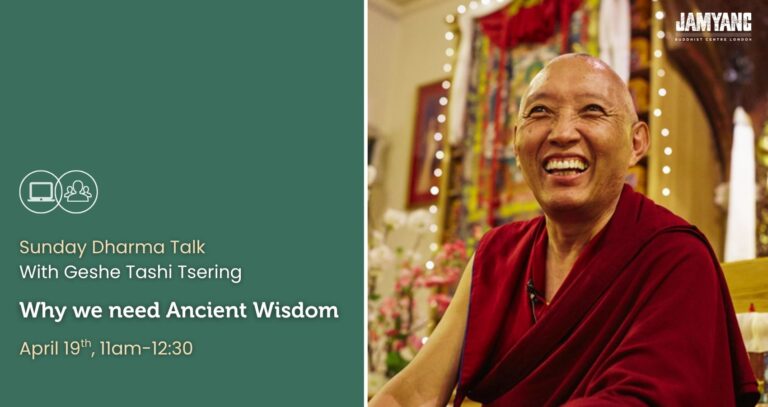
Why do we Need Ancient Wisdom (2006)
!
Oh yeah, oh yeah!
Please sit down. Can I have a cushion?
Oh yeah, please sit down.
Gen-la Rinpoche.
Welcome. Welcome back to Jamyang, London.
Such a familiar home. we're absolutely delighted and thrilled that on your visit to the UK you very kindly accepted our invitation to be here today it's a real thrill to be with you again and this morning I was
reminded of in 2019 in November you came it was an evening and the whole center was absolutely packed and there was such a joyful atmosphere because there's so many friends who come and
and today it feels like this again and so we're absolutely delighted thank you for accepting our invitation to be here today thank you and to all of you here in the temple and online welcome We're so, so glad you're here today.
And I know many of you are students of Rinpoche and have known him for decades.
But I know that there's some of you who may be here and meeting Rinpoche for the first time, either here in the temple or online.
So I just want to share just a few words. So, of course, Geshe Tashi Khen Rinpoche was Jamyang London's resident teacher for 20 years.
And Jamyang London just celebrated its 30th anniversary last November here in the old courthouse.
And on that day, we shared all these photographs and stories. And Robin here had prepared this incredible slideshow.
And there are so many photos of Geshe Tashi with boots and overalls and scrubbing the walls and painting and getting rid of all the old things of the old courthouse for years.
And when on Monday, this week actually, was the third anniversary of passing of Lama Zopa Rinpoche.
And we watched together this teaching of Lama Zopa Rinpoche from 1996. And I know some people were there.
And so there is Geshe Tashi offering the mandala to Rinpoche, who was in his mid-30s.
So anyways, this is such a long history with Geshe Tashi.
So it feels like family coming together. But since Rinpoche left Jamyang in 2018, he was appointed abbot of Sera Mey and did this for six years.
And then after that, when he was here in 2019, some of you may remember that Rinpoche shared his aspirations to return to South London.
But his holiness had different ideas. And so Rinpoche was appointed the head of a really important project, and it's a new project.
And it's the Dalai Lama Center for Tibetan and Indian Ancient Wisdom in Bodhgaya.
And so today we asked Rinpoche to share what the vision is for that project and so forth, so that we could learn about this new mission that Rinpoche is leading.
So again, thank you for being here. Thank you.
Venerable Thoma. And also thank you for the Chiamyong team.
And also thank you for the people who come here.
So many familiar faces. I was told not to say old friends, so I will not say old friends, but so many familiar faces here to come here and to listen.
I usually call my blah blah, so going to be an hour and a half blah blah, And, yeah, so very pleased to be back in Jamming here and very happy, you know, to have this gathering.
And today's topic I was asked, the title was Why Do We Need Ancient Wisdom?
I think that is the title. and so before I say some, you know, a few points on the subject and also share with you the project
which is, you know, taking place in Budkaya and, you know, and then we'll have also good questions and answers that's usually more productive.
and then, you know, me to say blah, blah. So that's what we're going to do.
And it is about an hour and a half. And so I always start, particularly when we have this kind of gathering, and always start with setting the motivation, which is quite useful,
and also which is also related to our topic, ancient wisdom, because, you know, if we read, listen, some of those great teachers, you know, the teachings,
there is a tremendous amount of encouragement, you know, to set the right intention, you know, if it is possible, every, you know, every event that we start,
if not in the morning and also like that. And from my little experience, it helps setting the good, right, positive motivation before, you know, engage into the actual activities.
And doing that again and again and again, eventually it becomes part of, you know, our habits.
And that usually positive habits. And so here, you know, as in a Buddhist, you know, very I usually call a holy place.
This place here, many great teachers, you know, had come, and I'm sure will come in the future, you know, including His Holiness Dalai Lama came from the Tibetan Buddhist side, His Holiness Satya Chinzen came,
and, you know, of course, Lama Sauron Bajie came many times, and also, you know, the two Giluk, you know, throne holders came,
Ringsong Rinpoche came here, and also the Lop Sang Tenzi Rinpoche came, and many other great teachers have visited this place and gave many, many precious teachings.
You know, some of the teachings are these days not easy to receive from that kind of teachers.
I mean, of course, there are many great teachers who are there, but still, you know, some of these great teachers who came here and visited and gave tremendous amounts of teachings.
So this I usually call a very holy place. You know, from the Buddhist point of view, holy place is not from the place its own side.
It is the place where those great, you know... realized beings have visited and said many prayers, have done many spiritual activities, then the place becomes a holy place.
So this is, though originally built as a courthouse, now it is a really holy place.
And, you know, when I look around, 80% of people here, physically here, and also maybe on the online people who join, you know, they have followed one way or another reasons,
follow the teachings of the Buddha, and or at least have interested in teachings of the Buddha.
So in that case, you know, for the follower of the teachings of the Buddha, than holding in our heart refuge.
You know, it's really something very, very helpful, useful mind to be with us.
You know, seeing the Buddha as a teacher, mentor, and recalling, you know, his great qualities, particularly his mental qualities, great compassion and wisdom,
and that we can tell from his teachings. Though in our Buddha, we haven't met the Buddha, but we have met his teachings, such as the Four Noblethuts and many other great teachings.
From those teachings, we can tell a great, great teacher.
So seeing the Buddha as a teacher. And also his teachings.
Here when I say his teachings, I'm not particularly referring to the verbal teachings, the contents of the verbal teachings.
Love, compassion, altruism, and all those.
as our, you know, the daily sort of, to bring into our daily lives those teachings, and also the Sangha members as their supporters.
When I say Sangha, not necessarily, and not disrespectfully, not necessarily referring to the only ordained monks and nuns.
Of course, there are also Sangha members, but also the people who closely follow the teachings of the Buddha.
There are also Sangha members. From them we can learn. So holding those three as a refuge, Buddha as a teacher, mentor, Dharma, as a means and methods to apply in our daily lives,
and Sangha as a supporter, and having that in our mind in the morning, during the day, and also at the beginning of an event that we are going to do, whatever.
A special event or, you know, daily routine events. But engaging that event with the refuge mind, it makes huge difference.
Then, of course, some of us follow within the Buddhist teachings.
Some of us follow Bodhisattva Yana teachings, sometimes called Mahayana teachings.
In that case, cultivating, you know, cultivating the altruistic awakened mind, Bodhichitta, the mind which genuinely, sincerely cares, concerns, well-beings of many.
Of course, well-beings of oneself, well-beings of one's own loved ones, friends, but also try to extend that, you know, sense of care, sense of concern of well-being of many, many living beings.
And that is, you know, very roughly, very generally what the meaning of the Autistic Awakened Mind.
And that mind, again, you know, refreshing in our mind, again and again and again during the day, you know, the morning before going to bed,
you know, it is some kind of more universal.
You know, it's like reading books to the children before they're going to bed, you know, and for the adults, and particularly like us to have some kind of spiritual path to follow, than before going to bed, before going to sleep.
Having those minds like a refuge, like a bodhichitta, is very, very helpful.
Going to sleep with that kind of minds and that we need to habituate.
That is what here the meaning of the meditation is really habituating those, mental states or amazing mindsets in our mental continuum so very very helpful therefore
we are going to start with refuge and bodhichitta three times but people who are not in that you know what you call having decided whether you are going to Buddhist or not I usually say have a good sleep
Okay.
SANGYE CHU DAN SOKGYI CHO CHANGGYOU PARTU DANI GYA SUNGU CHI DAGYI CHEN SO GYI BAK SONG DO LA PENGYI SANGYE DRU BAH
SANGYE CHU DAN SOKGYI CHO
Oh yeah, thank you.
So why do we need ancient wisdom? That is the title of the talk.
So, you know, either ancient wisdom or modern wisdom, we need good understanding of the things and events
that is taking place within ourselves and around ourselves.
That includes, you know, the living beings that we share, this planet.
And, you know, some of the very important realities that are shared by the past, those great teachers,
not necessarily exclusively Buddhist teachers, but also, you know, not exclusively Asian teachers, but those on this planet.
In the past, there were many, many great beings who shared with us the importance of the understanding of ourselves as individuals, human beings,
and also the surrounding world that we live.
And in that way, that kind of good awareness, good understanding helps our own inner lives get easier.
This life is a little bit complicated physically and mentally, quite often not straightforward.
But, you know, with the awareness, with the understanding, with the wisdom, either ancient or the modern, that ease our doors.
challenges. Though the life that we have, there are many, many great things within us and around us.
You know, the other day I was with my, one of my good friends, some of you know, black cab driver,
Steve. I was with him several times and just a few days ago I was with him and we were having tea at his kitchen.
And from his window, we can see there's a small garden in the back of his flat.
And there are these small birds. And they're jumping from trees to another trees.
And they are very, very beautiful if we pay attention. So the understanding, the surrounding us and within us, we can see many, many good things also.
Not only challenges, not only difficulties, but also many, many good things.
And here, you know, like those, some of those great Indian masters, like second century common era Nagarjuna, some of you have studied his texts,
or 7th century Shantideva, some of his texts, and so forth.
When we read, when we study, when we listen to those texts, this life that we have, they refer to saying, precious human life.
Precious in the sense, based on this body and mind, we can do tremendous good things to ourselves as well as to others.
And those are the something, you know, ancient masters and also, you know, modern, those great teachers also talk about.
and we really, you know, what we need is there are enough information out there.
You know, the other day, it's just, you know, these days they talk a lot and it seems may be going to affect us a lot, AI.
So other day, my niece put AI in my computer and I was very curious, and I type, what is compassion?
There are many informations, you know, that I haven't heard before about compassion.
So there's enough information out there. So us as human beings, as those great teachers, refers to this human existence as a precious human life, mainly, you know, physically, particularly mentally,
we can do tremendous good things to ourselves and to others.
And, you know, along that, like, you know, some of those great, I'm talking about those great Indian masters,
talking about how much good mental states that we have within us.
If we enhance them, if we activate them, these mental states will be very, very helpful, useful to ourselves.
maybe currently in a more, you know, potential level or just starting to show the, you know, the, what you call, the, you know, the small things coming up
due to, you know, our own efforts and receiving teachings, reading those great texts and then also putting a little bit of effort to do the meditations, those seeds might be showing some inner shoot.
And that is what we, you know, some of those, you know, the great teachers have encouraged us, taught us to bring those good qualities, not keep in a seed level,
not leave it in a potential level, but bring to more active, you know.
This great Indian master, Chandrakirti, I think, 5th century, he clearly, you know, stated in one of his great texts,
saying that compassion is like a, you know, if we're going to plant a tree, compassion is like the very, you know, what's called a healthy seed, what we need at the beginning
to grow a good fruit tree. and compassion is like water and manure to nurture when that seed starts to grow.
And compassion is at the end, those fruits when they are wrapping, ready to eat.
And we have those things within us. These are not just, these teachers are not saying, have someone happening somewhere in another planet, these teachers are saying, it is going to happen within ourselves.
So therefore, you know, some of these, these are, you know, very, very relevant, particularly, you know, today's time,
having lots of, you know, unpleasant events or activities or taking place and, you know, keep hearing, keep seeing.
And we may feel very, you know, down, very disappointed, and so on and so forth.
But, you know, what is helpful, these ancient, you know, the great teachers' teachings we should try to apply in our daily life.
And another important thing is, in a very, very early stage, stage, these great teachers have found, have noticed our mental state
is complicated but still it is very, very flexible not rigid it can be reshaped it can be re-tuned from the current, if you want to
change, if you want to transform. That is what those great teachers, including the Buddha himself, have said again and again And these are very, very encouraging in other teachings.
Because sometimes when we, I'm talking about, say, when we, I'm talking about myself, you know, for many, many years under those great teachers and great teachings and trying to do something but not seeing any improvement,
not seeing any tangible product that may discourage, that may feel disillusioned.
But then again, going back to those great teachers, teaching, saying these are flexible.
Your mental state is flexible, not rigid. It is clearly stated in the Shantideva's text, saying, there isn't anything which will not get
easier if you familiarize it. So these are very, very, you know, the helpful, you know, the teachings.
You know, at the...
though our physical, you know, form or physical body, you know, pain or pleasure, when we go through, is quite strong.
But if we train our mind, you know, our mind becomes more powerful than the physical.
You know.
So there's this huge amount of teachings, not just verbal teachings, but there are still great teachers to help us how to train our minds, thoughts, emotions.
you know, what the, you know, the very experienced teachers are still there.
And I'm sure many of you have been involved in Buddhism for many years and have done many meditation and received many teachings.
And also, some of you also have led many classes. from there you can tell at least there's something transformation is there.
And those are what these great teachers have taught us.
And here what is helpful and useful is how can we continue
You know, these important, helpful, useful teachings can take to the next generation and generation after.
In my case, I joined Sarah Monastery in 1970 in August, and that time in the Sarah Monastery,
the monks were 100% came from Tibet.
Our generation, we join, like a great translator, Kishitup Dinh Jempa, in our generation, we join with these monasteries and receive those teachings from those great teachers.
And now most of those great teachers are gone. Very handful of them are there.
but the monasteries are still quite vibrant institutions to study and the same here in the West many of you are the more or less first generation
to have met those great teachers in here like Geshe Wanchen in many great teachers and other great teachers.
So these things, these wisdoms, these knowledge that you have received, how to enhance them, and you have experienced, you have got taste,
and now how can you take this to the next generations?
and that is important for ourselves and also important for the humanity and for the living beings.
In that case, now this, just to, what I've said is only two, three things.
Ancient wisdom, something useful, helpful, like saying that our human existence has a tremendous potential, and that we should try to, you know, seize those potential and to bring that potential to the, you know,
not just in the seed or potential level, but more active within ourselves in that way to benefit ourselves, to others.
And that's the one point, just a few points I want to raise. The second point is, you know, the flexibility of our mental continuum.
And that is what's raised by those great teachers again and again and again. So, you know, even sometimes when we feel, you know, we're stuck, transformation is not going that much, but still, you know, try to continue
because, you know, our mental state is flexible. and you know the third point which I want to share here is in the ancient particularly those great Indian teachers that I know a little bit through their
teachings and also some of those great Tibetan teachers you know have a tremendous explanation about our inner world our minds thoughts emotions.
I'm not talking about next life, future life, all the way enlightenment. I'm just talking about right here and now.
You know, here and now. And that is, those are the something, you know, very, very priceless in what you call the treasure.
That's useful to keep. to explore, and then pass down to the next generation.
So in that case, His Holiness, Dalai Lama, you know, has been saying this for many, many years.
When I was a young student in Sarah Monastery, I remember very, very vividly, you know, the 19...
I think 1976 or 7, very early, you know, the... the Sera Monastery, established in South India, one of his visits.
He said, you know, the... the teachings that we have, you know, in the monasteries, study program, practice what we have.
Now it's time to share to the outside world. We have, though we lost our country, but we got the opportunity, this amazing, you know, precious thing that we have to share to the world, outside world.
This I remember very, very vividly and also he has been saying this again and again and again.
And through that, you know, he himself has done many, many amazing event, activities,
you know, like, for example, you know, those days, even these days, particularly those 1980s, late 70s, 80s,
the abbots of the monasteries are from the previous generations and they don't have that much access to the outside world and very much concern about.
But I think 1982 or 83 again one of his visits in in Sarah Monastery, he said, you know, now our debating system that we have,
and studying those amazing philosophical points, these structures need to take out from the Buddhist study to studying other topics like science.
In earlier those he was saying that. And then, of course, many of you know, you know, he had more or less forcefully, you know, asked the monastery, the monks to have studying modern science.
And which is now, you know, not fully established, but quite well established.
like that. So to bring these amazing those past great teachers those teachings how to embrace that to the modern knowledge and the modern lifestyles and so on so forth.
So in this case I was asked to say a little bit about the project that I'm leading currently in Buddhaya.
And that is what His Holiness, Dalai Lama, wants to have in a place, you know, anybody can come.
You know, not necessarily to do a degree course or, you know, like that.
Anybody can come to this institution, which is currently in a construction level, come and to study whatever levels that you would like to study.
Don't have to be Buddhist, don't have to be Hindus, don't have to be Christian, But the idea is to make that institution to, you know, the term that he used in Tibetan, Igmong.
Igmong means illiterate, people who can't read, you know, even they can come to the institution.
And that is the, and from that institution, institution really to learn all those, you know, the important subjects or, you know,
helpful to live this life more meaningful, you know, more productive.
And that's what here, you know, the institution is. The other day, I shared with some of my friends, because I was a little bit, you know, shaken up that.
My first week, this time coming to London, I stayed with my friends, Lopsom, in Wembley Park.
And the first day, we, you know, took the underground. And as soon as we get into underground, and of course, the sound is very familiar to me.
in the past saying, mind the gap between the train and the platform.
So, first time when I heard this, that's, you know, although I lived here 20 something years, it's very familiar.
But that is here, you know, these great teachings tell us mind the gap between the appearances and the reality.
And that is what's here helpful.
Many of our daily difficulties that we face individually or collectively we are falling in that gap.
not between the platform and the train, but their appearances and the reality.
Unable to reduce that gap. And these teachings really talk about, like, for example, very simple, very well-known practice in teaching, like mindfulness,
that help to reduce the gap.
Or in a more philosophical term, like a conventional truth and ultimate truth.
That's again trying to explain that things and events may appear in these particular shapes, colors, forms, smells, tastes, tactile, or just in imagination,
but they may exist in a different way. And that modern science, all these powerful technologies show us the difference.
you know recently four people three American one Canadian went to close to the moon and you know when you look at the pictures the moon that we see from here is very different from moon
the picture they have shared there's a gap isn't it and it is the same in our everyday life.
There are lots of small gaps, particularly at the emotional level.
How can we react to the appearance emotionally?
And in that level, like at that institution currently in the construction, it has it is a big institution going to be a big institution in general some of people whom
you know me very well very clearly I don't like institutions I have a little bit you know I don't want that but currently out of karma I mean I have no choice
So the current institution that we are building, it has going to be a big collection of these texts, references, recordings, videos, some of those great teachers' teachings.
so people can come, read, listen, watch.
So there is going to be a big library, one portion. Another portion is going to be a big museum, but not really to display objects.
They're mainly to demonstrate, to explain, to show how the mind can be trained.
For example, currently there is one discussion that we are going on, you know, that how his Holiness Daryalama lives in his inner place.
Although I've never been into his private room, I was told, very, very simple.
There aren't many, all these things, very, very simple. Some of us may have seen the photo of his in a private sitting room.
So to show to the people, some of those great practitioners, how they live their daily life.
And there's going to be a big museum. And the third part is going to be a study, not a classroom, meditation room.
and also research rooms.
So there are these three main parts of the institution, the main activities, library, museum, and academic.
Then there is a plan. I don't know exactly how much we are able to execute according to the plan.
There are going to be a big park. People can really sit quietly, if possible, in India.
So, you know, that is what His Holiness Dalai Lama is. his own, you know, tremendous, amazing experiences, learning from those, his great teachers, and going through those great texts.
He really deeply, deeply feels, you know, from these amazing teachings, people can benefit tremendously, not just for the Buddhists, not just for Hindus or Indians, but ordinary people, ordinary, anybody.
And that's the project that I'm leading currently. Currently it is in a dust, like a dust bowl.
And, you know, many of you have been to Bodh Gaya.
and first of all, India is a very interesting country.
While you are there, you want to get out.
While you are outside, you want to go in. That is the country. And also, you know, particularly, Dendhambhya is one of the poorest states and Bhutgaya.
You know, some of the materials that we need is easily available in other parts of India.
But in Bhutgaya, you have to, you know, wait a few weeks to get that material. So it's not an easy place.
And I think there is a purpose. Some, you know, since I'm working for this project, people ask why?
Why he built there? Not in another place near Delhi or Bangalore or another bigger city.
And I said, I don't have an answer. But only I can say, there must be a purpose.
So really, you know, the... important, you know, hopefully in the coming, you know, years and years may become very,
you know, very, very helpful, useful institution. That's what I'm leading. I'm not leading. I have lots of friends, colleagues who are working together.
So, yeah, that is briefly about the project. Sorry, I don't have any images to show, you know, but that's how ideally, you know, this modern time, I should have some, but I don't have any.
My apologies for that. So I want to conclude this. Last part, I would like to say this.
This, I mean, the human existence that we have,
the Buddhist term, those Buddhist teachers term use precious human life.
And as, again, Buddhist teachers have repeatedly said, it is important to understand its potential, its nature, in this case, nature of impermanence.
these two are something very very important to all the time to you know to bear in mind be aware of
and in this case the second one which I haven't said that much is nature of impermanence you know that many of us feel it you know particularly at the gross level
You know, when I was living here in the early 2000s, I can walk along the River Thames maybe two or three hours.
The other day with Patrick, we did about an hour or two hours walk.
At the end of the walk, I was completely exhausted. So that is, I thought, the nature of empowerment.
But we don't need to be fearful of that.
There's nothing to be afraid of that. That is the nature of this existence.
Nobody's punishment, nothing. What is helpful is be aware of that and embrace that.
and, you know, at a certain extent, enjoy with that.
You know, particularly I say people who live in London, the other day I said, oh, I'm enjoying my reaching, you know, first 60, now reaching 65, and now over close to 70.
Coming to London, I'm enjoying because I have this freedom pass. so I can go to underground or buses wherever I want to go.
So I'm enjoying it. So this is just a small thing. But there are many good things from these bodies in a natural process.
For example, in the last two years, 2024, I lost my dear teacher, whom I spent since 1970 to till in the same room.
and very, very dear, very, very kind, helpful. And also we lost, you know, this, another great teacher who came here many times, you know, gave Kui Samadha teachings.
And last year we lost him. And I saw them, you know, going through the process.
and so you know in a certain extent it is a part of our existence it is not something wrong it is part of our existence and the Buddhist teachers have repeated that again
so you know they're useful useful and helpful to understand the things that, you know, the nature of the life, you know, the nature of this existence
as a part of the existence instead of it is, existence is this, this is separate.
You know, and if we take it some kind of part, then we feel quite difficult to that.
And the last part is, as always, You know, as always, try to...
His Holiness Dalai Lama says these days, you know, his main practice is cultivation of compassion, or quite often he says, bodhichitta.
You know, try to bring that amazing, you know, the mental state, the artistic mind, and then try to live with that as much as we can.
Then we will see how precious this human existence is.
Then we see the benefits of how fortunate that we are, first of all, have this human existence.
Secondly, to have met these great teachings and those great teachers.
Then we will see that, we will feel, you know, that life has a tremendous meaning.
Tremendous, you know, what you call the meaning. So that's what I want to say at the last part of my talk.
And now we'll have 30 minutes, question and answer. Okay, thank you.
You can say anything, ask anything. So we'll start in the gompa if anyone has any questions for Geshe-la.
Or we could start online.
any questions online
I guess you're like so lovely lovely to see you it's just wonderful
I just I wish I were with you I send you lots and lots of love.
Thank you. How's Antonia? Sorry?
How's Antonia? Yeah, he's good. Thank you.
Yeah, he's at his yoga course. Please come to France.
We have room for you. Okay. Will you be teaching at this institution?
Sorry, I'm nearby. You'll be teaching nearby? Yeah, I'm not really teaching, but I'm living nearby.
institution that is building now. Can we come and see you? Yes, you are welcome.
Thank you. But careful. Currently it's very, very hot.
We're not together. Okay. You're welcome.
Lots of love. Thank you for all you've given us and your giving up. Thank you.
I just want to say do you not think this gonpa looks amazing now yes i was talking about it we said always be buddhist
blinged buddhist bling all the go um it was really different because i remember when we talked about it before and you said you wanted to keep it simple so i just wondered what were
your feelings about the building itself i i i sort of feel that suddenly all that heaviness that you remember in the early days and it was so much it was really a it was still a court wasn't it
and we were sort of if i feel it's completely transformed now what what are your feelings about the the changes that have been made and what would you like to see in the future here at I mean, as I said, at this building, so many great teachings.
were taking place through those great teachers.
And so, you know, I'm sure, I'm sure, you know, the place is really blessed place.
That's I'm sure. And, you know, and also the center is, you know, though it is south of the River Thames, people who live in North London, they may say,
oh, because Robin and Sue and some of them, they remember and still clearly remember when Jamyang was trying to move from North London,
Princebury Park, to here. and had lots of meetings in that small combat.
And there were lots of resistance moving south of the river.
And one time I was told even black cab driver, they will not go after 9.30 or 10 south of the river.
Anyway, it has a tremendous potential.
Look at now the Adipan Castle. That pink building is gone.
So all those subways are gone. So I was told there were so many younger generations living around here.
So there's a tremendous potential to reach out to that world.
Not necessarily to, you know, convert into Buddhist, but simply help create the opportunity to come to the place, do a short meditation, you know, listen, talk,
and also if you want to study some of those, as we are talking about, you know, the mental states, emotions, thoughts, you know.
And recently, I haven't read the book yet.
I think it's North Carolina or South Carolina University. And there's a professor to talk about mind and body.
And talking about many, for example, the migraine, headache, people who have from the young age.
though there's nothing to be found as something's wrong but it is simply the neuron just giving your brain is just still saying there is something wrong and having headache so there's tremendous things can be
sort of given opportunity to the outside world from here in the location and the facilities and, you know, there are good teachers.
Yeah. And I can say that the place can be a very, very, you know, productive, important place to the outside world.
Yeah. Thank you.
That's what I can say. Mm-hmm.
It's one over here. Same.
Yes, you mentioned the library in the institution. Is the intention to have texts from all different traditions and not just Buddhist tradition as well, but wider?
Yeah. And different language. Yes.
you know currently we have a put together a draft what kind of materials that are going to collect there as the institution itself is called
Dalai Lama Center for Tibetan and Ancient Indian Wisdom so therefore there will be a great collection of Indian masters, in this case, not just Buddhist masters,
also, you know, the non-Buddhist, you know, ancient Indian traditions like Sampyar and so forth.
Then also, you know, there is a plan to bring some of the modern, the contemporary texts or the other materials, particularly related to the mind, emotions, thoughts.
Yes, there is a plan to have a good collection of these materials.
And also, as I briefly said, one of the you know the purpose to collect to have those great collections is to have a good research facilities so there are people who want to do the research
there will be good accommodations for them and plus not only the books and those materials there is a plan to have at least few good teachers as a residence.
And also, you know, after 14th or 15th century, you know, the common era, there wasn't that much,
actually hardly any, you know, sort of interaction between the Tibetan Buddhist teachers and the Indian non-Buddhist teachers.
Though in India from the 14th to up to now there were lots of development in the spiritual path or in the philosophical. That is not really updated in the Tibetan in other.
So there is this plan to bring, we are already in a commission to translate from Hindi, Sanskrit into Tibetan, like a Baba Gita, which is not translated.
Few chapters in Tibetan, but not translated. Like that, to update.
And also to some of those great Tibetan younger students or younger Geshes have the opportunity to have this kind of dialogue with the great Indian non-Buddhist scholars,
and through that to update the Tibetan scholars or the practitioners, their understanding about contemporary non-Buddhist Indian philosophy.
So, yes, you know, it's not going to happen immediately because currently we are struggling to build the structure itself, but hopefully, you know, it will have a good sort of facilities, people who want to explore those things.
Yeah. Yeah, yeah. There's one later here.
I just wonder, would you plan to build a digital library, like archives of all the seminars
and talks and including the real life, maybe even streaming from that place to the rest of the world, then we will be able to look and research in that sense.
Yes. You know, there is a good collection, particularly His Holiness Dalai Lama's teachings, good collections already archived in Dharamsala.
So we have a plan to have, you know, many of those, you know, also in Bodh Gaya.
And, you know, as your question, saying, you know, digital, that is exactly what we are aiming for, material, physical things as well as digital.
And on the other hand, you know, I just told Venerable Drolma, in Ganden end of last year.
And currently we are putting together to have, initially to have a good podcast.
You know, the people who want to study. We currently have, in terms of the curriculum, to put two levels of...
you know, studying subjects. And now these initially, you know, the idea is initially used in a podcast level and people can have.
Then maybe after that, when the place is ready, then have a campus, people who physically want to come or people who want to do, you know, online.
So these are really in the process. it's going to happen.
Yeah. And my next question is related to the more than younger generation ever shot attention.
So that's why the mainstream of digital world is like three to four minutes a clip.
Have you ever considered to shorten something to have the essence to extract it out from a talk or seminar to build like a three to four minutes introduction one.
If people are interested, they can go into details of the longer version, but the shorter version will be much better and easier to spread it.
Yes. We have lots of debate or discussion on that. how much we really follow the younger generation's culture and how much we stay as we are
and to let younger generation to come. There is a risk.
If we just follow what they are doing, then benefit might be very, very little.
Like, for example, exactly what you are saying, like a TikTok. You have just five minutes.
And somebody says essence of this. Is it going to work for them?
Just five minutes? And that is lots of debate taking place, not just the institution that is starting there, But also while I was in India, I joined several discussions on that issue.
You know, how much we follow the younger generations, their culture, like a short, you know, time change short.
Or we'll stay, come into the middle. Instead of short, have 10 minutes or 15 minutes.
Let them listen. Get good taste. you know and so there are these things need to learn how to how to how to how to get the benefits
not just a follow i mean for example you know the anyway this is just my ego uh you know a few months ago before i come here because i run a a lead a class on saturday evening
Indian time, 8.30. 8.30? Yeah, 8.30.
Mainly to the Vietnamese, a group of Vietnamese, something that happened, but I didn't plan that, but it happened.
And the lady who leads that, she's very, very kind, very, very generous, very enthusiastic, and because I don't have Facebook, I don't have Twitter, I don't have all those things. I have only WhatsApp up because that when I was Abbott I need that
to talk to my Abbott colleagues otherwise I'm not saying these are wrong but I can't manage those things so the lady who runs this she said oh Rinpoche you have in your Facebook you have
500 people following then what but I don't know out of 500 people who listen one and a half hours.
I doubt. Maybe just one or two. But one or two, or a little bit, maybe not just an hour and a half, maybe 15 minutes, people who listen, it may get a little bit benefit, hopefully.
So there are these numbers, chasing numbers is one. Chasing the culture is one.
and also trying to, how to, the time that we spend, resource that we spend, how much benefits.
There are these things. Very good question. Yeah, thank you.
Can I continue? Geshe-la, do you have a kind of helpers and volunteering program also now for building up the hardware there or for helping with the digital things?
Yes. Now, you know, in terms of collecting the books, materials, we have two ex-libraryans, and currently they are based in Varanasi
because we don't have the actual space to put the collections.
And both are volunteers, you know, so like that.
But it is not that easy. I know a few Westerners last winter while I was in Bodhgaya, and, you know, I met them and they wanted volunteers.
In India, offering a volunteer job is not easy. There are lots of bureaucracies, lots of, you know, very, very careful not to break the rules because institution is very, very important in the early stage
not to break the Indian rules and regulations. So if you are a tourist, do the volunteers, you are not allowed.
So there are these kind of difficulties. I know there are several Westerners also doing volunteer jobs.
And then if you want to do the, this is a joke, if you want the physical, what you call the construction, then you Westerners can't go one meter where the actual work is taking place
because there's no hothead, there's no gloves there's no all those things even if you are in the third floor up there we insist please, you know, our constructors
give us, we give them lots of warnings something happens it is your responsibility please make sure have a hard head gloves and that means it's going to happen so it's not easy
okay yeah okay yeah is that okay?
yeah it's lovely to see you back in the gonfa it's really nice William and I were saying it's like being in FBT You just come in as that drop is back in.
Lovely. I had a question around division. You talked about impermanence, and that was really helpful.
And you also talked about seeing the best sometimes in situations. But there is a lot of division around at the moment, and I wondered if you had any comments or advice on how best to either be with that or help improve that in the situations that you're in.
Yes. so i'm just you know thinking about my own situation back in Bodhgaya we have four uh
different you know companies client then us that i'm a trust then architect then project manager So consultant, then contractor.
So we have lots of arguments, lots and lots of arguments.
We have two meetings a week, one in online Tuesday and one in face-to-face Friday evening.
So lots of harsh words, sometimes difficult. so the you know there was a now he left there was an engineer an Indian engineer very nice guy so at the end of the meeting
when we have a tough time in the meeting he will say at the end of the meeting he will say oh we all are arguing for the projects and I found that is very very helpful
you know, whatever divisions, whatever, you know, have argument or the disagreement and the difficulties that we have,
if we are all, you know, for the same reason, even though it is very, very difficult to have no ego, no self-interest, it is very, very difficult, you know, I'm these days challenged all the time.
during the meeting or at the site, you know, sometimes very difficult.
But then, you know, they're constantly thinking about this is for the project and the different what's called companies were all working for the project, although contractors have a deal on how to make, you know, profits
and architect how to make beautiful, not very much thinking about, you know, the maintenance, not very much thinking about functionality.
And for us, maintenance, how we're going to maintain this in the future, you know, how much it's going to cost for the future and how functional this will be, particularly this front called the water body you know so but we all
are this Indian guy who just retired civil engineer he said yeah yeah we had to argue a lot but we all are arguing for the project and I found that's very very helpful you know to not hold any kind of uncomfortable
unease at the end of the meeting because the main point is for the project.
The other thing that's helpful is to bear in mind, you know, as I just said a few words, you know,
bear in mind we all have this sadly or, you know, unfortunately, a little bit self-interest.
No matter whatever project is for what, there is self-interest.
Even if you try in the morning, set the motivation, this is purely, there is no self-interest.
But the self-interest is always down there. And also with that ego, plays a big role unnoticed.
You know, I was given this title saying, you know, general director.
But then when sit in the meeting, that comes. I'm general director.
You know, ego plays roles. So, when we work together in the community, in the family, in the society, all our inner doors, you know, little bit unhealthy side also play roles.
And the same to the other people do. It is not just our own. You know, they also have the same.
So in that case, sometimes, you know, accepting there are difficulties, there are divisions there are disharmonies is the part of the healing process that's what I found helpful to accept
architect is difficult though he's a very nice guy but it's difficult contractor is a nice guy but it's a big company and so on and so forth but it's difficult accepting that also sometimes quite useful
to not to feel too much deep in our heart.
There's a division. There's a disarmament. That's all I can say.
Okay, so there's a couple of people online you've had to hand up for a while. Okay. Wendy, would you like to go first and then Jenny afterwards?
Thank you very much. Geshe-la, it's just such a delight to see you. I really rejoice in all that you have done and that you are doing to fulfill his holiness's wishes. Thank you. It's a simple question, really. I just wonder how your new institution will kind
of overlap with the Library of Tibetan Works and Archives, Meridian Trust, and these kind of organisations that it sounds like the library part of your institution will overlap. So will
been working with them? Okay, so yes, we had last year, last year you know we organized all these
different institutions that over the years His Holiness Dalai Lama has set up, like a Tibetan
archive library in Dharamsala, like Tibet House in Delhi, and also Tibetan High Institution
in Varanasi, and Dalai Lama College in Bangalore, and also there are other several institutions I can't remember currently.
We had a good meeting. Mainly, how can we, first of all, these institutions, many of them have been there quite a long time.
They have good experiences. They have good connections. How these can support to the newly establishing institution in Bodhgaya.
Secondly, how can we not repeat the same project which is happening in the different institutions?
And also, you know, as you said, for example, in the Tibetan library and archive, they have so many, you know, what you call the materials in terms of those great teachers have given
currently in a more transcript level. How can we use those? So, yes, we are sort of coordinating and talking to each other and, yeah, doing something together.
Geshe-la, please, please live a long, long life.
Come back very often. If I had what you call the power, I want to live 200 years.
But the caveat is I don't have the power. My hair is getting more gray.
My body is getting a little bit weaker. But still, I'm healthy. Thank you.
so much, Geshe-la. Thank you. Next.
Okay, is it Jenny?
Yes, that's right. So, Geshe-la, wonderful to see you online.
I wish I could be there in person. So you've already said, so the question is, what other measures are you going to take to try and widen out what you're doing in the new institution?
You've already talked a certain amount about the library and translation and, you know, with the Bhagavad Gita, the discussion about podcasts.
And I'm wondering if the building in some way is going to, or the environment is going to reflect that.
So, for example, in Jamyang, London, there's a cafe. In Jamyang, Leeds, there's, you know, I was going to say a bit like alternative therapies.
So I'm just wondering, and you mentioned the parkland. So anyway, yeah. Blah, blah from me.
You can widen it out and attract a wide group of people. Yes, I think eventually, because like, for example, the Jamyang Buddhist Center in London,
people who come here for the classes and so forth, or they may physically come to Buddhaya, because Buddhaya is a very, very holy place for the Buddhists, in a place where the historical Buddha actually being there.
And after that, many, many great Indian masters had visited, and the current those great teachers have visited.
So some of the people who come to Jamyang and associate with Jamyang here or other parts of the world, I'm sure when they physically come to Bodhgaya, they can visit or have a cup of tea in cafe.
There's going to be a big cafe there too. and also some of those online activities.
Particularly, yes, it is going to be a big institution, but it's not going to be only academic, just theory to build.
It's going to be also more practical, You know, not necessarily Buddhist retreats may take place occasionally, but the main focus there is how those great teachings,
you know, that given by those great teachers, put into real practice. When I say practice, of course, meditation, recitation, sitting on a comfortable cushion, I will count as a practices.
But I usually count my understanding and my feeling of practice is in the real world, going to the outside.
outside the English term which I like very much is outside from the comfort zone.
That is. So in that case, people, wherever London, Leeds or other places, Buddhist centre or non-Buddhist centre, people physically come or online, sort of events hopefully people can benefit
from there ok? thank you so there's just one more question in the chat online Geshe-la and this person is asking if if there will be in the library of the institution there will be a range of different traditions especially
from the Tibetan schools of Tibetan traditions and they mentioned also Bun and will these be represented here?
Oh yes, yes, yes. You know, the library currently, you know, in terms of the space, has a huge space.
You know, we are not, we are currently worried about whether we are going to get enough materials to fill that.
And all, yeah, from the Tibetan side, all those spiritual traditions, you know, the materials can be there to study, for the research, and also Indians, and also modern, as I mentioned.
You know, the term that I used earlier, and which is used by His Holiness Dalai Lama, the place is going to be, even the illiteral farmer can come to the place to enjoy.
For example, when this institution was starting and initial the name of the institution, there was a title of Nalanda.
And his son, Dalai Lama, said, Nalanda, if you use Nalanda, then it's just Buddhist.
We need wider. whiter.
So therefore, the term Nalanda was not, you know, say, it's too narrow, just Buddhist.
And, you know, his son is initially, he doesn't want his name to be attached with that.
And then, as Indian central government, they insist his name should be there to the, you know, attached to the institution.
So, yes, in terms of the materials in the library, you know, all these different traditions, ancient, be there.
Yeah. Okay. Thank you.
So we'll say together one short prayer of dedication to cultivate bodhichitta, altruistic awakened mind, and dedication for his son Stare Lama's long life.
Thank you.
Once again, thank you for the center organizing.
Thank you for the people coming here. And also thank you for the people online.
This is, I'm starting to forget this. Yeah. Thank you for everyone.
And keep well and keep continuing. Okay. thank you Geshe-la very much for spending time with us today
for sharing what you're up to and last time you came in 2019 you were telling us about your adventures as an abbot at Sera Mey And now you're sharing about this particular project.
And as you can see, just so many questions that arise. And I think one thing that struck me, especially because you shared it when we were having tea before and you shared it twice today, it's like the vast vision of His Holiness.
You know, to establish a new institution that has on one side, you know, translates these new texts into Tibetan so that the new generation of Tibetan scholars can be exposed to both ancient wisdom of other traditions, but also modern science.
But what really strikes me is His Holiness keeps bringing up to the forefront also that this institution should be also serving those who are illiterate.
And this just shows like the vast vision of His Holiness. And so it's deeply inspiring, highly complex to support an institution that has the capacity to support in all these many ways.
So on behalf of all of us, we want to thank you for taking that on.
We so rejoice. We wish the project every success. And also in Wendy's words and on behalf of all the communities, for you to have a long life and to please return again and again and again.
And we know that you often come to renew your visa or visit family.
And so please, whenever you are here in London to return and spend time with us, it's really precious for us to be with you again together in this temple where we've received so many teachings.
And it's really joyful. And we wanted to offer you this photo.
and we found it in our archive, of course. In our archive, we have so many photos of you. And this is you with Geshe Jampat-Tachok.
And it actually was... Do you know where it is? I think it's in France.
You tell us, where was it? It is in France, near Nalanda.
There is what you call the Christian monasteries.
Actually, there are two monasteries. one male monastery, one Nandri. They're called Black Mountain, not very far from Nagbon.
And so me and Gachitekjo, we had visited that monastery many times because one of the abbots was very, very good one, very good friend.
And so that's in France, South France. Young Tashi.
Thank you. very much.
Thank you.
Okay. Thank you. Oh, yeah.
Thank you, Singapore. For all the work, hard work you're doing.
Thank you. Oh, yeah. Thank you very much. Really. I enjoyed being here and seeing so many people. Yeah. Thank you.
And so to those of you who are online, thank you again for joining us. And for those of you who are here in the main temple, just a quick announcement.
so we Geshe-la will join us and will stay for lunch I know that some of you have little wristbands and some of you might not and so please just encouraging those who have wristbands to
maybe go first and we've got plenty of food and hopefully we won't run out but at least if those who registered go first and then we'll try and feed everyone.
Thank you. I'll see you there.
Sign in to keep private, timed notes on this talk. Only you can see them.
Public comments
Public: open to everyone signed in. Your private notes are in My notes.
Sign in to join the discussion.
With Geshe Tashi Tsering
- Teacher
- Geshe Tashi Tsering
- Centre
- Jamyang London
- Recorded
- 1 January 2026
- Length
- 1 h 41 min
- Format
- Video · English
- Topics
- Mind Training
- Hosted on
- YouTube