 Free5:40:40
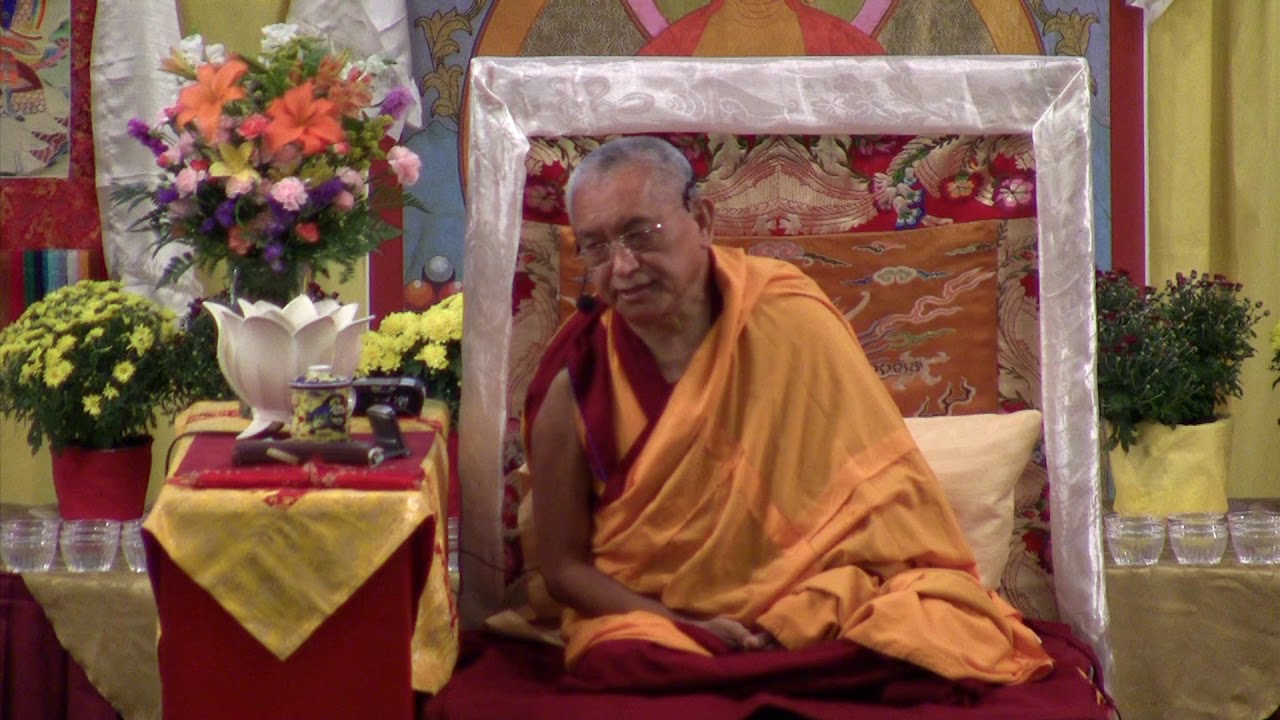
20090909 S1 LZR LOP - The Real Meditation is Lam-Rim ENGLISH
/It seems that many old mind came back, it seems, many old mind came back. What I’m saying, many old mind came back. Anyway, it is extremely worthwhile,
however the life has been up to now, however our life has been up to now, so generally speaking, comparing to others, I would say that our life have been most fortunate, most fortunate, compared to others. So, have heard the heart of the Buddhadharma, the very essence of the 84,000 teachings of the Buddha, we heard, the lam-rim, the very precious teaching, stages of the path to enlightenment, received, many of us have received so many times, so many times, from His Holiness Dalai Lama, the real living Chenrezig, Compassion Buddha, manifested in the human form but that monk form, to perfectly to guide us, the aspect that can guide us.
So, first of all, just that, just that itself is most amazing, first of all, that, just that itself is most amazing, what happened in our life, just inexpressible, most fortunate thing what happened in this life. I think it’s, that’s the most unbelievable thing, the most rare, most precious, that happened to us.
Then, we have met many other great teachers, who preserve the whole entire Dharma, the Lesser Vehicle teachings, Mahayana Paramitayana teachings, Mahayana Tantra teachings, many other great, unbelievable qualified virtuous friends have met. Then, particular, then Lama Yeshe, and many of us, the old students, have met and they have received teachings, initiations, who are kinder than all the three-time buddhas, numberless past buddhas, present, and future buddhas, so, whose holy name is extremely rare to express, say to, difficult to express, so that. So, really, if we look at our life in the past, what happened, most amazing, I mean, this, the qualified virtuous friend, revealing the path to enlightenment, who can show complete path to enlightenment, with experience,
it’ amazing, so many we met. So that’s, can you imagine how most unbelievable fortunate, fortune we had, life has been, but of course doesn’t last long, this, this incredible opportunity, this, it’s just like lightning in nighttime, the light, nighttime, lightning, being dark, being foggy, and lightning, just a short time you see, just a short time you see everything clear, then it’s gone, so like that.
So, life is not long, can’t really tell, when the death will happen, can’t really tell. And even the many living conditions, not only there’s so many conditions for death, this 404 different types of disease, then,?don ni sum ____ chu, spirit possession, 360, then?ge gyi tong ba gye chu, interferers, 1,080, say, there are many, so then, like that.
Then the nowadays, many new disease happening, which didn’t happen before, which you haven’t heard before, then, many new diseases happening, this, what’s it called? What’s this one? Pig Flu? Swine flu, Swine Flu. Not Pig Flu? I thought Pig Flu. Huh? Pig Flu.
or Kangaroo Flu or, I’m joking. No, not happened yet, Kangaroo Flu. didn’t happen yet. It happened, occurred yet, Kangaroo Flu. Only pig flu. Anyway, so, then cancer. You never know, we have been hearing all the time, this and that, say, people, I mean, the friends, family members, suddenly this, suddenly that, suddenly this has cancer, suddenly that has cancer, so, so up to now, up to now, yourself have been hearing like that, your family members, so then, friends, or, other people, or students, that.
So suddenly happened that, so this, what happened, one has been hearing like this. You can’t really tell. Sooner or later, sooner or later somebody hear, somebody hear your name, sooner or later, somebody hear your name, and with cancer, your name, with cancer.
So, after your name, then, cancer joined, name joined, so, and between that, “has.” So, anyway, so, like this, this is how, happening in the world, so, this happening so many people, so that. Then already, many students already passed away, that, different times we knew, that, old students, and, then of course, some time ago have been studying Dharma, student, and passed away.
So many happened already, from different countries, so like that. So this is the situation. So, can never tell, hts, this is the situation, the life. Then there are many other sicknesses.
Then also, diabetes, that brings many sicknesses, so, so some, I think, myself, have been friend with the diabetes, sometimes enemy of the diabetes, sometimes friend of the diabetes. So, anyway, so, can’t really tell, anyway, cannot, say, always believe, concept of permanence, we can’t live life with the concept of permanence, that we’re going to live, I’m going to live forever, not forever, I don’t think so, probably, unless you have taken drug or something, but I don’t think forever, hallucinated, when the mind hallucinated, or so, yeah, I don’t think so.
So, anyway, so, can’t live with that concept, concept of permanence. So the, there’s not much left, and, life is very short, generally very short, in this degenerated time, and there are so many, even the living conditions become the conditions for death, so like that.
Even medicines become, their side effects and conditions for death, it’s supposed to be for living, for our life, but also become condition for death, like that. So many things, shelters, so many people die, in the house, the house collapse, and, so, by food, so that.
So, the first, the very first Western nun, Buddhist, the very first Western Buddhist nun, her name is Sister Vajra. I think the very first one who received Tibetan lineage ordination. So how I come to know her is, I have one old friend, pen friend, the Frida Bedi, who started the school for young lamas, I think maybe five times, heart disciple of His Holiness the Karmapa, the previous life.
I think she was recognized by His Holiness the Karmapa as, I think maybe Dorje Phagmo, I think, Dorje Phagmo, I think, something like that I heard. And she had a throne, in Sikkim, that, there are high thrones for the lamas, and there was a throne for Frida Bedi, they made a throne for her.
So, she came to Buxa, where I was the eight years there, where I had a little fortune to receive the philosophical teachings, the extensive, some of the extensive scriptures, a little bit to hear, able to receive some teachings on that, or studying some debate.
So that time, I think she was, I’m not sure, must be Christian, maybe, I mean, very beginning, and I think she, I think maybe she went to Sri Lanka, I think maybe for Theravadin. So then her son and daughter went in the same university as Pandit Jawaharlal Nehru’s daughter and son, so they become friends, and then she was appointed by Pandit Jawaharlal Nehru to look after the Tibetan monks after they escaped from Lhasa, in Tibet, in the West Bengal, say,?Mussimeri, it’s a place called,?Mussimeri, extremely, unbelievable hot, so monks they arrived there, so, she was asked to look after them.
So that’s how she got connection with the Tibetan, to Tibetan Buddhism. So she liked. So she came to Buxa, after even the monks then they moved to Buxa, they came to Buxa, the concentration camp, which was, during British time, that was a concentration camp where the Pandit Jawaharlal Nehru and Mahatma Gandhi-ji were imprisoned, and, where Mahatma Gandhi was imprisoned, that building, very old building, covered by barbed wires, three or four stories around.
So some nuns came from and lived there, become a nunnery. So next to that, there’s a long building, and half, I think, the monks from Gaden Monastery, they lived there, some of the monks lived there. Then half of the building close to the building where Mahatma Gandhi-ji was imprisoned that was where some of the Sera monks from Sera Me and Sera Je, monks lived there.
That’s not the only place but some of the monks, as it fits there, so that. Very tall building, so outside, then was barbed wires, front, and backside, like that. So it has a few, tall buildings has maybe one or two main doors, then you enter inside, so you enter inside, and then monks’ beds all lined up, like that, then, not wide like this, maybe half of that.
So, then, so this, that same building where the monks fit, I mean where they live, and also the place for puja, when Sera Je, Sera Me, all together, when they meet and do puja, so then, use all the beds for elder monks to sit, then other monks sit on the floor, then able to sit up there, then next to that, incarnate lamas.
So like that, do puja, like that, then…. So, so many people killed there, very mischievous, full of spir-, I mean, spirits, at the beginning. Later become more and more peaceful, the place, so like that. Then outside, there’s a courtyard, maybe this, about, this size, maybe, I think, smaller, so then again there’s beds, all the way lined up, beds lined up, outside courtyard.
Then the outside, here’s the building wall, then here’s barbed wires, so that. Then, here, there’s a high bed, that’s Geshe Rabten, Rinpoche who’s my, who taught the, like the A, B, C, D, the debating subject, the dura, the first very basic subject, so from whom I received, began to study, so that.
Then, that time I had a robe, very tall, very elderly monk robe, the shamtab, very long one, very long, I think,?se ter, it’s called?se ter, kind of good quality, woolen. So folded, then wrapped around me, so I was looking very, kind of, looking kind of fat.
So, anyway, I came inside with one person, one person who brought a thermos of tea, I think that was, I don’t think there was any other things, I don’t think there was bread, just tea I think, so offering. So Geshe Rabten was sitting here, so I have to come all the way the front of the door, between the beds.
So then, because I carry name, just, bear name, incarnate lama, something like that, so then, Lama Yeshe was sitting there, there’s another monk, then Lama sitting there with a huge piles of texts in front, very devoted to Geshe Rabten Rinpoche, very devoted to Geshe Rabten Rinpoche.
So Lama picked up me, put me on Geshe-la’s, on Geshe Rabten Rinpoche’s bed, so that. Anyway, so, unbelievable hot, so very unhealthy, very, the hot, the unhealthy hot, I think. So, because the monks, they didn’t try to copy the Indian life, I mean, the Indians, way of eating food, didn’t copy from that, from beginning, Indian lifestyle or the food.
I’m not talking other lifestyle, but, I’m not talking the other part of lifestyle, I’m talking the food. So, they didn’t copy from that, at the beginning. So, if they did that, they would have lived for, many monks would have survived, lived, being healthy, not sick. But didn’t do that.
Then, of course, there’s a lot of announcement and many advices from the, from Dharamsala, from the Office, came, in newspapers, but many of them eat food like how they used to eat in, that. Tibet is most, I mean Tibet is very, very cold. So the monks who lived next to us, one group, and they’re?Dukampas, so they used, in Tibet, they used to eat the uncooked meat, in Tibet very cold, they have, cooked that. So they have such unbelievable hot, and they eat uncooked meat.
Then they had diarrhea for three years, sorry, three months, sorry, I a little bit jumped, three months’ diarrhea, so that. So anyway, so I use, so my bed is here, one time my bed is here, then door is there, so every week, monks pass away, and then the khangtsen, where the monks belong to, they all go together to the cemetery to pray. So every week you see like that.
So anyway, it’s a place like that. Anyway, I’ll tell you, the present, those teachers now, main teachers, main, the main top teachers now, most of the top teachers, now, who are educating the present monks in the Sera, Gaden Drepung, there’s Sakya, Kagyu, Nyingma, but very little number.
Then many of those who are at Buxa, they become great teachers now, they become great teachers in their tradition, like that. So anyway, who are the top, many of the top teachers now in Sera, Gaden, Drepung, many passed away already, so those who left educating many thousands of monks is from Buxa, those who studied so hard, unbelievable hard in Buxa, I think they were there maybe ten years, I’m not sure, after they escaped from Tibet.
Only 1,500, not all the monks, most of the monks I think went to, were sent to make roads in, different parts, Dalhousie, many places. So, anyway, much went to do work like that. So, who want to continue with this, who wanted to continue study, I mean who was able to go there was 1,500, that, those number.
So, they did unbelievable studies. In Tibet, just only you learn debating subject, memorize texts, root text, commentaries by Indian pandits, then by great, the Tibetan, say, great lamas, like Lama Tsongkhapa and others, so they, and the, each college, each Dratsang, Sera has Sera Me and Je; Gaden has Shartse, Jangtse, Drepung has Loseling, Gomang, so each one has author, author who wrote all the debating subjects, so studying those, memorize, many hundreds of thousands of pages, root texts, commentaries, the Five Great Texts: Vinaya, Madhyamaka, Abhidharmakosha, and then there’s the logician,?Tsa ma nam drel, Pramanavartika, like that, all the root texts.
Then the commentaries, the Indian commentaries, then there’s great Tibetan lamas’ commentaries, that. So the, I mean the full, 24 hours a day. So they debate, until nighttime, 12 o’clock, debate, I mean when, so some of the younger ones, they debate until that time.
For example, here, resident teacher here, North Carolina the Kadampa Center, Geshe Gelek’s teacher, who is ex-abbot of the Lower Tantric College, his name was, his name is?Uma Chukpa, Madhyamaka, Entering in the Middle Way, Entering in the Middle Way view, that was his name,?Uma Chukpa, say, his name is?Lo Delek, also.
So, anyway, for example, if I tell, then you will know the, many of the monks, how they did intensive study. So, of course, early morning memorizing, then go for teachings, then you go to debate, then debate in class, then after that, prayer, prayer for purification, collecting merits, pacify obstacles, complete your study and to have realization, and as well as people who ask, people who died, who are sick, or people who ask to pray, and also pray for them.
Then, again debate, person-to-person. Then the, then, say, then, come back have lunch, I’ve forgotten, I’ve forgotten the lunch, when was the lunch. So, anyway, then maybe some people go for also teachings, to, I mean, the elders they teach, and then others they go for teachings also, then, dinner, then you go to, again, to debate, outside in the courtyard, or, courtyard, say.
So there’s different places. So, one evening, in a week, there’s certain days you gather, one platform, all the four traditions, and do puja, prayer together, so the other traditions, or the, if they want to debate, they can debate as well, so like that.
So then the Sera, Gaden, Drepung monks, so debate together. So at the beginning there’s a class, then, do prayer, then afterwards, person-to-person debate, so like that. Then the young ones, then, sometimes, until 12 o’clock, like that, debate. So sometimes, some evenings like that, some evenings the Sera Je, Sera Me, so the Sera Je, say, so, Gaden has their own place to, Shartse, Jangtse, they have different days debate and do prayer.
Loseling has their own place, then Sera has their own place to do debate, prayer. Then there’s a large platform, where everybody comes together to do the same, like that. So then come down, after finish debating in the nighttime, so, for example, Geshe Gelek’s teacher, who’s the ex-abbot of Lower Tantric College, so, come down, then have black tea, then go outside, go outside of his house, just next to, just back side of my bed there’s a window, then a little bit, the right side, outside, there was his window, outside that, so he used to put some seat there, then chant all the many hundreds of pages what he had memorized, until 3 o’clock, until 3 o’clock in the morning.
So he come down from many hours debate, then recite all the many hundreds of pages, especially this very famous text, Drang Nge Lekshe Nyingpo, the Interpretive, Definitive Meaning, Good Explanation, the Interpretive, Definitive Meaning, the Essence of the Good Explanation.
So the Lama Tsongkhapa’s teaching, so this present a different, introducing the difference, four tradition schools’ views of the emptiness, having their different views, and especially the Madhyamaka, Prasangika School view. So, however, it’s a very important text.
So, he memorized those, which has, I don’t know, many hundreds of pages, so memorized all that. So then, he recite, outside, many times, so it takes several hours. Then, he go to sleep, maybe, I’m not sure, two or three hours, I’m not sure, not much, then he have to get up early morning to begin memorizing again, in the early morning, so like that.
So that’s just one example how they dedicated their life in studying Dharma. Most amazing. And then, so that gives, just, that gives an idea of, maybe the rest. So, then, of course, in Tibet, they did not learn Tibetan writings, many things they didn’t have to learn, and, in Tibet, in the monastery, if you start to learn grammar, poetry, like that, then, it’s recognized you are taking worldly life, it’s regarded like that, worldly life, if you decide to learn writing.
So that’s why, when the Abbot, the Abbot there, extremely learned Abbot from Tibet, I mean, well known, a very good practitioner, meditator, very famous Abbot, when he came to Buxa. Then, they had to sign at the Indian office, the Indian man, the head of the camp, head of the Tibetan, this lama’s camp, this is a Punjabi, Sikh, who is the leader of Second World War, he’s very, say, say, glorious looking, anyway, with all his beard, beard or mustache, not mustache, beard. Anyway, so they have to sign, the abbots have to sign, so many of them didn’t learn writing before in Tibet, so, so there’s some, they had to put a signature, their name, so they write something, look like box, they write, I heard, I didn’t see, but I heard, write, like a box, like box, small boxes, that or
anyway, didn’t learn writing, or then they had to put thumb signatures. But they were, but they’re very learned in Dharma, great meditator. The Sera Je has, for many years, Abbot, who was Abbot in Tibet, Geshe Gen Losang Wangchuk, Gen Losang Wangchuk, extremely, one of the top, learned, there are a few, very top learned in Sera Je, Sera Me, Gaden Shartse, Jangtse, Loseling, Gomang, each college has very top learned, so it’s one of those.
So it’s most amazing, so it’s most amazing in Tibet, when they were taking teachings, why they can’t write, so only it’s the mind, there’s no tape recorder, can you imagine? No tape recorder, to record silently, to record, say, to record without the teacher knowing.
Anyway, so, anyway, so didn’t have anything, so only your mind, no machine, can’t write, only your mind, can manage, isn’t that incredible? And subject is not easy, you understand, philosophical subject is extremely deep and vast, and so much different views and debate, it goes deeper and deeper.
So this is how they are able to manage, just the mind, can you imagine? So, anyway, so like, Gen, Uma Chupa, Geshe Gelek’s teacher, so there are a thousand monks now in Sera, he educate them. So many of the, most of the ones, many passed away already, but those, the top teachers, most of them are from Buxa, who educate the present, who educate present, the monks, many do that, elderly ones, the elder teachers.
There are many new teachers, there are many, like Geshe Gelek, like that, there are many who become geshe there, who studied well, for many years, and studied well all the five scriptures, so, there are many who become very good, who become good teachers, also educating now the younger monks.
But the elder ones, they’re mostly from Buxa, so teach many hundred, thousand monks, okay, so that. So I’m just saying that, how, unbelievable, unbelievable, most unbelievable hot place, completely surrounded by the mountain. So on Sundays, wherever there’s some green place, the monks filled, like that, outside.
So, they worked so hard, and studied. So as a result that, now, as a result of that, now, educate many thousands of monks, made them to have clear understanding of Dharma, brought very deep, profound, and the new, so many of our resident teachers nowadays is from, studied from South India, not from Buxa, but South India, become great teachers, learned, great teachers, so, example like that.
So all those from, educated from there, monks came from Buxa. So, anyway, so now, able to produce qualified teachers from these monasteries, and able to spread Dharma, in the rest of the world, and especially in the Western world, which has been dark, completely dark from beginning, so now the light of Dharma has been happening more and more, from these teachers, like Geshe Gelek, so many young, dynamic scholars, the teachers, so, able to bring, say, able to bring light of Dharma more and more spread in the rest of the world, so even just using, just using example, just even our Organization, the FPMT, just even using that example, so, for many countries, the rest of the world, able to bring, able to spread the light of Dharma, so like that.
So anyway, but of course, myself, that’s the best place to study Dharma, the place is unbelievably hot, very mischievous, get so many disease and, but what other monks did, the best study there, those teachers, so, but myself, I just wasted my time, a lot of my time is wasted there.
Not somebody caused me to waste, but my own mind, wasted my mind, wasted my life, so I spent time memorizing English words, like a text, like how you learn Dharma, memorizing words. So one time I started memorizing a dictionary, I began the dictionary, to memorize words, so, of course it didn’t work, so I’ll forget, then I again go over through the books, again try to memorize, so I did a few times like that.
Then, Lama actually copied, Lama Yeshe, Lama, copied from dictionary. There’s a thick book, there was a thick book with his own writing, I don’t know where it is, but thick book, dictionary from the, first English-Tibetan dictionary, who composed is by?Kasa Dawa Samdrup, I think, from Sikkim.
It was very bad paper, very, very bad paper; it will collapse, if you fold it, breaks, so printed from Calcutta, I think. So, anyway, so anyway, so, Lama copied from that with his own writing. So anyway, like that, say, wasted a lot of time, I don’t know, that really didn’t help the English.
When I use, people don’t understand. So, second time when I came to Dalhousie, Frida Bedi asked me to come to school. I joined the first school in, six months, but then I spent, but then I had to be in the T.B. hospital. So anyway, so also I tried to learn English from some old, I mean, by going to the house where old Indian people living, so from one, somebody who’s educated.
So I carried a book, was given to me by His Holiness Ling Rinpoche, past life, Ling Rinpoche’s attendant, secretary, TCC, Thubten Tsering, something like that. So he gave me one book, so, Hindi, Hindi into English, I think. So I tried to learn, went to the other compartment or something, and learned English from that Indian man, I met him outside while they’re walking.
So I went a few times, like that. So, anyway, the language that I’ve been speaking is what learned with from the students, just, I mean, since the time we met Zina, and then, so from like that. So, so second, so she started these schools, I think, six or five times.
So I was there the first one, second, second one I didn’t go, third, maybe she invited me to the third, the third time school, so I went there, no third or fourth, so then, I was meeting her, and I was talking about His Holiness Song Rinpoche, so I said, His Holiness Song Rinpoche is doing puja, but I said, I used the word, I think it’s ritual, but I didn’t say, I memorized the word but I didn’t learn from people, learned from somebody the accent, so it was just my own accent.
So I didn’t say, ritual. So I think I said, I don’t know, I don’t remember, I’ve forgotten now. She didn’t understand at all. She had a hard time to understand what I was talking. Then she asked somebody else to come. So anyway, I just, just I remembered.
So didn’t help, what I did at Buxa didn’t help. Anyway, so, anyway I’ve forgotten now, story. Originally I was talking, what I was talking? Oh, yes, you’re right. So anyway, so Sister Vajra, how I, the first Buddhist nun, how I came to know, she lived, so I came to know her is, so Frida Bedi, she found one pen friend in London, one old lady, member of Buddhist Society in London, her name is?Rachel?Lady.
So, very good mother, I think she’s a very good lady, so, after I got TB, so she sent all the expenses, medicine, milk, all the things, I didn’t know who was spent the money, when I was at school. I only found out much, much later, that she was the one who sent the money to school to, for all this.
And then, she sent a set of robes, no, not she sent, she gave money to Sister Vajra to make a set of robes for me when I was at Buxa, so things like that, that’s how, then, I came to find out, Sister Vajra. So, most of the letters I had at Buxa was from?Rachel?Lady.
Other people can’t read her, can’t read well her letter because it’s a letter written with old lady’s writing, so that. So one time she asked me, do you want to come to? She says. I think she just wants to check. She sent this question to experiment, so I think, to experiment on me.
So I think, of course I answered, yes. Then she replied back, when you become like Lama Trungpa, then you can come to. That’s what she said. So she’s very wise. Anyway, like that. Then, in, whom I met personally is her cousin and her cousin’s husband, so met a few times, so that. So, anyway, so Sister Vajra was ordained by Domo Geshe Rinpoche.
not the great yogi who lived in, Lama Govinda’s guru, not that one. But the next incarnation, who escaped from, who completed study Lharampa geshe, who completed study in Tibet, just about, to come back to Domo, Domo is near Sikkim, Yatong, it’s called Yartong, it’s called Yartong or Domo, but, near Sikkim, the, Tibet, near Sikkim.
So, monasteries, all the benefactors in the different places, all waiting, all there, totally, completely prepared and so excited, unbelievable, welcome. So, anyway, then, Mainland took over, and then it didn’t happen, I think Rinpoche was put in prison,?Ralong.
Then, of course, sooner or later Rinpoche was released. Then he brought, he’s very wise, he brought six, I think, trucks of texts, from, at Buxa, there was no texts, so, if there’s one or two, some texts there, everybody have to copy, write, so like that, had great difficulties, wow.
Then gave, Domo Geshe Rinpoche brought all the philosophical texts from, by truck, when he came to Kalimpong, and then the monks had, and then plenty of various texts, to make copies, I mean, anyway, so helped, very, very much. So, anyway, so what happened with Sister Vajra, sorry, so there was a landslide coming, I think must be, Darjeeling, a lot of rain, usually, normally, kind of, usually foggy, like that.
So, anyway, landslide happening, all the people outside shouting to her. She has a small, nice cottage, I’ve been there. Then, I think she was, she couldn’t get out so easily, she was, I think she was busy with the money, to pack up, in her briefcase.
So, anyway, she was, everybody was shouting to her, but she was just about to come out, just about to come out, then her house collapsed on her, she died, with umbrella in her hand, and here the briefcase, money with the briefcase, then the umbrella like this.
All the house collapsed on her. So, this was, because I was talking, even how the means of living, even like the shelter is for life, to protect, but, becomes condition for death, so I just, that was the actual story to mention but it went for a long walk, So anyway, so anyway, sorry, sorry.
So, so it become little bit movie show. So, anyway, so however, so what I’m saying is, there’s not much to live, so life is very short, so can’t really tell. So all the reasons I mentioned before, so therefore, can never tell when death is going to happen.
Any of these conditions for death, cancer, so forth, there are so many things, nowadays, so much, much more than maybe a few hundred years before. So anyway, so therefore, it is very worthwhile, that’s what I’m saying, therefore, it is extremely worthwhile, the lam-rim, to attend the lam-rim course, so here, and then, if it’s like me, then, the mind occupied with other things, and no time for meditation lam-rim, the real, the real meditation, the real meditation, the lam-rim, Stages of the Path to Enlightenment, didn’t have time for that.
Maybe doing more tantra meditation, not lam-rim, where your interest is more. More meditation that, but no lam-rim, so, or not any of the meditation. So anyway, however, so it’s extremely worthwhile here, so Pabongka Dechen Nyingpo, great enlightened being, Pabongka Dechen Nyingpo, as he mentioned in his teachings, that, even somebody who recited OM MANI PADME HUNG, or the mantras, many hundreds of millions, many hundred millions, who recite mantras, or, life is more meaningful, meditating on lam-rim.
And then, mentioned that, meditating on the three principles of the path, more meaningful than reciting many hundred millions of mantras. Or then, Pabongka Dechen Nyingpo said that, even life is more meaningful meditating on lam-rim, than even seeing Buddha, even seeing Buddha.
Of course, you can understand, by seeing Buddha, you don’t become enlightened, like that. If you’re able to see Buddha, you don’t become enlightened like that, without meditating on lam-rim, just by seeing Buddha you become enlightened, that doesn’t happen.
So you have to have realization of, all the delusions doesn’t go away like that. You have to have guru devotion realization, the root of the path to enlightenment, what makes possible to have all the rest of the realizations, up to enlightenment, the renunciation, the delusions, the particularly attachment, then the right view, wisdom, then realizing emptiness, the, eliminate the ignorance, and then bodhichitta, to eliminate the, antidote to eliminate the self-cherishing thought, so you need these realizations, then you need to actualize generation stage and the completion stage, all these things.
So, the visualization, that, the preparation, purifying the ordinary, say, death, intermediate state, rebirth, to, then, say, and then the path-time three kayas, path-time dharmakaya, path-time sambhogakaya, path-time nirmanakaya, preparation for that, to have those realizations, then planting the seed of the dharmakaya, sambhogakaya, nirmanakaya, planting the seed of those.
So you need to develop this realization of generation stage, and then the completion stage, so all this. The isolation, the speech, and then the isolation of the mind, that goes part of generation stage also, so the isolation of mind, then, illusory body, unification of those two, then unification of no more learning, so what I’m saying?
Yeah, so you have to achieve all that, doesn’t happen in one second like this, just by seeing Buddha. Of course, you receive blessing of the Buddha, but all that doesn’t happen like that. that. So, that’s why Pabongka Dechen Nyingpo is saying, more meaningful to meditate on lam-rim then even just seeing Buddha, that’s what he said.
I think, among the students, there’s somebody who have seen Buddha, who had, who received appearance of Buddha, who saw, there happened. So it doesn’t mean they achieved, just after that, then achieved bodhichitta realization or realized emptiness, it doesn’t mean that, leave tantra, even the sutra.
So, like that. I mean, ordinary people, they see Buddha, so I mean, who has great devotion, some, whose mind is purified, so like that. So therefore, here, in the group, you meditate in group, so you have to, so following the disciplines, then, so makes you to do, to meditate together, so, so therefore, I think it’s extremely worthwhile.
At home, there are so many distractions, say, so like that. So therefore, extremely worthwhile, even two weeks, to have some meditation get done, because, you’re never sure, it could be the last, this could be the last, you can never tell. So you get done some work, you get done some preparation in the mind, to achieve these realizations quicker, sooner or later, if not this life, next life, for sure, like that.
So quicker to achieve enlightenment, so, we can never tell, it could be last, you can never tell. Okay? So, I thought, little bit to follow, normally how one, in the daily life, how one should practice, how one begins the day, maybe I start with that.
So, for general understanding, so I thought to begin like that.
So, just mention this, what Lama Tsongkhapa explained in the, there’s a lojong text, the poetry, poetry, lojong text, I think maybe Thupten, Geshe Thupten Jinpa, I think, I heard, translated into English that. I have received that oral transmission from Kyabje Ling Rinpoche, at Dharamsala, with Lama.
So that time, so Ling Rinpoche mentioned, from his own side, he gave us the oral transmission of the, Lama Tsongkhapa’s, special qualities of Lama Tsongkhapa’s teachings, composed by Je Kungtang, the great Amdo lama, Je Kungtangpa, so Rinpoche, I think, maybe, he may have given to me the text, the text also, I think, so, Rinpoche gave the oral transmission of that.
So anyway, Lama Tsongkhapa mentioned in that, the: So if you don’t purify the negative karma and defilements quicker and quicker, quickly, quickly, quickly, quickly, probably it means, each one of us, means totally under powerful, forceful karma, under control of, forceful, powerful, say, power of karma, under the control of the, say, very hard, very forceful, karma, under the control of the karma.
And because of that, even you know, this is happiness, this is happiness, that happiness, even you know, many happiness, but you don’t have choice, means, but you don’t have choice to choose, you have to, to achieve. you don’t have control, I mean, you don’t have power to choose.
this is suffering, that is suffering, this is suffering, the problem, this is problem, even you know that, but you don’t have power to hts leave out. To leave out? Huh? What? Avoid, to give up, yeah, to give up. Tibetan 1.15.32.2] So, even you know this, this suffering, that suffering, this suffering, but you have no choice to be free from that, to give up.
Somehow, you have to go through, you have no power to leave it, means to forecast, to throw away, to give up, so you have no power, so you have to experience, you have to go, like sicknesses, whatever, relationship problems, whatever, many problems, problems in business, whatever, many things, like that.
Even you know it’s a problem, but you don’t have power to immediately, to give up, or to free yourself from that,. Then, say, therefore, reflect, the action, result, is unbetraying, unbetraying, or unbetrayable. Therefore, reflect, the action, result is unbetraying,.
So it is, it has no unbetraying. So, definitely happen. Once the action is done, karma is created, the result, if non-virtue is done, the result of that, suffering definitely has to happen. If the virtuous action is done, the result of that, happiness, definitely has to happen, definitely going to happen, so there’s no unbetraying, so it means to reflect that.
Therefore, by reflecting the action, result has no, say, has no, is unbetraying. Unbetrayable or unbetraying, huh? Unbetraying or unbetrayable? Unbetraying. Thank you very much. It must be language from. Salty, what? The area, the what’s it called. Anyway, it doesn’t matter.
So therefore, now therefore, look for choice, white and black karma. So it means to abandon negative karma, and practice the white karma, virtuous action. From today, to be careful,?same the food or any poison, or something that’s harmful, then, to be careful from that,?zampa, to be careful from that.
Poison, or anything that is harmful, something you see, then cause sicknesses, cause death, then you have to be careful from that, so, like a poisonous snake, poisonous snake, because of the danger what it can cause, say, to be careful to not be bitten by poisonous snake or, so, to, forbear, forbear’s not… Beware, means what?
Be aware. Beware, I see. Yeah, it has sort of the meaning, yeah. I think it means being care-, so when you advise somebody, being very careful, say, to be with that person, or somebody’s harmful, being very careful with that person, or careful, the very dangerous road, be very careful, so that, it protects you from danger.
Huh? Cautious? Yeah, could have also. Coming round. So, from now on, then say, be careful, from negative karma, creating negative karma. From today, therefore, from now on, from today, be careful from negative karma. You can say from, or with? Huh? What? Be careful of creating negative karma, okay.
It becomes very clear. From this night, attempt to the virtue. okay. then it talks about, more specific, therefore, then, what is better to do in the life, so to abandon negative karma, to be careful to abandon, to not create negative karma, to be careful from that, and attempt virtue all the time, to do that all the time.
So then, then it advises here, so then, to abandon, white and black karma, for the white and black karma, it depends on good and bad thoughts, good and bad thoughts, it depends on good and bad thought. So if you have good thought, then even the path, bhumis are good.
If you have bad thoughts, then even the path, bhumis are bad, it says. So everything depends on the, your attitude. So, I think, so if you have bodhichitta motivation, then, the good heart benefiting other sentient beings, then, also, then, you’re able to actualize realization, the Mahayana path, the path and bhumis, the five paths, ten bhumis, you’re able to actualize.
So, otherwise, without that, if you don’t have good heart, then, even you entered in the path, you don’t achieve that, so only you enter, even you have realization of emptiness, even you have realization emptiness and renunciation, but you enter in the lower path, the Lesser Vehicle path.
So you achieve, what you achieve, highest, without bodhichitta, what you achieve the highest is only the lower nirvana, so that’s it, cannot become a bodhisattva, those who collect skies of merits, merits in every second, with every single action of body, speech and mind, skies of merits, and even there are heavy negative karmas collected in this life, past lives, all can be purified, and then able to achieve enlightenment for sentient beings, so a bodhisattva can do that.
So anyway, so only highest what you can achieve, without bodhichitta, without good heart, benefiting others, highest what you can achieve is just only the lower nirvana, so only just that. So, cannot do perfect work towards sentient beings, so everyone, liberate them from oceans of samsaric suffering and bring them to enlightenment, or then cannot do perfect work, without even the slightest mistakes, so that. So then, also, then, with the self-cherishing thought, if the attitude is bad, then also cannot, it interfere even to achieve the realizations, even the lower nirvana cannot be achieved, the five paths, the Thirty-Seven Aids to Enlightenment, or however, the five paths to achieve liberation, even that you cannot achieve.
Example, ourself, oneself, yourself, we can use the example, oneself. So far, because followed the self-cherishing thought, so did not achieve even the cessation of samsara, the liberation from samsara, even didn’t achieve that, so far, from beginningless rebirth up to now, didn’t achieve even that, so, then, any of the path, realizations, to achieve liberation from samsara for oneself, didn’t, haven’t achieved, so like that.
Nothing, not even the first realization, the impermanence and death, even the very first one, that makes the mind become Dharma, even didn’t achieve that realization, so that. So one can use oneself as an example, so, so how, by, not practicing the bodhichitta, the benefiting others, not actualizing this, then following the self-cherishing thought, so what happens, doesn’t achieve even the, unable to achieve even the path to liberation, any of the realizations, unable to achieve, so that.
So even, not only it interfere to achieve enlightenment and liberate others from oceans of samsaric suffering, numberless sentient beings, from each realm, and bring them to enlightenment, not only that, it interfere even to achieve liberation from samsara for oneself.
It interfere even to achieve good rebirth next lives, happiness of all the coming future lives, it doesn’t allow to achieve all this. And then, even the works for this life, it interferes, so, even the works for achieving happiness for this life, then many obstacles, it causes many obstacles, the self-cherishing thought, then that causes, that self-cherishing thought causes, it doesn’t allow today’s action to become cause of enlightenment, and today’s action to become even the cause to achieve liberation from samsara, it doesn’t allow, it interferes.
Then, today’s self-cherishing thought, then it interferes even, today’s activities become cause of happiness of future lives, it doesn’t allow. So even the happiness of this life, even for that, many obstacles, so, whether it’s traveling, whatever, business, or whatever it is, many obstacles, makes so difficult, so, all the obstacles comes from the self-cherishing thought.
Then, from there, the delusions arises, and attachment to this life, then anger, all these things, then that’s how it becomes great obstacle, like that for the success of even this life. Then, yeah, like that. So everything, so everything depends on, say, here Lama Tsongkhapa says, everything depends on the mind, one’s own attitude, so, so that is great learning, how everything depend to the mind.
So I think maybe, yeah, then, I think start the motivation the daily life, okay, the bodhichitta. It is not only during this retreat, but it is general in the daily life, the idea is that, the practice. So just, maybe need to stop here? Or…? It’s five minutes to six.
Huh, to stop here or you have to stop at six o’clock? Huh? What? Stop where? Stop at the stopping place. Anyway, I’ll maybe stop here.
Sign in to keep private, timed notes on this talk. Only you can see them.
Public comments
Public: open to everyone signed in. Your private notes are in My notes.
Sign in to join the discussion.
Teachings from Light of the Path 2009. Kadampa Center, Black Mountain, North Carolina, USA. Transcript: https://fpmt.box.com/v/LOP2009
- Teacher
- Lama Zopa Rinpoche
- Centre
- Kadampa Center
- Recorded
- 9 September 2009
- Length
- 1 h 37 min
- Format
