 Free5:40:40
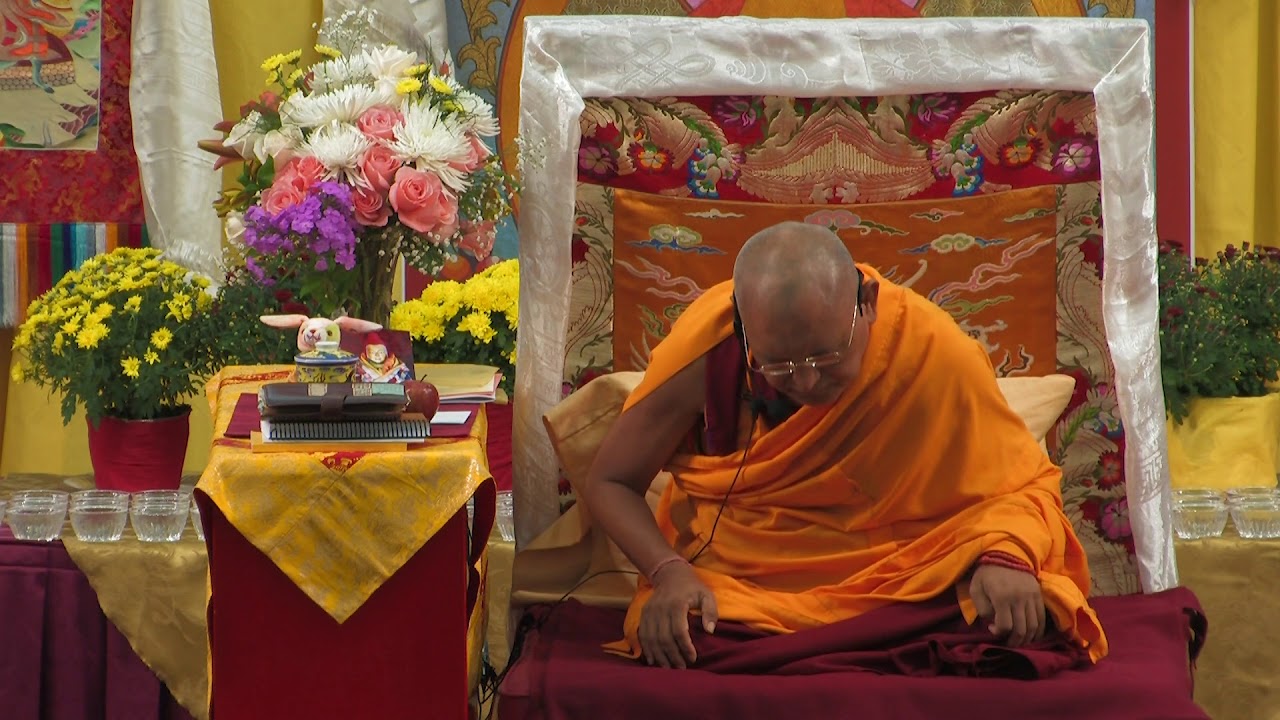
20090913 S1 LZR LOP Every little thing comes from your karma ENGLISH
Then Buddha said, "Oh, you have karma to become monk, I can see, you have karma to become monk. Sharipu did not complete the merits of wisdom, merits of virtue, these two, merits did not complete. I have completed the two types of merits, so therefore I can see."
So, by completing that, of course, then you have omniscience. So he said, I can see you have karma to become monk. Then Buddha explained, inconceivable eons ago, unbelievable length of time, then you were, what was that? Oh, that's a fly. I don't know. Usually there's no problem, I mean, probably I can't, I don't think hundred times, but, of course, telling, I wouldn't call numberless, but I mean, so many times, but today I could not remember.
I was thinking ants, but of course, somehow my mind got stuck on ants. A little bit strange. So I think, some, nature of the mind, this moment mind, like that. Anyway, so, fly, so you were born as a fly, then, there's cow dung around the stupa, so you followed the smell of the cow dung, then it become circumambulation, it become circumambulation.
So that, very small merit, so, by following the smell of the cow dung that was around the stupa, then followed the cow dung, followed the smell of cow dung, then become circumambulation. So said, there's a small merit there, so that is the cause you can become monk, Buddha said.
So that. So, so this is by, I think, by, why? Why Sharipu, who is arhat, why he cannot see karma of this old person, can become a monk, cannot see this small merit, so this I think must be due to, I think, distance of time, I think, so there are the four cause of unknowing.
So one is, I think, secrecy of the Buddha's, the qualities, the actions, however, only Buddha can see; even the tenth bhumi bodhisattva cannot see secret actions or the qualities of Buddha. So that's one thing. Other one is subtle karma, subtle karma.
So the subtle karma, it's mentioned that, in the teachings, like for example the peacock feather has different colors, and what is the cause of each color? I mean, color can be one design like this, color. So cause of each color, that. That become very subtle karma, very subtle karma.
So, I think, so similar reason, I would call subtle karma, I think, why, for our enjoyment, why this flower like this? The design like this, and this flower here, say, there's many petals, this small one has many petals, many petals, it doesn't have leaves, no?
It has only the, doesn't have leaf? Doesn't have leaf, this one? Only flower, oh. Looks like, this one doesn't look like it has leaves. Or leaves cut, or it has no leaves? This white, this small one? Huh? What? It has. Ah lay. Ah lay. Somebody cut? So this tiny flower, why design like that? You know?
I mean, so tiny flowers, certain, particular design, particular design. And then the leaves has a particular design. So this leaf, so like that, so, and then this?has?got flower, this is maybe a separate one. Anyway, so anyway, this plant, leaves like this, I don't know whether this is a flower or not, but all this design, like this, I check, and then, I always find, always find, the flower and the leaf, very suitable.
I don't find unsuitable. When I check the flower and leaf, whether it's a big flower or a small tiny flower, the design of the leaf is so interesting, it's so interesting, very interesting. There's a lot of things to learn, I mean how it looks is one thing, but the cause of that, that tiny flower has so much design, color and the leaves, so many designs.
So it's very interesting. So I think, all these designs, what's the cause of all these designs, on those tiny flowers, all the shapes, different color. So I think's it's same, I?would?call?that subtle karma, that you see that, that you can enjoy, you see that, those subtle karma.
It's very interesting, it's extremely interesting, the phenomena, it is really amazing, you have each flower, shapes, all these details, all these shapes, details, and the leaves, so many designs, so it fits the flowers, every leaf, every, say, it fits.
So, I don't remember the, there's one quotation, but one quotation, Abhidharmakosha, so, various worlds born from the karma. Karma is not external thing. Karma is mental, karma is, say, mental factor. There's principal consciousness, so sem, then there's fifty-one mental factors.
So then there's six root delusions and twenty secondary delusions, and there's eleven virtue, and four changeable mental factor. One is sleep, one is regretfulness, I think, and one is more rough, thoughts or mental factor, one is more finer mental factor.
So they can become virtue or can become non-virtue. Then there's, five mental factors they always accompany with principal consciousness. Then feeling, cognition, so du she sem pa, intention, so ___ du she sem pa. Then, yi le che pa, how do you translate?
Yi le che pa? Sempa? Yi le che pa, attention.?Regpa. So, sempa, intention. So karma is sempa,?sol wa du she sempa yi le che pa reg pa, sempa, so the intention. So it's mind, body and mind, mind, so, I mean jigten, I mean one meaning could be the earth, and then also the aggregates. So jig is changeable.
Aggregates is under the cause and conditions, so they're changing, decaying, changing nature, so change. Then, jigten, ten is depending on that. Jigten so, the one who depend on that. So, the, including the aggregates, and then the earth, the place, the sun, moon, the whole universe is born from karma, it came from the mind, the mind of the sentient beings who use, the collective karma of the sentient beings who get reborn in this world, use this world.
So everything came from the mind, everything came from the mind, so that means.... So, is it correct or not? Is that correct or not? Huh? Is that correct? It came from the mind, it came from the mind who, collective karma, everything came from the collective karma of the sentient beings who get reborn in this world.
So the main cause, without talking of the conditions, just the main cause, they come from karma, the collective karma, the whole entire thing.
What about the plants, what about the plants that growing in the rocks, growing in the rocks, that nobody can see, nobody can see, plants, what about that? No people can see, the plants in the forest, or inside the rocks or something. Is that born, is that came from the karma? Is it came from the mind?
Rinpoche, back when His Holiness was talking about this in, he had a tulip in front of him. A tulip, flower. Rinpoche: Yes. And he said that the fact that the tulip was there on the table beside him was due to karma. Rinpoche: But? But then he said that the growth of the tulip was from the sun and water and the soil.
That was a cause and effect process which wasn't karma. He said it was a natural cause and effect process, chemicals, that the?matter, the tulip grew. So His Holiness presented two types of cause and effect.... Rinpoche: The flower grew, flower existed due to karma, right, that's what His Holiness said?
He said the fact the flower... Rinpoche: But the way it grew was due to all this water, I mean, depend on many things, but that's not karma? That's what he said, Rinpoche. Rinpoche: That's not karma? But the flower existing is karma? Yes. Rinpoche: Yes. Yeah.
I remember that during Dharma Celebration in Dharamsala, during mahamudra teaching, Dharamsala, during Dharma Celebration, there were some flowers in the container. There were flowers, one like that, one, blue flowers, one like this, one like that, one like this.
So His Holiness said, the way, didn't say the flower did not come from karma, but, didn't depend on karma, but the way the flower, one this way, one that way, so that's not karma. His Holiness said that's not karma, that time. Remember? I don't remember that.
Rinpoche: Yeah, that time His Holiness mentioned that, the way it,?not karma. Then I think maybe mentioned, His Holiness, one time, from the tree, leaf, flower, falling down. Do you remember? Not karma. You remember that one? But I don't think that time, but another time.
I think, His Holiness, my point of view, His Holiness is telling us this, so that we can, gives us to check, gives us to analyze, makes us, gives us to analyze. So, for example, one leaf falls So, it gives us opportunity to check, so then whole tree fall down, not karma?
Flower dead, not karma? So then, then this world, when this world degenerates, then the four great elements, fire, all this burns the rocky mountains, then, all this, then, at least, that, also, then, not karma? I mean, His Holiness saying that gives us opportunity to check, to analyze.
So, why this one here, why this one there. Why this one has to be here, so, there's a reason for that, decoration, has a reason. So it's karma. So, one way of decorating, ugly, ugly. So this can be decorated, somebody can decorate this, but very ugly.
Somebody way to put together become very beautiful, so it's karma. So then you see ugly, you don't like. Then somebody, same flowers, like, so karma of the, yeah. And then somebody like this, somebody like this decoration; somebody won't like this decoration, so, that's karma.
So somebody doesn't like, for somebody this is undesirable, that's result of that person's negative karma. Somebody find very beautiful, nice, that's the result of the person's good karma. So that. You see, like that, same with this. So then, I mean, that's a small one, but then can go into larger examples, the explanation of karma.
So I think His Holiness giving us to think, making us to think, to analyze, that. So anyway, so what's usually subtle karma, why the flower's like that, say, why is it like this, and this one, then this one like this, here, so like that. Why we see like this, there's a cause for that, why we see, why we see the different shapes.
So, looks like, for us, when we don't, for us when we don't relate it with Dharma, when we don't relate to karma, when we don't relate from where they came, from where they came, the main cause, when we don't relate karma, looks like they all, they exist from their own side, looks like, very good example of gag ja, object to be refuted, so looks like it has been always like this, this has been always like that.
This flower, this has been always like that. And it will always be like this, sort of like that, see, gag ja. Of course, your mind just, your mind merely imputed rose. I don't know, what do you call this one? Chrysanthemum. Then this one? Baby's breath. So, right now, when you look at this, right now, your mind merely imputed, or if we don't know the name, tiny flower, white tiny flower.
Anyway, so, right now your mind merely imputed, but you're not aware. Right now your mind merely imputed, and you see that label, then you see the label what you have given: rose, chrysanthemum, so anyway, your mind just right now merely imputed and you see that, you see what you, you're seeing what you have labeled, but totally not aware of that, so coming from your mind, but totally not aware, and exist from its own side, not merely labeled by mind, Not only that, not labeled by mind,?simply appeared, not only not merely labeled by mind, even very gross, not labeled by mind, appear, when you analyze, the way you see the flower, not labeled by mind at all, if you analyze how it appears.
So that's not true! So, anyway, so you can see, came from, so it came from the, so you can see it came from the mind, so, came from the mind. If there's no mind, if there's no mind which label, rose, rose doesn't exist. Chrysanthemum, if there's no mind labeling chrysanthemum, chrysanthemum doesn't exist, so like that.
So, I guess here I'm talking two things, but, well, I think it's, so here's two things coming from the mind: so the, whatever they're called, they're called, this, this, this, this, rose, and chrysanthemum, whatever, each of these flowers, so, mind merely imputed, Without the mind, they don't exist, okay.
Without the mind labeling, they don't exist, label do not exist, so, it came from the mind. Then this, then this, other than that, other than that, not merely labeled by mind, not labeled by mind at all, then something real one, something real one existing from its own side, oh that, completely came from the mind, completely came from your mind.
It's not labeled by mind, say, not merely labeled by mind, that's subtle one. Then gross: not labeled by mind at all, something, rose, exist from its own side, everything, existing from its own side, truly existing from its own side, so all that came from the mind.
All this hallucination came from, hallucination, hallucination came from the mind, came from the hallucinated mind. Without hallucinated mind, hallucination doesn't exist. So there's no way to come about. So you can see now, as I mentioned last night or, relating to the Fifth Dalai Lama's quotation, so, first of all the, all the labels, whatever it's called, came from the mind.
Then second, all this, not merely labeled by mind, existing from its own side, not only that, but truly existing from its own side, not even, not labeled by mind at all, truly exist, rose, rose from its own side, chrysanthemum from its own side, so everything from its own side: white from its own side, red from its own side.
So however, so you see, all this, as I mentioned during that quotation, decoration, projection, projection from the ignorance, from the ignorance, that hallucination is a projection, decoration, on the merely labeled this and that, from the ignorance, by leaving negative imprint, concept of true existence, by leaving negative imprint, on the mind.
Then, that, projected, this real, existing from its own side, that total, kind of cover on the merely labeled rose, this or that, then this total cover, existing from its own side. So, so you can see, completely came from the mind, you see now, what exists and what doesn't exist.
What exists: merely labeled one; what doesn't exist: all this, true existence, appearing truly existent, all came from your mind. Then, now, now, then there's karma. This is right now what's happening. Then there's karma, the other longer explanation, then about the karma, came from your karma.
Anybody who sees this flower, anybody who sees this flower, came from their karma, so like that. Anybody who sees this, sentient beings, came from their karma, so that. So the view of you I see came from my karma. Your view of me came from your karma.
So well, I'm very sorry, your view of your karma, of me, so it came,. So anyway, so completely came from the mind. So that's, I think it's very, that's very important meditation, that's very, that is extremely, I think it's extremely important meditation, that practicing awareness. The, I think the very basic philosophy of Buddhism, very basic, that....
So like this, so this completely came from the mind. So, then there's karma, third one, the karma: there's a cause you have created to be able to see these flowers. What is the, that's virtue, non-virtue, it's virtue because something nice, something which, pleasant feeling, gives pleasant feeling, okay, so that came from this past karma, virtue, so correct explanation is that.
So then I was talking about subtle karma, all the details, the shape, so many, many, many designs, colors, like butterfly, this design, the flower, the leaves, so many designs, so why, so why this design, this, why they design like that, why this design like this.
It's not somebody printed, not somebody, they're not made in company, these flowers, all these flowers, tiny ones and big ones, not made, not produced from company, by printing. So, so it's, that's, I think that's, I think really interesting. I find very interesting this one, because it looks outside, but actually expressing your karma, how those defined.
All the tiny flowers, I mean there's so much design on the leaves, wow, can you imagine, you look. It's not something came from its own side, no. It describes your mind, what you see, it comes from your karma, it describes your karma, it came from your karma.
So there's gross karma, subtle karma, so, like that. So anyway, so I think, so every single thing has karma, what you see, every single thing has karma, it came from your karma: forms, whatever you see; sound, whatever you hear; whatever smell; whatever taste; and contact, whatever, tangible; and then, so every single, every single thing, the form, every single form that you see, the plants or anything, every single detail comes from your karma, from your mind.
So, many unpleasant things came from your negative thoughts, negative actions. And all the beautiful things, virtuous action, virtuous thought, positive thought, healthy mind, positive thought. So, I think, so it's, I think, I think it's, so it came from you, from your mind.
So, while we're here, while we're here, you see the lights. All the details, whatever you see, all the details, the red light, the exit there, that clock, the picture here, on top of that, machine, that camera machine there, people up there, and what you see here, all the holy objects, those different colors there, the deities, the Lama Tsongkhapa, so every single thing, all came from your mind, came from you, came from your mind.
So that's what the so Abhidharmakosha, however, came from your mind, your karma. So that's incredible. That's, when you drive in the car, when you drive by car, or, when you go by car, anyway, so, then you see mountains and trees and ocean, lakes, people, house, so many, when you go by train, when you go by airplane, so, it's like movie, so, it's a movie, here, you see movie from your karma, movie, movie from your karma.
So movie shown by this, the films you put, somebody recorded, put in the machine, and projected, projected on the screen. So now here, your mind is the film, your mind is the film, and negative roll, and all the imprint that was left on, all the imprint what's left on, what is printed on that, from the past actions, past thoughts, past actions.
So that, now, so that's now projected there. Now that's projected, experienced out, projected. So whatever, with the movie camera, whatever you took pictures, printed on the negative roll, so then by putting in the machine, and then project over the screen.
So exactly, so exactly same, here, your mind is the negative roll, and then so much karmic imprint by the past thoughts and by the past actions, virtuous thoughts and virtuous actions, then the negative thoughts, negative actions. So here, I mean, unimaginable, unimaginable, so much imprint, karmic seed?left there, imprint.
Then that is experienced out. So when you go by train, so every second, minute, you are seeing the movie of your mind, your karma, you're seeing, experiencing out, you're seeing. And when you go by car, that's what's happening, pleasant, unpleasant, so all that.
Then due to that, it's ugly, unpleasant something, beautiful, then pleasant feeling, so that, happiness and suffering you experience. So, otherwise, then your happiness, suffering, didn't come from karma. Otherwise, your happiness, suffering, nothing to do, then not related to, not related to your karma.
Because that happens by, that happens because of the objects, sense objects, what's pleasant, what's ugly, ugly or beautiful, whatever you see, that. So, you see, it happens. So anyway, in the essence, so these feelings, the feeling, and then the, before the feeling, all these objects what you see, the, so that's, all this manifestations of your karma, result of your karma, creation of your karma, okay, so, so like that. So including here, everything what you see, in regard form, every single detail what you see, including people, the shape of the body, the shape of nose, okay, so the view?all this, form, so your karma, your mind.
Then all the sounds, like that. So, sounds, smells, tastes, everything, that one day, whatever happens, six sense objects, they all come from your mind. So that. So this is, I think, very important meditation, very, very special, very particular Buddhist view, Buddhist view, or the view of Buddhism, Buddhist philosophy, the very foundation, very essence, very foundation, everything come from you, come from your mind, came from your mind, your mind, so that. So this becomes very interesting, very, very, very interesting, you understand, very interesting.
So you look at one leaf, look at one leaf, all the designs, it's amazing, came from your mind. So this, so I was thinking that, because all this came, all these details, wow, came from your mind, karma, your karma, so I think, so, I think the karma definitely exists, karma definitely exists, and every thought, every action, has a result, bad and good, so it depends on negative thought, negative action, result suffering, something no good, something unpleasant. Then, positive thought, positive action, something good.
So therefore, I think, so because like this, so it's always experiencing your karma, every single day. So therefore, I think, so therefore, I think even a small negative karma, a small good karma, even a small negative karma, one must abandon. Therefore, I think, so important, even a small negative karma, one must abandon, even a small virtue, one must practice, very important, very, very, very important.
That's what I think, by seeing these things, the explanation of karma, your karma, something?products from the mind. So I think these things exist. So I think, it seems the karma is something that you have to be really careful, that's what I think. What it says in the teachings, that, so much is, what explained by Buddha, in the sutra teachings, in the lam-rim, so I think, even a small thoughts or actions, positive, non-virtue, I think, you can't just pass through, then later, the result you have to face.
Rinpoche, may I ask a question? Rinpoche: Yes. This is something I've been trying to work out, the difference between flowers, or between plants and animals. That a plant seed is created by coming together of male and female substances, male flowers and female flowers.
When the pollen comes together, female flower, you get a seed. So, the question I have is, in animals, for the development of the fertilized egg, enter an animal body, you need mind, you need consciousness coming from a past life, with a subtle wind...
Rinpoche: Yes....and I understand that it's the ripening karma that acts as the cause for the development of the fertilized egg in the womb to grow into the body, the human or the animal. If you don't have mind, you won't, it won't be a human or an animal, you need to have consciousness.
With plants, you don't have consciousness, but they have a fertilized egg, which then develops into a plant, so.... Rinpoche: The powder comes from the flower, you're talking about that? There's a male plant and a female plant coming together and you get a seed, that's how plant seeds are created.
But there's no mind. So the question is, how does the fertilized flower seed grow into a flower plant, without direct?development of mind? Rinpoche: That's the karma of the people. Karma? Rinpoche: Yes. Karma of the people. People have karma, that happens.
People have karma to happen that. People have karma? Rinpoche: Some nice people have the karma. Maybe some people who have a long nose. I'm joking. Oh then, people have karma to happen that, so it happens. People have karma to happen that, so it happens.
I mean science agrees 100% that flowers totally depend upon sentient beings. Science will agree that a flower, its existence depends totally on sentient beings. Rinpoche: I see. They evolve to attract bees and insects to pollinate them. If there were no sentient beings, there would definitely not be any flowers.
Rinpoche: Wouldn't exist. That's right. That's the scientific view. Rinpoche: Right. I think, yeah, I mean, yes, there are things, that sentient beings can see. There's insects, even people don't see but there's insects who, doing that, or I mean, then there are other beings who can see, they have clairvoyance, so can see from distance.
And other one is the insects who doing that. I mean, the certain places where no people come there, nobody see, no common people coming there, nobody see. I mean, they're insects who use that, or who, karmic view, there can be people, I mean, see from distance, clairvoyance, in regards object of mind, related to sentient beings.
So, anyway, I was talking about the refuge, bodhichitta,, but I just want to mention this. So, the one that I normally introduce, so, how things came from your mind. So this, what I'm talking here is similar to, so when we were a child, so the, when teacher or parent, when somebody was teaching you the alphabet, so drew the line there on the blackboard or the paper, okay, so here, due to your karma, maybe I'll start this time here, because we talked karma, so, due to your karma you see this line, okay, this line like this, like that, so that line came from your karma, your intention, sempa.
So the characteristic of the action. The intention that which accompanies with the principal consciousness, so that's the definition of karma. So the, came from that, why this line appeared to you. Okay, so, but this time, you don't see that this is, you don't have appearance that this is A, that time.
Then, because you don't have appearance this is A, nobody has taught yet, so, you don't have appearance that this is A, so you don't see that this is A, okay, so, you don't see that this is A. So when somebody taught you, This is A, then by following to that person, then, following to that person's label, label that taught you, then your mind merely impute A by following that person's label, then, with belief. So then, after that, you have appearance that this is A, you have appearance that this is A, and then after that, you see that this is A, so that takes all these things.
So now here, so now here it's very clear, it's very clear, A what you see came from your mind, your mind merely, if your mind did not merely impute, you wouldn't have this appearance, and you don't see that this is A at all. So only after your mind label, believe, then you have appearance that this is A and you see this as A, so like this.
so friend, enemy, stranger, now form, sound, smell, taste, tangible, like the Heart Sutra, the whole thing, as I just explained before, right here, and when you go out, to the six senses, however, all these objects, like the A, exactly, what you see came from your, what you see came from your mind, imputed, after the imputation, then you see that phenomena.
So everything like that, came from the mind, came from, right this mind, just second before your mind imputed, oh, then you see that, everything like that, okay? So, then, then now, after that, that's what we should practice mindfulness, one thing. Okay, now next one, then this projected, hallucination, true existence decorated on the merely labeled A by the ignorance, by ignorance, okay, so that, everything has that, everything what is merely labeled is covered by that, then, covered by that, and that's one thing that you don't, that's one thing you're not aware, that everything existing in mere name, merely imputed by mind, you're not aware.
Sorry, I don't mean everybody, but many of us it's like that. So everything made real: sky, trees, people, whatever you see, all the sense objects, everything made so real, existing from its own side, okay, so everything is a total hallucination, so everything is totally empty, hallucination, everything is, all these totally empty, totally empty, nothing exists there, okay.
Things exist but this do not exist, so that, so totally empty: I, action, object, everything you see, that, what appear, what appeared existing from its own side, all this, real, in the sense from its own side: I, action, all these six sense objects, totally empty.
Then next one, of course, karma, all this came from karma, your karma. So that we have to more to talk. So this, so I think, stop here. This we should, I want, what you want to do is, here, by sitting you do this meditation. Go out and walk, do this meditation.
Don't talk, meditate. If you talk then, distracted, you can't meditate. Meditate very seriously. Walk, go out, practice awareness of the six sense objects, okay. So this is very unique, very basic Buddhist philosophy, and the reality of the phenomena, okay, so everything comes from, it gives an idea how everything comes from the mind, the false and the truth?existence.
Maybe I stop there? Yeah.
Dag gi ji nye sag pai ge wa di.... Jang chhub sem chhog rin po chhe.... Tong nyi ta wa rin po chhe.... Ge wa di yi nyur du dag.... I don't know how you planned, but, there are some people taking dinner, but some, but many who have taken ordination the Eight Mahayana Precepts, so, when you do the walking meditation with this, exactly what I said, to do this, to get some experience.
This is very, very point to Buddhism. So one very important: everything came from the mind, it's so important. So that's why we get angry, that's why we get angry in daily life. How much you have learned philosophy, all this, five, I mean, sutra, tantra, how much you learn, but, you get angry, unable to practice patience, why anger rises is because you don't think of the Buddhist philosophy, coming from the mind.
This life situation, whatever happened, it came from your mind, you don't think that. Somebody created this, somebody created this, even you don't think of God, but somebody created this, somebody from outside created this, so then you get angry. But the minute when you think Buddhist philosophy, that it came from your mind, your karma, of course, merely?imputed, all this hallucination, came from mind, and then, even you don't think all three, but at least karma, came from your mind, impossible to get angry, because you don't see anything come from outside, so evolution is from your mind, so impossible to get angry.
So if you get angry, you're creating suffering world for you, you're creating suffering world, in the future. You're creating suffering world now, and it produces suffering world for you in the future, to receive harm back from others, so that, what will happen in the future, you suffer, so that. So therefore, impossible to get angry, not only angry but all the other things, even attachment, it came from your mind, so even it helps to not rise attachment.
If you think it comes from outside, somebody created, then you get attachment. So you see, huge, it makes a huuuuuuuuuuuuuuuuuge differences; maybe I should say even longer! So anyway, to your mind, sky and earth differences, for your mind. That's all, thank you so much.
Sign in to keep private, timed notes on this talk. Only you can see them.
Public comments
Public: open to everyone signed in. Your private notes are in My notes.
Sign in to join the discussion.
Teachings from Light of the Path 2009. Kadampa Center, Black Mountain, North Carolina, USA. Transcript: https://fpmt.box.com/v/LOP2009
- Teacher
- Lama Zopa Rinpoche
- Centre
- Kadampa Center
- Recorded
- 13 September 2009
- Length
