 Free5:40:40
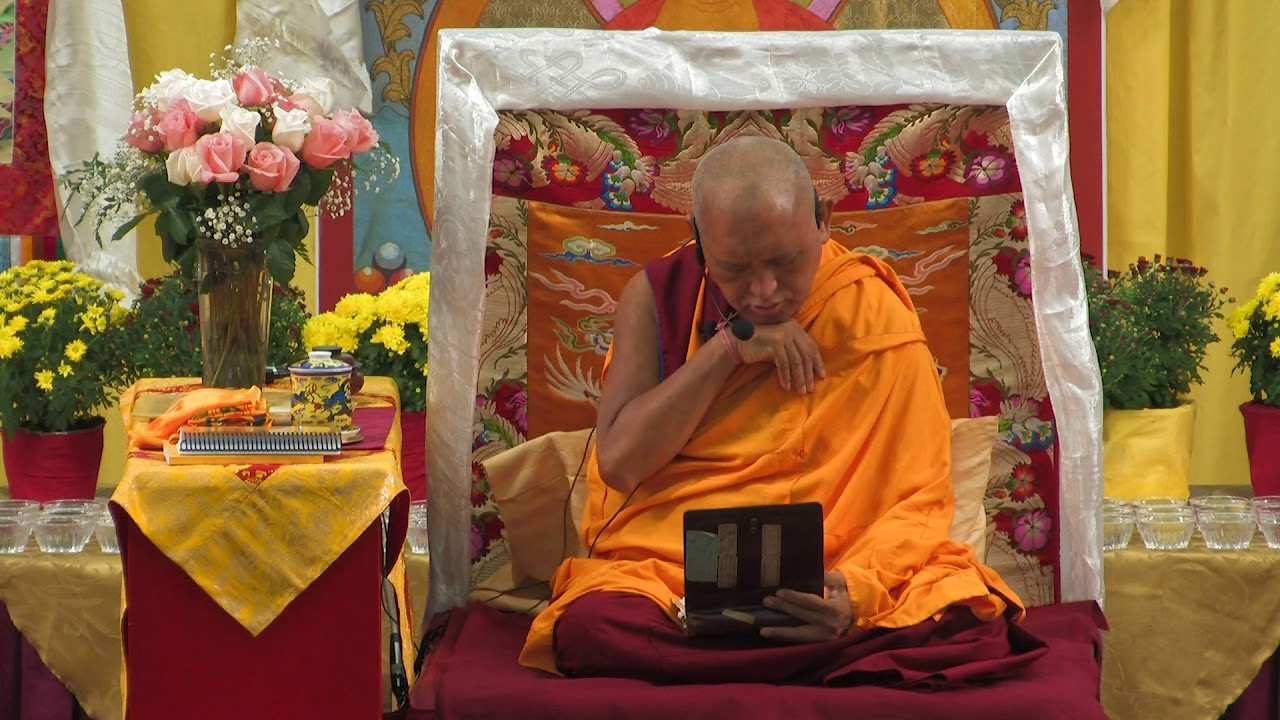
20090912 S2 LZR LOP Mindfulness of Bodhichitta ENGLISH
some of these mindfulness practices as, of course, normally you can do, that’s incredible, but especially during retreat, I think it’s, when you do your personal retreat or the group retreat, these things, if we practice, then it’s extremely worthwhile, the mind to keep in the bodhichitta.
Yes, of course, there’s renunciation, there’s right view, you can relate to many things, you can do activities with the different parts of lam-rim, but especially bodhichitta, so everything, whatever activities you do, with bodhichitta, so that’s the wise, that’s the most wise life, most meaningful, most beneficial life.
So as His Holiness the Dalai Lama often says, that,
so, if one follows, maybe I put this way, if one, His Holiness the Dalai Lama said, if one follows delusion, it harms to yourself, it harms others. means numberless sentient beings, others, numberless sentient beings. Then, I mean, one thing is, if you follow self-cherishing thought, for example, then it doesn’t allow to have realization of bodhichitta, to have good heart, doesn’t allow to have, to generate a good heart, so totally seeking only happiness for oneself, only working for oneself, like that, so whatever you do it’s only for yourself.
So anyway, so then, one unable to generate bodhichitta, so then, that means, then unable to complete the merits of wisdom, virtue, and the Mahayana path, unable to enter in the Mahayana path, then also unable to achieve the exalted, the Mahayana path, the arya path.
So then, you don’t have all those incredible, those wisdom directly perceiving emptiness, I mean, all those many qualities to be able to offer extensive benefit to sentient beings, so you don’t have that, so unbelievable. Anyway, so you can’t do the extensive benefit to sentient beings, you can’t offer deep benefits, so, like that.
And then the, cannot achieve, cannot complete the path, cannot achieve full enlightenment, cannot cease the defilements and cannot complete the path, cannot achieve full enlightenment, so, therefore, so can’t do perfect work towards sentient beings, bring them to enlightenment.
So then, even from that side, so the sentient beings have to suffer for a long time, so that’s how it harms, so, that’s one way, by following delusion, harms to oneself and harms all sentient beings, so there’s direct harm, indirect harm. So then, if you think from life to life, then, life to life, so that’s?why it harms numberless sentient beings, if you think life to life.
So that, then if you, so, if one practices Dharma, you want to follow bodhichitta, good heart, then happiness to yourself, happiness, totally opposite, happiness to oneself and happiness towards all the sentient beings, towards others. That happiness is like that.
This, yeah, as I mentioned before, then, the happiness of this life, even without clinging for that, it just comes, when you have, through the good heart, without even thinking of the happiness, it just comes. Then happiness of future lives, liberation from samsara, then full enlightenment, all that, then as well as all those four different levels of happiness, you’re able to cause other sentient beings, the numberless sentient beings they receive from you, so that.
So however, then, by practicing good heart, even for yourself, day-to-day life, moment-to-moment life there’s happiness, comfortable life, life without fear, depression, guilty, all these things, all these package, all these things doesn’t happen, so you don’t?engage, because good heart, so happiness to you, happiness now and happiness, like sun shining in this world, happiness in the future for yourself, like sun shining, in your future lives, so that.
And then, also, bring, it brings peace in the world, like that, towards other sentient beings, anybody who’s around you, also bring peace to others, so that. So from there, to the whole world, to others, numberless sentient beings, like this. So, like that, from Dharma, from the good heart, like that.
So there’s nothing, when the death comes, there’s nothing to feel sad, only to rejoice, only to feel great happiness. So even when the death comes, you die with great happiness and joy, no, nothing to regret, feel depressed, sadness, like that. So the person who is seeking liberation, state of omniscience, then need to attempt many methods, so many methods, collecting merits and purify defilements.
Then, the means to do that, then the Omniscient One, who is very skillful, who is extremely skillful, who has great compassion to us sentient beings, and then explain that even our daily life conduct, by the way, even our daily life conduct, so eating, walking, sitting, sleeping, doing job, so forth, all those things that which we normally do, then, by the way, these activities, I mean, not only, studying Dharma, however, doing meditation, all these things, living in the morality, so forth, I mean, many other virtuous activities you do, but even these activities ____ ______, these small activities what you normally do, then, by the way, they become, so the Omniscient One, who is extremely most skillful and who has great compassion to us, so then explained,
even these activities what we normally do become method to collect unfathomable virtue, so like that, skies of, means of collecting skies of merits, so that. So, not only beneficial to oneself, but beneficial towards all the sentient beings, like that. So explained this, the Buddha explained, us, those whose level of mind is lower, so I guess maybe who do not have bodhichitta realization, so this is how, particular, yes, lower minded, however, I think, so everything become, whatever you do, everything become dedicated for other sentient beings, for their happiness, so, yeah, cause of happiness of all sentient beings, like that.
So this is, so this is something to immediately to practice, so, then there’s a lam-rim meditation, but even other times, break times, all the activities, to, as much as possible, to do with bodhichitta, and to, thought to benefit other sentient beings, to be beneficial to, making beneficial to all the sentient beings, okay, so that. So then, so the?Do De Konchog Trin, there explains some of the things, quite a number of things is from sutra, the name of the sutra is?Do De Konchog Trin, Clouds of the, Konchog, is Sublime Rare Ones, then the Buddha, Dharma, Sangha.
So the, some I put it, so it’s not mentioned there, so this added from, say, added that. So in the morning, when one wake up, then, the very, very first thing, one wake up from sleep, just the?minute when you wake up, then think, “May all sentient beings achieve dharmakaya,” to think that, the minute when you wake up, okay?
Maybe the eyes is still closed. Maybe mind is opened, mind wake up, but eyes still closed. I’m joking, anyway. Then, so remember that. Then when you, when you put dress, then to think that, “May all the sentient beings wear the dress of shy and shameless.”
So, reasoning oneself, then, say, shy, ngo tsa, one is ngo tsa, shy, and the other one is tel yu shame. So, do you have other word? Yeah, yeah, consideration. That’s right. Shy and shame. Huh? To be reserved. Reserved means what? Means you don’t expose?to reserve.
I’m not sure. So, reason because of, then, so, you protect these negative actions, reason because otherwise you have to suffer, and then cannot achieve realizations. Then other one, other one is, if you do engage that, say, for example, you made bodhisattva vow, made a vow in front of Buddha, Dharma, Sangha, or made a vow?for the sentient beings, then, if one break, then become shameless, not shameless, yeah, shameless, careless for other sentient beings, careless for sentient beings, so, careless for sentient beings, so reason of others, then you practice.
So may the sentient beings, this is from sutra, May the sentient beings wear the dress of shy and shameless, ngo tso, tel yu, so, yeah, when you dress. Then, when you put belt around, then, when you put a belt, then you think, May the sentient beings’ mind being bound by the three higher trainings; beings’ mind being bound by the three higher trainings; may the sentient beings’ mind being bound with, hts, three higher trainings: higher training of morality, higher training of concentration, higher training of the special insight, so that.
So, because that’s what it said in the sutra, so I just, when you release the belt, then, think, “May the sentient beings be free from the bondage of karma and delusion,” when you release the belt, so that. Then, so when you go to, after you lay down, so that. Then, so when you go to, after you lay down, or, I mean, when you go to bed, after you lay down, then, “May the sentient beings achieve dharmakaya,” so that.
That’s same thing when you see the stupa, when you see a stupa, that’s also what you think: “May all sentient beings achieve dharmakaya,” so that, like that, the minute when you see holy object, a stupa. when you see the Buddha statue, holy object, “May all sentient beings achieve enlightenment,” say, “May all sentient beings achieve enlightenment quickly,” so can dedicate like that.
Then when you get up, then, you think, “May all the sentient beings rise up from the oceans of samsaric suffering.” When you get up from bed, in the morning, so think that. That might be same also every time when you get up, what mindfulness, to think.
So then, so when you offer incense, in the sutra explained by Buddha, when you offer incense,?Do De Konchog Trin, that, “May all the sentient beings, anyway, the essence, meaning, is similar, then, “May all the sentient beings, the?wicked nature,?nyenpa, nang tso nyenpa, wicked nature, the stains of the?weak nature be eliminated, and smell the scented, have the scented smell of the the scented, have the scented smell of the morality.” So, when you light incense, can think, dedicate for sentient beings like that.
“May they live in the pure morality. May they live in pure morality,” like that. Then, when you do the cleaning, then, there in the sutra it mentions that,, “May all the sentient beings, the bad conduct to not happen, and perfected in the beautiful conduct, wonderful conduct,” that’s what?Do De Konchog Trin, that mentioned by Buddha, what to think when you clean, so when you’re cleaning this, wiping off the dust, I mean, or cleaning the floor, like that.
I mean, the other thing is then you just, what mentioned in the lam-rim, the explanation of the Jor wai cho druk, the six preparatory practice in lam-rim, so the very first one is cleaning, the very first one is cleaning. So, then perform the altar, perform the altar, then without deceit. So there’s external, hts, so without deceit, beautifully decorating the, beautifully performing the offerings, so that, then, beautifully performing the offerings, offerings one thing but beautifully performing, then, also create good karma, extra good karma, so like that.
Then after that, then sitting on the meditation bed, the body, say, set up or arranged, set up Buddha Vairochana’s, the seven posture of Buddha Vairochana. So the, why it’s related to Buddha Vairochana? So, I think, Buddha Vairochana’s, no, I’ve forgotten.
His Holiness Serkong Tsenshab Rinpoche showed the mudra, I think it might be this, Buddha Vairochana. There’s one like this, but, there’s one like this. You see sometimes buddha’s white, then the mudra like this, this is Vairochana, Vairochana mudra, pointed finger going like that.
So, mudra is like that normally, Vairochana, so, the rest is same, of course, others, but just I, but just, this is Amitabha, so the Buddha Vairochana like this, yeah, that’s right, like this. That’s how His Holiness Serkong Tsenshab Rinpoche have shown when Rinpoche was giving commentary on Bodhicharyavatara, no sorry, Jorchö, preparatory practice, at Dharamsala, in Rinpoche’s room, for us, our Sangha. What happened was, what happened was, that was the first time, that was the first time, what do you call, what’s the word, that’s the first time at Kopan, in Nepal, the number of the Sangha increased, the first time, many Sanghas.
I think Thubten Pemo is one, who is left now, who is left. From that time? When the Nepalese government didn’t give visa, and I went several times to When the Nepalese government didn’t give visa, and I went several times to town to see the head of the Buddhists, the lama, I’ve forgotten the name, huh?
Tsechu Rinpoche, who said that? Ah lay! Oh, I see. No, Karuna wasn’t, I don’t think he was a monk before. Sorry. Sorry. But, lived, Karuna become Nepalese citizen, no, I’m joking. Lived a long time in. Yeah. That’s right. That day, at, when there was the Universal Education, the song, and the sixteen human dharmas, so that time I talked about to Connie.
Is Connie there? Connie is here? Okay. Sorry. So that time, we have one beautiful statue, made by Nepalis, so we were painting that, so she was helping, dressed Tibetan, with the rainbow, this rainbow, the, what do you call this? What do you call that one?
Apron and then chuba, and all this, dressed. So I was asking, what she was doing, and she said, way up near, one nunnery, old nunnery, studying there. So I said, do you have to send information to, information back to. She said, “Yes, yes, she has to send.” Then I was saying she, Oh, she is American spy also.
I was, while we were working on the statue, I was making…. Anyway, so maybe half serious, half joke, whatever. Anyway, so that time Karuna was also there, the same time, right? So they are the ancient, holy American-Nepali; American-Nepali, lived in.
Anyway, so I went many times, quite a few times and offered, somebody gave me this zen, very long, thick zen, I don’t know whether it’s cashmere or not, but offered to him, asking, please help to give visa to our Western Sangha. So, his style is, say a few words, and that’s it.
But he didn’t say no, he didn’t say yes, but a few words, and that’s it. This is how Tsechu Rinpoche’s style is. And then, didn’t get, so everybody have to leave to Dharamsala, all the Sanghas. Then they had to find place, and they lived in, lived Dharamsala in cow shed, in Dharamsala, down where there is Hotel Bagsunath, is that Bagsunath Hotel, huh? Near Bagsunath Hotel?
Between the temple and McLeod Ganj, between that. The cowshed, right? You stayed in cowshed? Oh, servants. You prepared a title! Oh, that’s even better. That time you were there? Oh, I see, I thought maybe later. I see. So, anyway, so, His Holiness Serkong Tsenshab Rinpoche advised Nick and Roger how important it is to go in His Holiness’s temple, the Namgyel, the temple and pray in front of Padmasambhava statue.
So Roger went to pray there to find house for the Sangha, right? Oh, I see. So, a few of them. Then what happened? Ah lay! Then? Then found a cowshed. Then become Inji Gompa, right? So I heard after, there was a gelong, there was, you took gelongpa that time, right?
Nick and you took gelong at that time, that time you took gelong vows? No, I thought, what I heard was,?they?said received gelong vows, and then, so from His Holiness Serkong Tsenshab Rinpoche’s house, you were going back to the place where, I mean, where they lived.
So, Nick and Roger thought, they decided to not look anywhere, just go straight from the room to their room, make sure don’t get distracted, the mind, so might break the vows. So, go straight from the room to their house to read the vows. So go there, then read the vows, so to make sure to not get break, so don’t look at side.
Oh, tantric vow! Ah lay! Sorry, I made a mistake, I misunderstood. That was not gelong vow, it’s tantric vow, the highest. So anyway, it was very interesting. So anyway, so that time was very good, the Sangha was very good, say, many Sangha, and everybody was trying very hard, so very, very good, as pure as possible, so it was very, very good.
So, yeah, that. So, anyway, so then after some time, it happened to be at Dharamsala, So, yeah, that. So, anyway, so then after some time, it happened to be at Dharamsala, myself and Lama, then I think requested Kyabje Serkong Tsenshab Rinpoche to give commentary on the Jorchö, so I tried to translate, sort of my own, say, broken English, tried to translate.
So then, yeah, Rinpoche, what did Rinpoche say? I’ve forgotten, what I was going to say. I don’t remember now. Anyway, it doesn’t matter. Oh, yes, you are right, that’s right. You’re perfectly right, no mistakes. Yes, that’s right. Then Rinpoche was showing, like that, Vairochana mudra.
So, anyway, that is what we were talking about. I don’t know which, I think that might be the Thirty-five Buddhas. In the dividing Thirty-five Buddhas in the aspect of the five types of buddhas, so it might be that. Otherwise, can’t see the…. So anyway, so I think, in the tantra, so so the purity of the impure aggregates of form, then that manifests into Vairochana, Buddha Vairochana, so I think might be that.
So, might be, my guess is relating to Vairochana, the physical position is relating to buddha, maybe to help for that, I think, that’s my guess. So, anyway, the seven positions of the Buddha Vairochana, so that. Then the, on the basis of that, then to generate into virtuous motivation, our mind to become Dharma, before the actual practice, mind should become Dharma, then your meditation become Dharma.
So then, for that, then to do the, if your mind is not already in virtue, distracted by delusion, then, by the worldly concerns, then you do the breathing meditation, nine-round breathing or the breathing, the short one, breathing out, and breathing in; breathing out is by, and then you do purification, and breathing in, then you receive all the qualities, like that.
Then by making clear the mind, indifferent, then you transform into virtue, so that, the motivation. Then, you visualize the object of refuge, say, object of refuge, the merit field after that, the merit field, all that. Then the seven limb, the mandala offering, then one-pointedly requesting the guru, that.
Then after that, then meditating on the path, then the actual practice doing meditation on the, say, the stages of the path to, the graduated path to enlightenment. So, what I’m saying? Yeah, so, anyway, so then the very beginning, the very first one is cleaning.
The cleaning doesn’t, cleaning doesn’t depends having garbage cleaning doesn’t depend on whether there’s garbage, it’s not that there has to have garbage, it’s not that. It’s just part of the, no matter how clean it is, for the first thing to do cleaning, six preparatory practices, the first, cleaning, so, have to do that.
It’s not a question of whether there’s garbage or not. So then, dul pang drima pang: abandon dust, dul pang drima pang, by reciting, abandon dust and abandon stains. So, the first means disturbing-thought obscuration, and then the second one, abandon stains is shedrib, the obscuration to the fully knowing mind, so that, subtle defilements.
So, anyway, in the lam-rim, there, related to your own defilements, more present that way. However, here, in Do De Konchog Trin, according to here, then everything is related to bodhichitta, everything is dedicated to sentient beings. So, however, so cleaning, cleaning the sentient beings’ the disturbing-thought obscuration and subtle defilements, so can think that when you wipe off the flour, sorry, not flour, floor, when you wipe off the floor.
So the, just mention, it’s not the point here but the one I mentioned before, morality, scented smell of morality, perhaps that may not be aware in the West, maybe someone?know, anyway, I don’t think that’s experienced in the West much. There’s certain lamas, that, practitioners, then they have this scented smell of morality.
I remember when I was in Solu Khumbu, when I was a child in Solu Khumbu, so there was, not Thame, not Thame where monastery, a little bit above from the village where I was born, Thame, then, there’s a monastery, by going up, half hour walking up, more or less, I’m not sure.
So because I escaped a few times from my uncle, who was a monk, gelong, so because close to the village so I escaped a few times. While my teacher went inside, so we have, maybe food, maybe four times, three times, or something, food in Solu Khumbu, so, anyway, so when my teacher,?Awu Lekshe, so he, what he does, particular function in the Solu Khumbu is, other people ask, request, family, some people, request to carve mantras over the rocks nearby the road, or maybe side, some distance, or especially in the road, so then somebody sponsor, please carve the mantras, so then my teacher spent, maybe one month, two months, depending on how big the rock is, then carve, then become very beautiful, paint, then the family invite all their neighbors, I mean, their friends, and they do
tsog at the end. Then, they bring a lot of containers filled with the chang, alcohol or wine, a lot of container, with the grain, some chang with the grain. So they put a bamboo tube inside, then they drink, suck the chang. So this, and do puja, then tsog offering, then at the end everybody lined up, hands on another person’s shoulder, each other, all lined up, then they dance.
and, that’s quite common at the end of the puja, in public pujas, so quite common to do that. So that’s sort of, enjoying, I guess the Dharma celebration or Dharma activity, kind of happiness of that, somehow expressing. So then they, those songs are not present, modern world song, it’s not that, not expressing about attachment, not advertising attachment.
It’s not a song advertising attachment. It’s all praise to the lama or to the buddha or things like that. Very interesting, very nice. It’s song that which, when you hear, it brings, it doesn’t rise attachment, it doesn’t afflict or, it brings the mind very calm, very peaceful when you listen, like that.
So, anyway, then they wear, everybody wear khatag, scarf, then they leave, back to their homes. So this is how they do. So my teacher, I remember, first teacher, the very first, alphabet teacher, this is how he did, many, many rocks he carved, so that.
Because I escaped a few times, back to home, no other special reason, just to play. I didn’t have any special reason to run back to home, just to play. You feel more freedom there, so it’s just that. In child time, in the child time you think that, and just to go, you think that and just do it straight, that’s all.
So one time, I think, well, my mother put me, pants, dress, pants with the upper wear, all together joined. This cloth, cloth that they use for prayer flag, like, I mean probably that’s the only one that’s available, I guess, so this is very cheap, you use for prayer flags.
I think she dyed in the red color. Then, of course, when you wear, the color goes away, so become pale, becomes pink. So she put this dress on me, but I didn’t know how to open this, when I went for, what do you call? Disposal? So disposable poo-poos, and like that.
So I didn’t know how to open this, I had no idea. So I escaped from my teacher’s place to home. So I didn’t know how to open, so I escaped with poo-poo inside to my mother’s house. I mean, my mother was outside, with quite a few people around, I don’t know what they were doing but, so I reached there, then my mother took off all my dress and cleaned, I was naked, so she cleaned everything, all the ka-ka, everything.
So one time that is what happened. So, anyway, so then my mother send to a much more primitive place. From there, by crossing snow mountains, I think maybe that day, and then maybe one whole day on the mountain, I think. Then next day, then maybe you arrive to the first village, I think, so, something like that.
So the, so everybody has got the ropes, because sometimes there’s snow on top, but then there’s many stories, there’s crack, very blue, crack dark blue, and way down there, water. So, if you fall down, then the previous, later person can hold up. Otherwise you drop, then that’s it.
Because I was always carried by somebody. One person was carrying me, that time. So, then coming back, going back, I came with my second alphabet teacher who was also my uncle, so brought, we came for teachings, we came for the teaching, from this old lama who founded the monastery at Thame. He’s like a long-life man, the bald head and long, very long hair, like this, say, long beard, sorry, beard like this, but very good-hearted, very, always did, leading retreat and giving teaching, initiations, and like that.
So he was, when I was at Thame Monastery, when I was staying with my first teacher, so evening, before sunset he does protector pujas, I guess by now, I think might be protector puja, so you could hear the drumming, you can hear, no, I think, sorry, in the morning, in the morning after sunrise, so you can hear the drum quite far.
So I usually go down, so I was kind of impressed, and I usually go down. Then open the, his room, his room door, the cover, what you call, his room door, cover, open, from outside, open a little bit. I just look at him. And then he, one or two times, I think, gave tsog, the food, they offered tsog, so one handful so he give, then I take, I put in my robes, then I just run up, took my teacher’s place.
So this, mountains, snow mountains, so went, came back, then went back, for initiation, then come back, then go back, so a few times, but I was always carried. Second, when I was going back to, the second time when I was going back, I was carried by my teacher, second alphabet teacher.
So, there’s sleeping, there are other things, food, carry, my teacher he carried. Then on top of that I sit, then, facing to the teacher’s head, I was sitting back side. Then my teacher, while we’re climbing, while we’re walking on the mountain, on the rocks, all this, then he carry, pieces of meat that’s cooked, brought from home, then he passed me like this.
I was eating behind him, behind his head I was eating, so that, my teacher, like that. So, anyway, there’s a few dangerous places and, sorry, so the story got carried out. So there’s one very dangerous mountain, it’s not snow, it’s, I don’t know, when it’s raining, I’m not sure what happens, so many stones fall down from that mountain, big rocks and small ones.
When small one comes, say, when a small one comes it makes noise, sriiiiiiiiii taaaaaaaaa, like that, kind of, and big ones, wrr, wrr, wrr so, wrr, a lot of noise. So, anyway, so you stop, usually you don’t cross immediately, you stop, before crossing that you stop.
People carry very heavy loads, the Sherpas, and then, say, very heavy load they have to carry. Then sometimes there’s a yak. There’s no actual road, so you push on the rocks, so very, extremely hard life, so, can’t imagine that. So, anyway, then, everybody drink the alcohol, very, very common, it’s like coffee in the West, so chang. But there’s some monks who don’t drink chang, in that, kind of become habit, but there’s some who stayed pure.
I’m talking just, it doesn’t mean, it’s not saying the whole entire, I’m not talking about that. So, anyway, so first drink, they would drink some, then you rub your hands like this,?and it’s cold, you rub hands. Then everybody carried a very heavy load, food, and the things, blankets, all things, then the other things to sell, they have a huge load to carry.
Then they once get into trail, when you’re coming back from that primitive place to Thame, then you have to go up a little bit like this. But going back, I don’t remember. at all, was another road or the same. So then, when you go up like this, then everybody, then they start to go up like that.
The very first time, then suddenly you hear this sound wrrr, wrrr, wrrr so I didn’t realize what, I was carried, I was behind somebody’s, over the load. So wrrr, wrrr, wrrr, I hear this noise. I was confused what was the noise. Then later, I realized, all these people, everybody who was going up, reciting mantra, reciting Padmasambhava mantra, everybody.
So, that time their heart totally rely on Padmasambhava. Maybe there’s some Tibetans, maybe they recite OM MANI PADME HUNG, but there they did Padmasambhava mantra. But, very surprising, very surprising thing is, so I went a few times, there must be support there, there must be somebody, I’m not sure protector, maybe Padmasambhava guiding.
So everybody recite, everybody, hundred percent, rely on Padmasambhava. Then, of course, I think, I might be the, probably I might, the very first time, I was not at the beginning, maybe end somewhere. But whenever you reach, you cross like this, whenever you reach here, whenever I arrived here, then the stone fall down, then the stone fall wrrr, wrrr, huge noise.
Then I think, Oh, now somebody got killed, died, but that really makes to think like that. But actually, everybody just finish here, just came out, then the stones come down. But during this time, during the time going, never, not even one stone, so that’s very interesting.
So there must be somebody guiding, definitely. So the refuge you take, it works, the people totally rely on Padmasambhava. So never saw one stone fall, but the minute when we finished, then come down. So it’s very interesting. You don’t hear falling down before, when we were preparing, next to that, you don’t hear.
I hear a few times when we came out, so that’s very interesting. Of course, karma, but I think the faith. So, anyway, what I’m saying? Huh? Oh yes, that’s right. Thank you very much, otherwise I lost. So I was in Rolwaling, this place, Rolwaling, this place, Rolwaling, is Padmasambhava’s, it’s a very primitive, Padmasambhava’s holy place.
So the name is in the Padmasambhava’s life story, in the Padmasambhava’s prediction, there’s a prediction,?Padma Ka Tang, the name is also in the Padmasambhava’s prediction, the life story. So, anyway, so in the gompa, one time there was, I don’t know, initiation, I think it’s happening, so the people came from, Jim-, Jimbesi, not Jimbesi, yeah, Jimbesi, from very far, for initiation.
I think from the lama, from Thame Monastery lama, I think he came there. No, sorry, no, sorry, I made a mistake. This is not Rolwaling, this is at Thame. So, the lama in the center, then there’s one row like this, then there’s another row, like that, facing this way, there’s another row like this facing that side, then same thing here.
So this side, there’s one incarnate lama, one very small, young, incarnate lama. So, at night whenever they finish, so, I was sitting this line, so there’s one lama there, came from Jimbesi somewhere, so then everybody stand up and get, step on the floor.
So this young lama came out, so it’s not a smell of perfume or anything, I’m quite sure there’s no perfume there. So anyway, so, a very holy smell, scented smell, from this young lama, a very scented, holy smell. So then, the scent, so smell of morality, like that.
So sometimes the, say, there are some holy beings who are like that. So Kyabje Pabongka, one geshe, I think one lama, I think, I don’t know who was that, so taking Kyabje Pabongka’s dagam, the monk’s coat, put outside in the sun. So the robes they have a smell, very scented, very holy smell.
So then, the geshe or the Rinpoche, Kyabje Ribur Rinpoche told me this, I think, I don’t know who, the one?Ani-la, told Kyabje Pabongka Rinpoche, Oh, this is smell of your morality and Kyabje Pabongka said, No, no, no, no, I have a little bit good heart, might be smell of that, so Kyabje Pabongka said that.
Anyway, sorry, it took some time. Then, then the, it’s said also, when you eat food,?duk so na, when you eat food then you dedicate, the Konchog Trin it says, all the sentient beings to not have delusion, and the six roots, I think, six, there’s six root delusions and twenty secondary delusions, those things, to not have delusions, and the secondary delusions, it says.
That’s what it says in that. So, just that. So when you enter in the temple, so here, when you enter, every time when you enter inside, then what you should think is, think that you’re bringing all the sentient beings in the city of the liberation, so that can mean also enlightenment, great liberation.
Think that you’re bringing. So here, it’s everything related to the sentient beings, okay, so that. You are bringing inside, in the city of the sorrowless state. Then also you pray: May they be entered in the city of the liberation, like that. Then when you go out, then think that you’re bringing the sentient beings out of the prison of samsara, so you’re liberating them, bringing out of the prison of the samsara, the sentient beings.
You visualize that, and also pray that. Then, when you open the door of the house, then you think that you’re opening door of the transcendental wisdom, you’re opening the door of the transcendental wisdom gone beyond the world, gone beyond samsara, so that’s what mindfulness what to practice.
Then when you close the door, then think that, I’m closing the door of the samsara of the sentient beings, you think that and then pray, May this happen. Then every time when you sit down, then think that I’m bringing the sentient beings to the heart of enlightenment.
So generate that thought each time when you sit down, to think. Then every time when you’re doing washing, so, when you’re cleaning the teeth, when you’re washing the body, so, when you’re washing the pots, so all this, any time when you’re doing washing, then think: I am washing all the stains of the delusions of sentient beings.
So every time think that. So, that’s what when you do washing. In the Do De Konchog Trin that’s what’s explained. So washing all the obscurations of all the sentient beings, washing, like that. So, so the brush, similar when you clean the room, vacuum or brooms or whatever, then you think that is antidote to the obscurations, the path, the complete path of method and wisdom, whole path to enlightenment, from guru devotion up to enlightenment.
So you think?all?that. So similar here, toothbrush, tooth also, toothbrush, you think all that, complete path to, completed graduated path to enlightenment. Then, cleaning the obscurations of sentient beings. Same thing when you’re washing clothing or also in the kitchen, washing pots, so anything washing, think that. Then the water, soap, whatever, that’s a path to enlightenment, so like that.
The sentient beings’ mind you are cleaning, so that. Then this, that, so even you’re making firewood, making fire with the wood, then, think that is all the sentient beings’ delusions, you’re burning, by the transcendental wisdom fire. So like this, everything, whatever you’re doing, always dedicate to the sentient beings like that.
Then, also, in the Do De Konchog Trin it says
also, when you laying down with the right rib on the bed, so then, it says, you generate the bodhichitta that, to bring all the sentient beings in the sorrowless state, so means, so can think, the great sorrowless state means liberation, so great liberation, enlightenment, what the buddhas have achieved.
Then,
when you cut, when you are making food in the kitchen, whatever you are cutting, the vegetables, or the meat, whatever, onions, so forth, or the vegetables, or whatever you’re cutting, so, then practice mindfulness that you are cutting all the sentient beings’ ignorance, delusion, the ignorance, with wisdom, with the knife, sword, is the wisdom realizing emptiness, so cutting that, cutting the sentient beings’ ignorance, the delusions, like that.
Then also can think that, so what you’re cutting the food, whatever, think the sentient beings, the ignorance, the delusions, the knife is wisdom realizing emptiness, like that, think it’s the path. Then or the sentient beings’ self-cherishing thought, then the sword is bodhichitta, so like that. Like So cutting the root of, cutting the self-grasping, the root of samsara, the self-grasping, wisdom realizing emptiness, so that.
Then, so when you, so
the, it is mentioned in the lam-rim teachings, what Lama Tsongkhapa explained and other lam-rim teachings, what is explained, there’s the sleeping yoga. So it is mentioned in sutra that when one go to bed, then, you go out and you wash your feet, then you come back inside.
Then you put your right leg on the left leg, sorry, sorry, left leg on your right leg, then, sleep like snow lion. So that’s what mentioned sutra. So like that, then in the position of the snow lion laying down, then you/
Sign in to keep private, timed notes on this talk. Only you can see them.
Public comments
Public: open to everyone signed in. Your private notes are in My notes.
Sign in to join the discussion.
Teachings from Light of the Path 2009. Kadampa Center, Black Mountain, North Carolina, USA. Transcript: https://fpmt.box.com/v/LOP2009
- Teacher
- Lama Zopa Rinpoche
- Centre
- Kadampa Center
- Recorded
- 12 September 2009
- Length
- 1 h 37 min
