 Free5:40:40
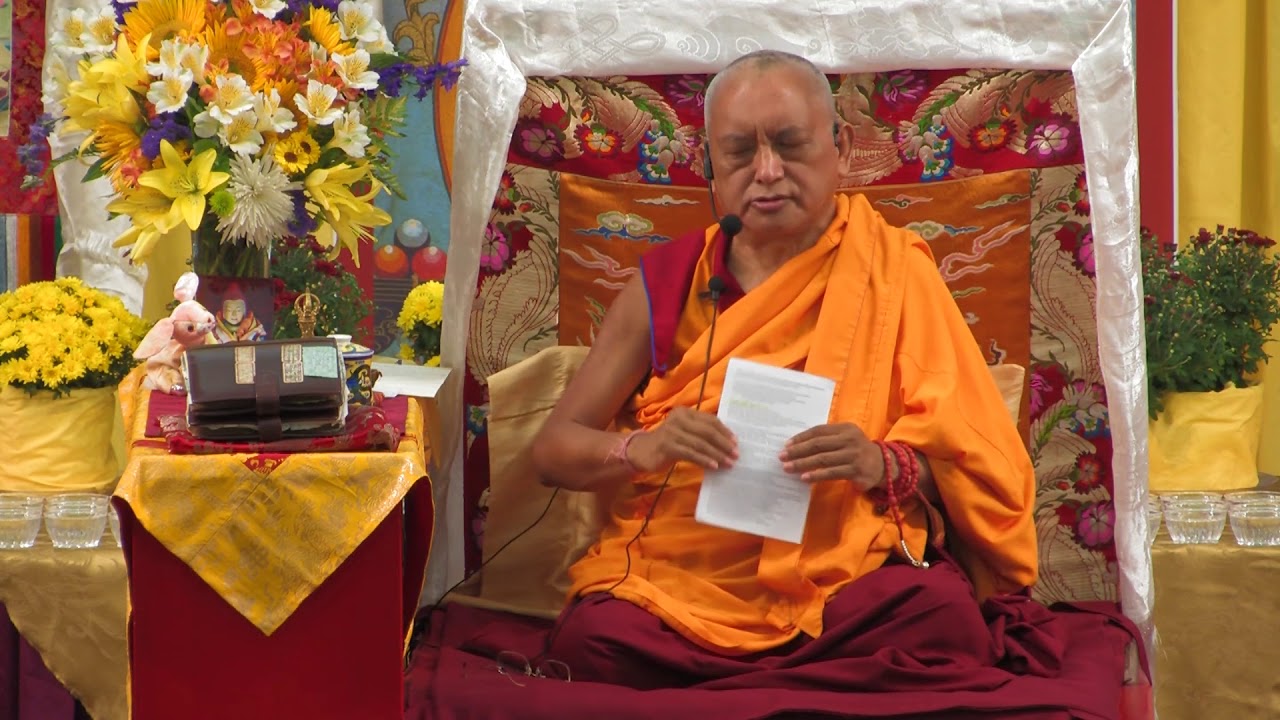
20090918 S2 LZR LOP This is going to happen to you ENGLISH
ears being split open By the sizzling and crackling sounds of a fiery conflagration-what to do? By the swirling dark winds of the end of an eon-what to do? When you're driven by the powerful red winds of karma And swallowed up by a terrifying darkness-what to do?
When you're bound with a lasso by the messengers of Yama And, in total despair, are led away-what to do? By ox- and scorpion-headed karmic agents-what to do? When you're before the Yama king, the lord of death, As he weighs up the whites and blacks-your virtuous and non-virtuous actions-what to do? So, when you are in the hell realm, so the, ox- and the scorpion-headed karmic agents, you're tortured in so many detestable ways, so just, so, as you get idea this.
At Dharamsala, where His Holiness the Dalai Lama lives, a little bit down below Tushita, where our retreat center is, you come down, there's old palace of His Holiness the Dalai Lama, old, where His Holiness the Dalai Lama lived, I don't now how many years.
The first time and place in Dharamsala. So the Namgyal monks lived there at Tushita. So they lived in the, this side where, not this side, His Holiness Trijang Rinpoche, root guru of His Holiness, and the Dalai Lama's younger tutor, lived for seven years, so it's extremely holy place.
Where Heruka really lived there, in this side of the house. Now, I mean now, it's built new gompa, I mean, totally, like a Tibetan monastery, like that. But they still kept that, I mean not, hts, there's one Lama's room there inside, kept all the Lama's things inside.
So what Lama had before, it's in same room kept. I mean, in this way, made one room and kept in there. But everything made new because it's very, very unbelievable old, so can't make it new, new one there and keep the old one, can't do that. So they had to rebuild the whole thing.
So, anyway, so there's a corridor, then the dining room, small dining room. I mean, now I don't know, but, I don't remember, before, a long time ago. Then there's kitchen. So His Holiness Trijang Rinpoche lived there, and attendant, this part of the room.
So Namgyal monks lived there. This part of the house where there used to be the gompa, in the past, it was the gompa. So, where the gompa was. Namgyal monks lived there. Then door here, corridor, that was their temple, Namgyal Monastery, lined up, His Holiness put throne there, then they lined up for the puja.
Anyway, when His Holiness arrived Dharamsala. So that's corridor. Anyway, so His Holiness lived down below. So, there's a road, so when you come down, His Holiness's palace, the old palace here, so when you come down, when you come down like that, then goes down like that to McLeod Ganj.
So anyway, when you come down like that, there's the palace here, so at the end of the road there's one family, there's a house there, there's two houses, two, anyway, close to the road. So one house, the father, the man of the family, was dying, but he was screaming so much.
screaming so much, making so much sound, screaming so much, because he sees many sheep, many sheep attacking him when he was dying, many sheep coming to attack him. So, how I found out the story is that, so Gen Jampa Wangdu, an extremely successful meditator, who has actualized calm abiding, shine, in Dalhousie, and who actualized bodhichitta, who actualized emptiness.
So from Tushita, then you go straight, other side, on the end of the hill, there's His Holiness Ling Rinpoche's, His Holiness the Dalai Lama's elder tutor lived, that house. So you go down below, down, then there's a rock, he dug, under, the earth, then it become cave.
So, lived there seven years. So there he realized emptiness. Then maybe when he's, there's another house on the mountain, behind Tushita, where there are many meditators, then he had one house there. So there, I think, he realized bodhichitta there. So Geshe Rabten Rinpoche, when I was taking the first commentary on the mahamudra from Geshe Rabten Rinpoche, is Gen Jampa Wangdu's teacher, his main teacher, so, I was receiving oral transmissions, commentary from Geshe Rabten Rinpoche.
So Geshe Rabten Rinpoche said, if you have any questions on emptiness, ask Geshe Jampa Wangdu, he has just fresh experience of realizing emptiness. Geshe Rabten said this, at least two times, I think. So he had realization of bodhichitta, I think, when he was telling us, I think maybe seven years ago, already had realization.
So, time to time he comes to meet Lama and myself, come to Tushita, so, that's one of the best times, that's, when he comes, each time when he comes, that's the best time. It's the best time, because what you hear from him, because of that, best time.
It's best time. I mean, you hear about somebody had realization, this and that, or other Dharma practitioners, other meditators, what realizations they had. So you hear through him, otherwise, you don't hear, otherwise, nothing you hear. So he's the, Gen Wangdu was the sort of door for us, door, like T.V., like T.V., of what you hear, where you find out, which meditator has which realization, or other stories, things like that, very inspiring, or his own life story in Tibet, and practicing, I mean, very inspiring, very, very inspiring, very inspiring.
So he told us, oh, he said, he said he never went to other people's house for his own purpose, for seven years ago. he never went to anybody's house for his own purpose, he never went, he never went other people's house for his own purpose, he said that.
He didn't say that I have realizations, he didn't say that, but, just the way, just the way of expressing, so it means, it means, what he's saying is, he didn't have thought, he didn't have self-cherishing thought, he did not have self-cherishing thought seven years ago.
He did not have thought of seeking happiness for oneself. He did not have thought seeking happiness for oneself seven years ago, that's what it means. He never went. It's not that he didn't went to other people's house, it's not saying that. He didn't went for his own purpose, seven years ago.
You understand? So that means had realization of bodhichitta. When there You understand? So that means had realization of bodhichitta. When there were scorpions, Tushita has many scorpions, so there's, where His Holiness Trijang Rinpoche's room, big room, Lama's room.
From there, then when you go out, between, there's a bathroom. Then the scorpion drops, scorpion, not plastic scorpion but it's a,, not plastic scorpion, not plastic scorpion, real living scorpion, drops, I don't know, when Lama was doing retreat, Guhyasamaja, in the bathroom, many scorpions.
In the bathroom where he wash, many scorpions. I think Lama thought maybe good, some kind of sign, sounds like Lama was happy of that. So, anyway, there were a lot of scorpions there. So I keep a scorpion at the altar, at the altar, then I put some milk in, Gen Jampa Wangdu says, so nagas, so I put some milk in the lid of the bottle, then the scorpion drinks milk. He looks very cute, where you want to pet, but I didn't touch, but it looks like that, when they drink milk, you want to pet.
But I think, milk become old, then I think, maybe, I'm not sure, maybe become, I don't know, become poisoned, I'm not sure, anyway, he died. So anyway, then I showed Gen Jampa Wangdu. He want touch, he want to touch the scorpion, amazing, no fear, want to touch, I didn't let him to touch, but, I mean, of course, great blessing, I don't know, I didn't think that.
It would be great blessing, because the bodhichitta realization, can imagine? Who renounced the thought of seeking happiness for oneself, I mean, just talking about ordinary person, who has the thought of seeking happiness, cherishing I, from beginningless rebirth, now, abandoned, and then only thought of cherishing others, only thought of seeking happiness of only others, can you imagine?
their life? That's most amazing. That's incredible achievement. Most amazing experiment. I hope the scientists will do that, scientists in the West, come and experiment on that, developing compassion for all living beings, so, then can really bring peace in the world, the most practical.
So the, I mean twenty-four hours, nothing, no slightest thought of, no one single thought of seeking happiness, cherishing I and seeking happiness, there's nothing, then like that, for month, year, whole life, I mean it's just, then, from now on. I mean, sometimes, I think, maybe due to not having enough merit, maybe, sometimes can, say maybe change, until you reach the stable, the level of the path.
So, there's degeneration, yes, so depends on the individual's karma and things, maybe past karma, and not having enough merit, possible, like that. So, of course, if he touch, wow, that animal's so fortunate, bodhisattva touch, wow, great purification, great purification, for that connection, and as well as great purification, that animal, great blessing.
But I somehow didn't think of that, I was so, I was afraid myself, so I don't want, bite him and, bite his finger or something. So, His Holiness many years ago, I don't know which year, but His Holiness gave Lam Rim commentary, Lama Tsongkhapa's Lam Rim, the greatest commentary of the Lamp of the Path to Enlightenment, at Drepung Monastery, so I attended that.
So then, there were many dogs, the monasteries have many, many dogs. And many of the dogs have this, what this skin problem? What do you call? Mange. Mange. Also Buxa, where I lived eight years, many dogs have this mange, skin worn out, and not skin, sorry, hair, the hair's worn out, and then so much suffering, so much suffering.
Because they eat monks' food, they eat the monks' food, so I think, it's very heavy karma, they don't have, ability to, able to have, say, undigestible, I mean, not exactly, but, say, very heavy for them. So then these problems happens, it's too much for them, the food coming from the monk, to eat.
Especially, something offered to them by, from, by people with the faith. So that, to the monks, then, so, it's called kor, kor means pollution. So you receive kor, pollutions, so they don't have Dharma practice, or living in the pure morality, or bodhichitta, or, renunciation, detachment to this life, don't have. So it's too much for them, pollution, so they get these problems.
So, anyway, I think looks like also in Thailand, Theravadin monasteries, seems also many dogs. So, anyway, because the food which the people offered with devotion to the monks, then they eat, then the dogs get many sicknesses. So, anyway, so at Drepung Monastery, in South India, this, Mundgod, where the Ganden, Drepung monastery is, so His Holiness said, during the teaching, I think maybe during the time of talking about how he made bodhisattva prayers, and perfect human rebirth, and all this, meaningful, difficult to find again, and that this life doesn't last, impermanent, it can be stopped any time, and Dharma's the only thing what helps at the death time, and all that thing, beyond from this life, that what brings happiness is only Dharma.
I think, it must be during those sections, so, I think, or maybe the section on karma, I'm not sure. So His Holiness said, giving food to the dogs, His Holiness said, somebody who has bodhichitta, bodhichitta realization, then giving food to dog, then, he said, incredible benefit to the dog, His Holiness said that.
There's great benefit that the dog receives. I think what it means is, otherwise, you give, but of course you can make charity to the dog, you collect merit, but the dog can't digest, or can't, say, it's too much, the pollution, too much kor, so, then it's probably coming from the hand of the monk, I think might be like that.
So if you have bodhichitta, then the dog has great benefit, made connection and great benefit in the future lives, to meet again, to get benefit, with that bodhisattva. So, even somebody harmed a bodhisattva, then it's said that, even you can't make, even you cannot make connection with the bodhisattva in a positive way, in a peaceful way, even you can't make connection, but you make connection with a bodhisattva, to a bodhisattva by harming to the bodhisattva, or criticizing, something, whatever, so, by harming to bodhisattva.
But, bodhisattva, result of, a bodhisattva only, so there's peace and happiness that other sentient being will receive from bodhisattva, in return. Normal, ordinary people who harm to you, you harm back, you retaliate back. But a bodhisattva, if somebody harm you, then you cause happiness to that other person, to that sentient being.
So, like this, I think, the five tiger family, who ate Buddha's holy body, or the five, well, the spirits, who suck, when Buddha was the bodhisattva time, the spirits sucked the Buddha's blood from Buddha's holy body. Then what happened was, because of that connection, then they become Buddha's disciple next life.
Then Buddha teach them Dharma, then they enter in the path, so like that, great, incredible, great, unbelievable benefit. So the harm, sucked Buddha's, say, bodhisattva time, blood, then due to that connection, then they become Buddha's disciple, then revealed teachings to them, then enter in the path.
I don't remember the quotation, in the Bodhicharyavatara, the first chapter is benefits of bodhichitta, and the very last stanza is talking about this, To the bodhisattva, even somebody who gave harm, but it has a result happiness to, the other sentient beings receive happiness from that, through that connection.
They pray, the bodhisattvas, in return, only they pray other being to have happiness. Not just only temporary happiness, not just only long life, not just healthy, healthy body, to not have cancer, to not have diabetes, all this, enough money, plenty of money, big house, what else, swimming pools, and T.V., and house, what else, all that.
I'm just mentioning the basic things. So, anyway, but bodhisattvas pray to meet Dharma, then, to meet Dharma, and then able to bring them in the path to enlightenment, liberation and enlightenment, and for them to achieve enlightenment, so eventually that becomes sort of, that connection, harm, they give harm to a bodhisattva, eventually that helps, causes the sentient being to achieve enlightenment.
So bodhisattvas pray that way, like that. But, of course, ordinary people in the world who do not know Dharma, who do not know karma, who don't have good heart, not only there's no realization, but there's not even good heart, then, of course, only harm back.
They think this is the sort of realistic, they believe, what they, with their delusion, their mind is delusion, anger, attachment, all that, self-cherishing thought, then they think most practical thing is to harm back. So, with the self-cherishing thought, with ignorance, grasping truly existent, then ignorance not knowing Dharma, then discriminating thought, anger, attachment, all that. So, ordinary people, they to harm back, because they don't think, they don't know karma, they don't know Dharma, so therefore, they don't know future they have to suffer.
By harming others, then they receive harm from others, as a consequence, as a result of their harming to others, then, as a result, they receive harm from others, so they're creating karma, creating result similar to the cause. The four suffering results, the last one is creating, the creating the result similar to the cause.
So it becomes endless suffering of samsara, for you; it becomes endless suffering of samsara. So in the future, again you harm others, from this karma, again, this negative imprint, you harm others. Then again, you receive harm, cause and result, receive harm from others, then you harm back again, then that creates the cause again to receive harm from other sentient beings.
So endless suffering. So they don't know that, they don't know that, No idea, not knowing Dharma, so therefore, cannot see, that all that causes suffering to oneself and causes suffering others, others, both sides, so do not see that, don't understand that. So the other ignorance, of not knowing Dharma, like that, karma.
So, therefore, ordinary people, the ordinary people in the world, then always their motivation, live the life with self-cherishing thought, seeking only happiness for oneself, then attachment, anger, discriminating thought. So the, so, those delusions, say their point of view, so that. So the thing, if somebody harm you, you should harm back.
That's it. So even Buddhists, even in the West, who has studied Buddhism for a long time, still does that, then, in the West, studied Buddhism, heard about karma, heard about thought transformation; all these teachings heard so many times, all these teachings heard so many times, lam-rim teachings, heard many, many years, from great lamas heard again and again, but then somebody spanks you, somebody, it's just a very simple thing, somebody spanks or somebody says some harsh words. Anyway, then you harm back.
Then that time you, that time there's no practice. That time, when somebody spanks you, or says something, so, then, can't remember Buddhism, can't remember meditation, all the unbelievable teachings from these incredible, perfectly qualified, unbelievable, unbelievable, great teachers who, whom themselves, not only learned, but actualized the path in their heart and gave teachings, unbelievable, most unbelievable.
But, after so many years of teaching heard, when you encounter problems, oh, that time, then, that time, same as you become, that time, then, don't remember all those things, teachings, then because of the emotion, the anger, all that, self-cherishing thought, then, oh somebody did this to me, somebody treated me this, somebody treated me like this.
So there's so much of that in the West. Me, somebody did this to me, the so, say, fighting for freedom, fighting for, there's so much of this fighting for your freedom. Yes, I'm not saying everything fighting for freedom bad, I'm not saying that. There's many good things where you can fight for freedom, okay? But, here, you heard,, Buddha said, Buddha himself, what practice he did when somebody harmed him, when he was a bodhisattva, cherished that person more, generated more compassion to that person, who criticized, whom he helped, but in return harm, generate for that person, generate more compassion.
This, end of the Chod practice, this offering the illusory body, your illusory body as tsog offering. So end of that, give the tsog, at the end of that Chod practice, there's a very powerful prayer, requesting Buddha: How you practice, may I be able to practice like this.
It goes, so different stories, like that. The words, I don't remember the words there. Uh? Oh, can you read? Just that part.
Is it the same? Huh? I see. Older version, another time. Can you read again? That verse, can you read again? No, just read. Can you read the verse again? Anyway, you have a loud voice, anyway, you can read loudly. When he was Prince Great Meaning of Virtue, He was able to bear betrayal with compassion. In the same way, may I cherish with great compassion those around me Who disturb with bad manners and perverse behaviour.
So Buddha himself practiced this way. How Buddha responded, how Buddha handled that is like that. So if we want to achieve enlightenment, we want to be free from samsara, we want to achieve enlightenment, we want to follow footsteps of Buddha, oh, this is what has to be done.
So I mention now, here, so, when you find a problem, then you follow, then you follow the worldly people, then you follow the worldly methods. When you encounter problems, so, then Dharma has nothing to do with you, Dharma is good-bye. Dharma is nothing to do with you, Buddhism, Dharma, meditate, nothing to do with you, nothing, kind of doesn't exist, doesn't exist, or no value, or doesn't exist.
So, what common people in the world do, then you do that, in the world, who do not know Buddhism, who don't know Dharma, meditation, then follow the self-cherishing thought, the attachment, anger, so like that, so that's, so it becomes very strange. So, then that time, that time it's like you're not Buddhist, because you believe creator.
Even though you don't believe God, but you believe creator, one person, there's somebody who created this problem, not I created, that person created this problem. So, either somebody created this problem, a sentient being, somebody created this problem to me, so then you fight back.
So with that belief, so, it's like you're not Buddhist, so, the creator, as a Buddhist, you are the, I mean, creator is yourself, your mind, your mind, from your mind came. Thinking negative way, mistaken way, impure way, mistaken way, hell, and suffering, problems.
Then, thinking positive way, good heart, enlightenment, enlightenment, liberation from samsara, then happiness, day to day, moment to moment, peace and happiness, so like that. So, so you're the creator of your happiness, your suffering, your hell, your enlightenment, your liberation, your samsara, your daily life, every moment, peace and happiness and problems.
So, there's not somebody outside creates; your mind. So, therefore, so many years you received all these teachings, unbelievable teachings from those great, great, great, perfectly qualified, learned, learned, pure, good-hearted, who themselves practiced many lifetimes, now, we, so we hear from them, from their holy mind, their experience.
But then, like that, then, say, I mean, of course, I mentioned in the West, but I think, of course, that does happen also monasteries, and then those who are not practicing, of course, yeah. But here, I think sometimes, more teachings we receive, I think more teachings of thought transformation, lojong, lam-rim, the more teachings, as, I think, this, the Western students, in Buddhist center, I think they receive perhaps even more than the monks in the monasteries, they, so much is the philosophy, the extensive.
But now become more, now become more. His Holiness teach, gives a lot of teachings at Dharamsala, and goes quite often to South India, the monasteries, even though unbelievably busy, but still takes, makes time to go down monasteries and give teachings, lam-rim, lojong. So, compared to, almost impossible, extremely, extremely rare, and not only His Holiness, but from many great lamas.
So the, now there's more, there are more opportunities to hear lam-rim and lojong, thought transformation teachings, if not His Holiness, then other great lamas, more happened, in India, I think more happened. However, compared, I think Western students receive much more this kind of teachings, many, so much, than many of the monks in the monasteries, this is my view.
So, the sutra, tantra, s-o-o-o much received, unbelievable, unbelievable, from His Holiness the Dalai Lama, but then when somebody, when somebody, sorry, I didn't?plan this one; I gave spank to this one, Then, after so many years of teaching, wow, from the lamas, from whom we receive, wow, that's most rare to find in the world, so extremely, unbelievable highly qualified, so anyway, but, so in the daily life, somebody said nasty word, or some, with the body, some disrespect, then you truly get upset, truly existent upset.
So, then it's like, it looks like you're not Buddhist, sort of like that, because you believe creator, somebody create your problems, not came from your mind, came, somebody created your problem. The problem never came from your mind, problem never came from your mind.
Buddhist philosophy came from your mind, but this here, somebody created you. Even you don't believe God, but still you believe somebody, sentient being, or even with the fire, water, air, earth, even there's no living being involved, fire, water, air, earth, never came from mind, it's outside, those caused danger to you.
So, anyway, then never apply the meditation. Because of that, because of that belief, oh, then, you never apply, you don't practice, you don't apply, so like that. But if you live, but if you live, but if you live, our mind, in Buddhist philosophy, or the reality, how everything comes from your mind: if it's something pure, comes from your pure mind.
If it's something impure, comes from your impure mind. So as I mentioned the other day, I used the flower, it's not the same flower, the other flower is gone! Gone somewhere. Anyway, so, I mentioned, the first, merely labeled by mind, flower, then, came from your mind, then the hallucination, truly existent, exaggerated, decorated, projected there, that appears you back, appears, but which makes you to see, which makes to see a real flower, so appear real flower, and makes you, and then, by following ignorance, then you see real flower, so believing real flower, so that.
And then that came from your mind. And then, then other one is karma, so like that, what type of flower it is. So anyway, why you're seeing this flower now, then karma, okay, then your mind, the intention, the sem jung sem pa, le sem ni, the karma, the intention, that which accompanies with the principal consciousness.
So it came from your mind. So we're talking mind, as I mentioned, to practice mindfulness, also by walking. So, I mentioned before, the reason why I went through this mindfulness practice is not just to listen, it's not just to listen, it's not just to hear what I have to say, not that one.
Practice now, it's to practice during this retreat, to get familiar with it. So, always with bodhichitta. Everything's to do with the sentient beings, dedicate for sentient beings. Everything what you do, so it's like that, everything is dedicated for the sentient beings, related, so to practice now, during this time, during the retreat.
So that becomes the real retreat, that becomes the real retreat when you, always mind, best mindfulness, bodhichitta, best mindfulness, bodhichitta, watching, "I'm walking," watching, "I'm stealing," watching. You can steal, and at the same time, you can watch, "I'm stealing."
Understand? I am just using as another example. I say, when you rob the bank, something, you have to be expert, how to come from the roof, all the time and all the, or how to open the door, window, I mean, come through, all the skills, all the techniques, all the things, all the new things shown on T.V. All the time, what new things, new ideas what they make, how to steal, how to cheat others, always taught through T.V., how to cheat others, how to steal, that other people not knowing, all the new techniques, always shown on T.V.
So, all those, I don't know. So, what I was saying? Huh? My mindfulness is like the water, the ocean, or lake, or river, dried up. So, idea is really practice now, not that, what I have to say, not that. So, then this becomes good habit in the daily life, so also can do in normal life, so it's unbelievable.
So everything is bodhichitta, okay; refuge, bodhichitta; so everything dedicate for sentient beings, for numberless sentient beings, not only your friends or somebody, family, somebody whom you like, not just that; numberless sentient beings, to benefit, whatever you're doing.
So that is the case. Can you imagine? It's unbelievable, the motivation, do that. Everything, whatever you're doing, dedicate for sentient beings. So the keeping in mind bodhichitta, thought to benefit to sentient beings, and that's the best retreat.
That's what makes life most meaningful is that.
So the wonderful life, the happiest life, wonderful life is only when you're able to, when somebody criticize, when somebody put you down, don't respect you, when somebody talks about your mistakes, however, ah, that time, best time to practice, that time, then, thought transformation, developing compassion, developing loving kindness, and then bodhichitta, then patience, so the tong-len, especially, the most important one, wow, especially tong-len practice, wow, using tong-len, using the tong-len.
Then, even anger rises, you take all sentient beings' anger on yourself, all sentient beings. You use the anger in the path to enlightenment; attachment in the path to enlightenment. So you take all sentient beings' anger, or their attachment, then the sentient beings', all their attachment, and then destroy, totally destroy or eliminate ego, the selfish mind, that, and then all the result sufferings, which comes from that, take everything, absorbed to you, your heart, take it in your heart, the self-cherishing thought.
Then, who didn't allow you, who caused the heaviest obstacle: didn't allow you to achieve enlightenment so far, from beginningless rebirth, who didn't allow you to achieve liberation from samsara so far, and who become obstacle, even the cause, even the success of, not only future lives, but even success of this life's happiness, who cause so much obstacle, the selfish mind.
So your main enemy, not outside, but in your heart, it's within you, the selfish mind, completely destroy, eliminate. So that's unbelievable, wow, you are destroying the enemy of the bodhichitta, so then it allows to have realization of bodhichitta in your heart, so that. It's unbelievable powerful practice.
So when you take the anger, all the anger, then, numberless sentient beings, numberless hell beings, hungry ghosts, numberless hungry ghosts, numberless animals, numberless human beings, numberless suras, numberless asuras, all the anger, can you imagine?
Then, all the result sufferings. Same, the attachment, Then all the result, all the sufferings, wow, what they experience, from life to life, wow, endless, you take, and then give to the selfish mind. So that's the main thing. And then, if it's more helpful for you, then all absorbed to your attachment, then your attachment destroyed, could do that also, if you find more beneficial.
So this way, you're using the attachment in the path to enlightenment. Three poisonous minds in the path to enlightenment. I
don't remember exactly the words, but in the Seven Points of Thought Transformation,?Lojong Dun Duma there's, just before ending, there's one, so the object of attachment, say, like the mandala offering, like we have the mandala offering from Kopan, from the very first course at Kopan, the mandala offering, then after Sa zhi po kyi..., then you offer, Dag gi chhag dang mong sum kye wai yul...jin gyi lob, the objects of my, from where arises my attachment, anger, ignorance, the enemy, who are the enemy, dra, nyen, then enemy and friend, and indifferent one. Dra nyen bar sum..., then, after that, object of attachment, your body, possessions, long cho, lu dang long cho cha, so forth.
Without any feeling of loss, Phang pa me par bul gyi leg zhe, I'm offering you, all this I'm offering you, objects of three poisonous minds. And, may I be free, say, may the three poisonous minds be, may the three poisonous minds be naturally pacified.
Or may I be liberated naturally from the three poisonous minds. So like that, similar, here, yeah, you give away to the sentient beings. So you do tong-len, by taking other sentient beings' three poisonous minds, then you use in the path to achieve enlightenment, your three poisonous minds, so that. Then also the, like that, offer, then make charity also the objects of the three poisonous minds, then also past, present, future, all the merits, maybe the verses might be this, maybe that one, I'm not sure.
I'm not really clear, so maybe could be like that. So the, then later, condensed advice, then train the mind, generally, in all the conducts, you train with the words, so, in all the conducts, while you're doing job, or walking, I mean, whatever activity you are doing, so always recite this, you recite the words, the tong-len, for example, thought transformation, tong-len words, what Nagarjuna said, Dro wai dug ngal gang chi rung...chig, "Whatever suffering the sentient beings have, may it be ripened on me.
Whatever happiness, merit, I have, may it ripen towards all the sentient beings." Dro wai dug ngal...min gyur chig." That's what Nagarjuna explained. And then, I think maybe Jewel Garlands. Or from the Guru Puja, De na je tsun la ma thug je chan...ngal kun, by relying upon the Guru, Jetsun Lama, Jetsun, perfect Guru, thug je chan, the compassionate one, then requesting the Guru that, to receive, all the sentient beings, one's own mother sentient beings', dig drib, dig, all the negative karma, drib, all the obscurations, all the sufferings, then, may they be ripened on me right now.
now. And by giving my happiness, my happiness and merits, all the causes of happiness, all the merits, past, present, all the past, present, future, all the, then happiness, de ge, and then in the happiness, when you say happiness, that means not only temporary, but ultimate happiness, liberation from samsara, enlightenment, so everything, then you give away, to all the sentient beings.
By doing this, and then, may all the transmigratory beings, to have happiness, so that, to have happiness, like that, then especially ultimate happiness, enlightenment, like that. So, like reciting, it's like reciting mantra, so normally people recite mantra while you're working, doing job, walking, or, I mean, as much as possible, while you're doing other activities, along with that.
So here, similar, you recite these thought transformation prayers, the tong-len practice, taking and giving, the prayers, or the other thought transformation prayer, so chant. So you train even with words, so that. So when you do that, it's unbelievable, most unbelievable, so good, even just to recite the words, wow. So, anyway, so when you receive the cause of suffering, karma and delusion, of the numberless sentient beings from each realm, then, result, unimaginable suffering, complete suffering of each sentient being, numberless sentient beings from each realm, can you imagine?
The purification, wow. Numberless eons of your negative karma get purified, negative karmas collected from beginningless rebirth get purified, can't imagine what...? Then, unbelievable, unbelievable purification. Then the merits, wow, skies of merits collected, skies of merits collected, because in each realm there are numberless sentient beings.
So you're taking all their, all the cause of the suffering, you're taking. Then on top of that, all the sufferings, can you imagine? So, like this, so you're collecting, the merits, limitless skies of merit, numberless merits, numberless merits, when you take the cause of the suffering from numberless hell beings, numberless merit.
Then, when you take from numberless hungry ghosts, you collect numberless merits from that. Then, numberless animals, then collect numberless merits from that, so like that, six, seven times the numberless merits. Then intermediate state beings, seven times numberless merit you collect.
Then there's the result suffering. Then you're giving your, I think I mentioned already before, I think. You give your happiness, all the past, all the present, all the future merits to each numberless sentient beings in each realm, can you imagine? Then numberless, wow, wow, how many times, how many times numberless merits, wow, numberless merits, so, uncountable number you collect.
Then all the happiness, result happiness, up to enlightenment, every single happiness, every single enjoyment, wow, this life, all the future lives, then liberation from samsara, enlightenment, you're giving to numberless sentient beings, numberless hell beings, numberless hungry ghosts, numberless animals, so each time when you do that, numberless merit you collect.
I mean, say, one virtue, you give, I'm giving an example, one virtue, I mean, say, one virtue, you give, I'm giving an example, one virtue, you did some practice, collect virtue, then you give this to numberless sentient beings, numberless hell beings, numberless hungry ghosts, numberless animals, numberless human beings, numberless suras, asuras, can you imagine, you did water offerings or whatever, you made charity to a beggar, something, whatever, you collect merit, okay.
Now you give to all sentient beings that merit. So you collect numberless merit by giving that merit to the numberless hell beings. You collect numberless merit by giving that merit to numberless hungry ghosts. You collect numberless merit by giving that merit to all the animals, so like that.
So, by dedicating that merit to all the sentient beings you collected numberless merits, so many merits, seven times, when, that one merit, can you imagine? Now there's so many merits present, future, wow, can you imagine? You give to numberless sentient beings, wow, with each one.
Can't imagine, can't imagine, can't imagine, how much merit you collect. And then result happiness, happiness not just one, all the temporary happiness, can you imagine, this life, future lives, wow, there's so much, wow, then whom you give is numberless sentient beings in each realm, okay. Can you imagine?
So with each one you should collect numberless merit, okay, can you imagine? And then there's, then liberation from samsara, enlightenment. Not only that, then you have wealth, you have wealth, you give your body, numberless merit, so many times numberless merit, okay. Then wealth, there's a house, I mean, the material possessions, so you give, make charity to numberless sentient beings in each realm.
So you should collect numberless merits with each object, with each material, with each money you have, with each money, with each material you are giving to all sentient beings. So, with each one, you collect, just giving, just doing practice giving one time, six times numberless merit you collect, six times, including, no, sorry, seven times, because numberless intermediate state beings, so seven times numberless merit you collect by one time giving.
Then of course you can do the practice again and again, so can you imagine? Wow. So it's, if you think of how much merit you collect just one time tong-len practice, one time doing the practice of giving, wow, with each thing that you're giving to them, whom you're giving?
Numberless sentient beings. So, whether it's your body or house, or one material possession, or one dollar, for example, you collect numberless, seven times numberless merit you collect. So unbelievable, most unbelievable, most unbelievable. So it is something, if you think like this, details, it's something that you're kind of fainted, fainted, you fall down, fainted.
It's unbelievable. Then ends up going to hospital. Anyway, I'm joking. Anyway, so like that, anyway, if you really think well, that merit, wow. So what I'm saying? Again I lost my mindfulness. So, like that. So it's a most amazing the practice. And then this is the best practice when you die, when you're dying.
When the death comes, you just do that. Wow. You have incredible peace when you do this. Inner, incredible inner peace, happiness, satisfaction, joy. So this is what, you die with bodhichitta. So this is what His Holiness the Dalai Lama calls, self-supporting death. This is what His Holiness calls self-supporting death.
So other people, you don't need other people to pray, to do something, doesn't need to be there. You just, whether there are people praying or not, just you, you guide yourself. So I just finish this one. So, when the doctor says, you went to check in the hospital and the doctor says, oh, you have cancer, then, but I think there are some people whose mind is so happy, because you can experience for others.
You can experience cancer for other sentient beings, because you've got a practice. When doctor tells you you've got cancer, you've got a very special practice, make your life best use, purify all the past negative karmas, so powerful, quickest way to purify, and then collect extensive merits, as I mentioned before.
Your life becomes totally special, very special, quick way to achieve enlightenment. So kind of cancer becomes your very special, dynamite, dyna, dynamite, what? Dynamic. Cancer becomes your dynamic practice, dynamic, so it's powerful, to destroy the delusions, the defilements, and to achieve enlightenment, quick way to achieve enlightenment.
Quick way, that yourself able to liberate sentient beings from oceans of samsaric suffering and bring to enlightenment. So it becomes quick way you to do that, to benefit numberless sentient beings. So because the advantage, people who see the advantage, who normally practice, like this, so, who think in their daily life, sentient beings, most important and their happiness is most important, to cause, say, who look at the I as, from where all the suffering comes; others, from where you receive all, from whom you receive all your happiness, who normally think this way, who train the mind this way, so, then the mind is, wow, so happy, unbelievable joy, happy, when the doctor says you have cancer, wow.
So, for example, and then, kind of face, your face, very joyful, very, joy, not closed, not all the veins come out, very depressed, very down, very down, your heart went down below the earth, not like that. Not only this earth, but went down below, not like that.
There are people, I think, I mean, yeah, like that, practitioners like that. Also, I think, and also in the West, I think those who are really practicing, I think, so like that, so, also full satisfaction. So, of course, it shouldn't be, motivation shouldn't be, best, it shouldn't be for recovering, best, of course it shouldn't be, best it shouldn't be for recovering, but it happens, but, the recovery, because of the power of Dharma, the power of bodhichitta, it happens, recovery.
So, if you have some pain, suddenly some pain starts somewhere, immediately you do tong-len, and the pain gets stopped. Even before, even before you engage actual tong-len practice, when the mind is about, when the mind is about wanting, when the mind is just about to start tong-len, it goes, even, so powerful that the pain stops, or the pain in eye, or pain, so like that, can happen.
Even you're not actually engaged in tong-len, but just about to do, close to do tong-len, close to do tong-len, then the pain goes away, so like that, That is the power of bodhichitta. So, sorry, I started then I go all over, then I didn't finish even the story, which I started first.
So because he's talking about So the, so Dharamsala, so there are two houses close to the road, two or three houses, so there's one man, father of the family, dying, so much screaming, because he was get attacked by many sheep, sheep coming in the room and attacking.
But nobody, people around him, nobody see; there's no sheep inside the room, there's no sheep coming, there's no sheep, nobody can see sheep, animal sheep. One is ship and sheep. Boat is what, sheep, ship? Boat is ship? Boat is a ship. The animal's a sheep.
Rinpoche: Boat is what? Boat is a ship. Animal's a sheep. Rinpoche: Then? Animal's a sheep. Rinpoche: Animal is sheeeeep. So, the man screams. So Gen Jampa Wangdu was, actually quite far, where he was, down below, from Ling Rinpoche, a little bit down, quite far.
But I think because he has clairvoyance probably, achieved shine, he has clairvoyance so he sees who, he sees from afar, I think. It's not that he knew this, so he came from very far, he can see; nobody told him what happened, So he went in the room.
Yeah, I don't remember what he said. So, nobody, I mean, there's no sheep there in the room. All the people helping, nobody sees sheep. But his karma, just before he died, his karmic vision,?le kyi nang wa le nam, karmic appearance, showing the sheep.
So then, Gen Jampa Wangdu asked the people, how he lived his life in. Then, his life in, he lived, killed many, many sheep; he killed many, many sheeeep. Killed so many sheep, killed in his early life in. So didn't get purified, the karma. So now, it's sign to be born in the lower realm, in hell.
So you have, so, just when you're dying, you have lots of unbelievable, So you have, so, just when you're dying, you have lots of unbelievable, terrifying visions, what you call, nightmares, or karmic appearances, most unbelievable terrifying. So that's sign to be born in the hell realm.
So he asked the family, and the family they said, in, in his life, he killed many sheep, not ship, sheeeeps. So anyway, so like that. So I just want to tell the story because, if this may sound like, kind of superstition or, say, I mean to confirm, these things does happen, is what I'm saying, even this life it happens, okay.
So like that. For the person, real. So he got so scared, unbelievable, unbelievable scared. Then there's another person, one Amdo, Amdo, one Tibetan who become very rich in by selling statues, by selling holy objects. So he, so he was very well known, I don't know if?that's the word, I've forgotten, Amdo something like that, very famous.
So, so he got sick. He went in the hospital. The doctors, there's nothing, could not, there's nothing to help. I don't know what that sickness was, I'm not sure. He couldn't eat food. So one drop, one or two, three drops a day, water, drops of water, that's it.
So then, his wife brought from hospital to his home. Then it takes one hour for climbing each step, takes one hour to climb the step. Each step, it takes one hour. I don't know what the sickness, maybe body is swollen, I'm not sure. Then he went into his room, he sees ants coming through the windows and doors, on his bed, coming ants, ooooh, unimaginable.
But people who were helping him can't see one single ant, and he was screaming. But I didn't hear the, I didn't hear what he did, I think it's expression of some karma did this life. So, anyway, so that's what, story what I heard, like that. So it's a karmic appearance, so, sign before you get reborn in lower realms.
When you're dying there's those terrifying signs,?about to happen. Karmic appearance, so similar, same, like this, here what is mentioned there], okay. Okay, so I just read this. By ox- and scorpion-headed agents-what to do? When you're before the Yama king, the lord of death, As he weighs up the whites and blacks-your virtuous and non-virtuous actions-what to do?
Your human life in attachment, hatred, and deceit-what to do? When at Yama's court, the punishment that is the ripening effect Of your negative actions is meted out-what to do? When your naked body is stretched out on the glowing red-hot iron ground in the fires of hell-what to do?
Though your body is cut to pieces by a rain of weapons, You have to experience it without dying-what to do? Though you're cooked in molten iron until your flesh falls away, and your bones disintegrate, Still you have to experience it without dying-what to do? Though your body and fire burn inseparably, Still you have to experience it without dying-what to do?
When your body is pierced by a freezing cold wind And cracks into a hundred thousand pieces-what to do? Having fallen into the miserable state of hungry ghosts with its hunger and thirst, You have to starve for many years-what to do? When you have become one of those stupid, dumb, unfortunate animals That eat each other alive-what to do?
Have actually befallen you-what to do? Now! Don't be distracted! Needs a bracket. "Now! Don't be distracted!" In a bracket, "With the sounds of hurrying," La la which means quickly. Right this moment is the time to steel your will. It's not only time-it's almost too late. Right now!
La la means apply yourself with great force! Holy precepts of the Lama, kind father, Heart of the authoritative scripture of the Victorious Losang; Practice of the complete path of pure sutra and tantra; It's time to place real experience upon your mindstream.
So it's mentioned that by Gungtang Rinpoche, Losang Gyalten nying po la. So Gungtang Rinpoche
explained that, to the teachings of the Losang Pure Wisdom, Lama Tsongkhapa's name, and then Losang Gyalten, teaching of the pure wisdom, victorious one,?Losang Gyalten nying po la tho sam gom pa chig tu de, You integrate listening to teaching, reflecting, meditation practice, you integrate together.
You integrate all this into one. If you attempt to collect merits and doing purification, so the behind,?kyab ten means the support for that, the behind support, behind support. So like political people or people who are doing, or president, who are doing works for public, then there's people behind who are supporting, giving ideas, or giving, spending money, or however.
So behind, kyab ten is behind, behind supporting. Then, is collecting merits, jang is purifying, purification, okay.?Be na, be means attempt. So if you attempt purification and collecting merits, which is behind, support, then if you do that, sang gya, the enlightenment, the Buddhahood, sang is elimination, sang, eliminated, sang is eliminated; gya is fully developed the realization.
Sang eliminated all obstacles; then gya is, the two obscurations, gya is fully developed the realizations. So sang gya, sang gya. So, sang gya, full enlightenment is, means, on the tip of your fingers; enlightenment is on the tip of your fingers. It just means so easy to to achieve, means so easy.
If you do like this, so easy to achieve. Said by a great lama called Amdo Gungtangsa. So that. Also, Dromtonpa, while he's doing listening, he does reflecting, meditation practice. So while he was reflecting, doing the listening, meditation practice, so he's?meditating without separation.
But, Lama Tsongkhapa mentioned, first do extensive listening, first you look for extensive listening..... In the middle, then all the scriptures appear to you as practice, as a teaching, instruction. All, in the middle, first do that, middle, all the teachings appear to you as instruction, for you to practice.
At the end, you practice all day and night. means, All that you dedicate to increase the Buddhadharma, within you and to increase the Buddhadharma in the world, I mean, to others, in others' mental continuum. But it's not contradictory. Looks like contradictory, but it's not contradictory.
It looks like contradictory, but it's not contradictory. So here, not contradictory. It doesn't only do listening, only do listening, for a long, for many years only do listening. It's not just saying that. You don't do reflecting, you don't do meditation, only do listening, listening for many years, listen, listen, listen, do not do practice.
It's not saying that. You do, I think what it means, why there's no contradictory what Lama Tsongkhapa is saying, what Dromtonpa is saying, what Gungtang is saying, of course, without knowing, without knowing, then, without studying, without knowing, there's so much misunderstandings, so much ignorance, then how you going to practice?
There's so much misunderstanding, how you're going to practice, how you can achieve realization? No way. Then, so many mistakes. It's like, I mean, there are many examples, I mean, for example, without learning how to drive a car, all the techniques, you maybe drive car, anything like that, so, without learning. So anyway, even worldly way, without learning, then, can't do, you're not qualified.
So why they're not contradictory is, of course, so therefore, at the beginning you do more listening, as much as possible, more learning, do as much as possible, more listening, but, at the same time, do the reflecting, the meditation practice, I mean, do the essence, do the essence, but spend more time listening, learning, like that.
So then, so there's always the reflecting, meditation, always. It's not talking about not doing anything, just only listening, listening, like a computer, not computer, like, say, like tape recorder, or computer, then your mind becomes tape recorder or computer, so another computer here, so, but no practice.
A computer only receives, only record there, no practice. Is there practice? Computer, computer has practice? Does computer do practice? Does a computer practice Dharma? The tape recorder. So not become computer, only collect information, okay, otherwise, if your life becomes computer, nothing more.
Otherwise, there's risk become, a risk become computer if you don't practice, without meditation, without reflecting, like that. So just collecting information, that, then, but no change to your life; your daily life, no change, whole life. But a lot of information, okay.
Then same as computer; your life becomes computer, so like that. Anyway, so, so it means that. So it's not contradictory. Okay, so, so basically even you later, later, when you do meditation, so even that time, even that, it's not that you completely stop listening, it's not that, you do still listening but, of course, you do more meditation, after you become learned, I mean, after you, then, you do more meditation, you can still do listening, but more meditation.
So that's not contradictory. So it's very much emphasized to learn, very much emphasized to learn, how it's so important, okay? So anyway, we are so fortunate, unbelievable fortunate, our centers, the FPMT, now we have, I don't know how many geshes, maybe thirty or forty, I forget the number, number also doesn't stays always the same.
So, thirty, forty, thirty, I'm not sure. Now, I don't know, we have many. So all of them are very qualified. They studied their whole life in a monastery. They study their whole life in a monastery, they study whole life, live their life in a monastery, for so many years, did extensive study, through debate, question and answer, analyzing.
So one person trying to learn how to build airport, I mean, sorry, airplane, sorry, airplane. One person try to learn how to make airplane, try to learn everything about the airplane, every single nail, and everything, every part, one person tries to learn, so it's like that, the whole path to enlightenment.
So base: two truths; then path: method and wisdom; goal: dharmakaya, rupakaya, what to achieve. So, try to learn everything as extensive as possible. So they spend many years, by living in the vow, pratimoksha vow, by living in the vow, practice, the vinaya, essence, the heart, very essence of the teaching.
Whether the teaching exists in the country or not, depends on the vinaya, the living in the vow, pratimoksha vow. So on the basis of preserving that, the teaching of Buddha, then, with the practice, then, extensive listening, study, all this, like that.
So, therefore, did so much analysis and extensive study with very learned teachers, receiving teachings, not just even one, but a few, very learned teachers, highly qualified teachers. So, therefore, say, there's so much correct understanding and less mistakes, I mean, ignorance. So, as there's that much that extensive understanding, then much less ignorance, in Dharma. So, it's unbelievable, incredible opportunity, to learn from them.
So here,, Kadampa they have Geshe Gelek. So, the, who began to learn and become geshe there, so that. Then those, the elder teachers, now, elder teachers who've been educating the young monks, young monks, many hundred, thousands, so, so many, so those great teachers, very learned, they're from Buxa, who unbelievable, unbelievable, unbelievable put effort, wow, day and night, study Buddhadharma in Buxa, it's such a hot place, so that, and kind of with bad conditions, where there's so many monks died and sick and all that.
So therefore, so must realize, so we must realize this, that these teachers can teach so much of this, the very extensive, this, five major sutra texts, then also there's tantra, so, then there's lam-rim, the condensed, understanding Buddhism, lam-rim, so it's amazing, just so clear, about, learning about, learning the path to enlightenment, brief way, and elaborate way; middle way, and elaborate way.
Brief way is lam-rim. Then, middle way, like Seventy Topics, things like that. Then, elaborate way, studying Madhyamaka, Abhisamayalankara, so forth, okay. So it's really most amazing, so unbelievable fortunate we have, the students, say, studying at the center, so unbelievable fortunate we have those who are studying, those who've been studying, unbelievable fortunate, and those who have not been studying, has unbelievable fortune to study now, who have not been studying before, didn't realize how important it is, must study.
And then, must, you have the opportunity, must take it now. Don't leave for the future, do it now. And also, so this, it's not just,, of course, not just for happiness of this life. But it's for your enlightenment, liberation from samsara, your enlightenment.
It's not just for that, it's not just that. The purpose, real purpose is that you liberate numberless sentient beings from each realm, from oceans of samsaric suffering and bring them in full enlightenment. So, offering this extensive benefit to sentient beings from you, you offer, this is the main goal.
So, learning Buddhism, whatever, even doing jobs, many things, but as much as possible, even though there are jobs, many things, in the life to do, but whatever you can, how much time you can spend, whatever you can, to put effort to learn Dharma, the different texts, oh, different, okay?
When you're studying that, is meditation, that itself is meditation. When you're reading, when you're studying, because you think of the meaning, you think of the true suffering, true, I'm just giving an example: true suffering, true cause of suffering, true cessation of the suffering, true path.
Cessation of suffering is not only the liberation from Hinayana path, the lesser vehicle liberation, not only that, enlightenment, great liberation. So, however, when you are thinking of the meaning, it's meditation. When you're thinking of the meaning, it's meditation. So it plants seed of the realization, enlightenment, okay.
Then it causes also you to have higher rebirth next life. It purifies your past negative karma, okay, so that, so collect merits, extensive merits, all that, okay. Studying these texts has unbelievable benefit. Then emptiness, studying teachings on emptiness, wow, the reading, writing, or reading, thinking, even for, even one minute, even one minute, it's unimaginable purification and collecting merits.
So, the different texts, then, it has its own benefit. So now the last one. So who is the, so before that. How much you are able to study Buddhism now, how much you're able to do that, wow, even you don't understand, even you can't understand, just able to listen, wow, even that one can't really understand, it makes huge difference, huge differences, unbelievable to your next life, future, your future, future of this life, the next lives.
Ah, what you heard in the past, wow, the minute when you hear wow, you're able to understand the meaning, words, meaning, ah, so easy to understand, unbelievable. Then practice, then to have realization, and overcome delusions, cease the delusions, including the seed of delusions.
Then able to achieve liberation and able to achieve full enlightenment. So any teaching you listen, the imprint left on the mind this life, as much as possible, oh, next life, unbelievable, most unbelievably easy. So the, I might have mentioned before, but, like the Vasubandhu, who recited Abhidharmakosha, and then a pigeon, on the roof, can hear every day.
So one day the pigeon died, and then, the pigeon died, and then I think he checked with his clairvoyance, where the pigeon was born. Then he saw way down there one family, he was born as human being, born in that family. Then one day he went down, he asked the family, he saw the child, he asked the family whether he can have the child.
Then the family offered the child to him. Then he brought the child back. Then child become monk, his name is Lopon Loden, and then, then he became expert all the teachings of, when he was pigeon, life before, when he heard, he become, he wrote four commentaries on that.
Then the Madhyamaka he didn't hear much in the past life, so he had some difficulties. That Kyabje Kirti Tsenshab Rinpoche explained, okay. So like that. It makes unbelievable difference even next lives, wow. Even you don't understand, it doesn't matter.
Even you don't understand now, it doesn't matter. In Buddhism, by listening to Buddhism, you get higher rebirth next life, purify negative karma collected from the past, okay. Then plant, because plant seed, so next life, you become expert in this, okay, like that.
So like that. Then benefit so much to other sentient beings. Okay. Who's the faster: Yama, the lord of death, Or, you in your practice of realizing the essence of your eternal dream-means happiness beyond from this life, up to enlightenment. The welfare of both yourself and others-as much as you can each day?
Unifying the three doors, Put the whole of your effort into your practice. Like that, Pabongka really gave heart expression like that, okay. So I think that's it. So, what I was saying just now is very, extremely important, as much as possible to learn Dharma, as much as you can.
I think it's so essential. And many centers, even though they're Buddhist center, many centers, there are many centers, well, of course, compared to others, other religions, others, of course, Buddhism is very small, very small number. But, but what I'm saying, many centers, I mean many temples, many centers, okay, many temples, many centers, but, but they don't have opportunity to have teacher, have qualified teacher who studied all this extensive scripture and who can teach, who can teach, they don't have.
Most of them don't have, okay, don't have. So just Sangha, monk, say, I mean, monk, nun. So anyway, do not have, living Sangha life, I mean, in ordination, then, able to teach philosophy, Buddhist philosophy,?wow, do not have, can't, extremely difficult to get.
They don't know where to get. Even they want, they don't know where to get, they have no idea. For example,, many years ago when Lama and myself, we went to Indonesia. So there are many, many centers, there are many small centers, Buddhist. So there's one center called Three Yanas, something like that, Three Yanas.
So Lama gave a short talk on the Four Noble Truths. So, not so many people, just some people. But these people really want to learn, want to know about Lama Yeshe or teachings, but they have no idea, no idea. There's exiled Tibetan government, Dharamsala, you can ask them to send teachers.
I mean if you have, I mean manage sponsor, the traveling, and they have to take care, but they have no idea they can do this, no idea at all. So, then among themselves, I don't know what they talk, they teach, they talk something, I don't know what. Anyway, so like that, time goes like that. People spend time like that.
So, even, not only that, even Tibetan Buddhist centers, most, most do not have qualified teacher to teach philosophy, to really teach the meaning, explanation, about lesser vehicle path, I mean, to say: suffering, true suffering, true cause of suffering, all that detail.
Then cessation, true path, how to achieve; what is the path, how to achieve, then how to achieve cessation. Just even Hinayana, Hinayana subject, in details; no opportunity. And then, Mahayana teaching, five paths, then, Mahayana teaching, five paths, ten bhumis, all that.
Then, of course, then tantric path, to learn, so the extensive learning, extensive learning, those vehicles of teachings, even most, even Tibetan Buddhist centers, most do not have. So, they receive teaching for a short time, and then maybe some lama comes, and some initiation, some short initiation, jenangs, very short teaching, some, so much, many like that.
So the people don't really learn, people don't really get to learn Buddhism, about the path and really don't. So some short initiation, or something, then maybe a very short talk, but not really teaching the whole text from beginning to end, so it's very rare.
So, therefore, we should realize this is how it is. Everybody do not have, even though there's a center, but everybody do not have that fortune to have a qualified teacher, to study, to study the, to really study the Buddhist philosophy, say, about the path, that you can be free from oceans of samsaric suffering and cause, and then to?achieve enlightenment.
We leave the, I mean, just even leaving the tantra out, just only the sutra, like that, no opportunity, so much of it. So therefore, here, the Organization, F.P.M.T., I think is extremely fortunate, so much to learn, always so much to learn, those different texts.
I think it's, say, there's just one thing I mention, then finish. Then I have nothing to say. So the, so, this is because the monasteries, it's all, goes back to the monasteries. So these monasteries, the Lama Tsongkhapa tradition, like these great monastic university, Sera, Gaden, Drepung, then there's also Tashi Lhunpo, Panchen Rinpoche's monastery, then two tantric college.
So, what I'm saying, in Tibet, many, I mean, hundreds of years ago, hundreds of years ago, the way they established the study in the monastery, it's so well done, the way it's established, learning Buddhism, giving the education. On the basis of, in the monasteries, total, on the basis of total renunciation, on the basis of total renunciation, which helps to keep the vows, contentment,.
In Tibetan,?dor chung, so small desire, having contentment, having satisfaction; small desire, having satisfaction. So how the monasteries in Tibet, on the basis of that, which support the vow, which you're able to keep the vow, so on the basis of that, then, all the extensive study, wow, all day and night, the whole set up.
So for hundreds of years, so there have been always learned teachers, top learned teachers, Buddhist philosophy, so, then educating many monks, I mean, now the nuns study philosophy, but not, I don't think, maybe didn't happen much. So the, so it's, it has been continued, I mean, for hundreds of years.
So now, not everybody escaped, but some top learned monks, some top learned geshes, lamas, are able to escape, then many other who studied well also escaped. So what they have studied in, what they learned, then they educate in, for the young, for the new ones.
Then they become now great teachers, those young ones now become great teachers, many of them, now educate the present, many educated young monks, so like that. So, able to continue, what happened in Tibet able to continue now, in, India and Nepal. So, therefore, these monasteries able to produce many qualified teachers, because the system of study in is so good.
So that's why the F.P.M.T., just even this our Organization, just even why able to receive many qualified teachers is because of that. So that's, that is another thing. So there are many Buddhist centers, even Tibetan Buddhist, but doesn't mean everybody has a teacher.
And even they receive a teacher, but comes once a year, or two, some lama, but very short time, but, almost difficult to learn one scripture from beginning to the end, to really get, so very, very difficult. So, we must realize that, how this, in the Organization, many learned teachers give, able to, say, opportunity to study, that is extremely precious, and those, because they themselves studied for many years, under great teachers, so there's, generally speaking, no mistake or less mistake, able to give so much correct teachings, explanation.
So, it's like this. Then, then I want to tell this. Our past experience, anyway, say, I haven't gone through Lam Dron, Lamp of the Path, I haven't gone through yet. So, one night, when I start, then I will go through. I think maybe two times got through, other talks.
So, anyway, it's all preparation. So, say, so the, really, many countries, like Taiwan, it's just, I'm talking my own view. There's temples, huge temples, wow, amazing temples, huge, but there are only a few monks living there, or only a few old nuns living there or something.
So, I mean there's some temples, of course, many monks there are, but I mean, mostly, seems like that. So, because people are very devoted, the benefactors, lay people, are very devoted, so they're very happy to build temples, things like that, so which they collect a lot of merit, because it's for Buddha, Dharma, Sangha to abide, holy place, I mean, so that.
But, there's no even one monastery there like Kopan, if I tell you. Forget about Sera, Gaden, Drepung, like Kopan Monastery, that has all the five, five major sutra texts study, then there's also Lama Gyupa, Tantric College, started at Kopan, Kopan has also that, studying mandala, all the rituals, all the prayers, chanting, those things, and then to learn also meaning behind.
I think, can't find like Kopan, there in Taiwan, for example. Maybe they're studying, they're really studying only Vinaya or some, maybe they're studying philosophy, but, maybe they advertise studying philosophy, but I think difficult to find, really serious, really deep learning, even like Kopan.
According to my view, seems almost doesn't exist. Of course, there are many temples, many monasteries, of course. Then, I haven't been to China. Sorry, I have been in, sorry,, a few years ago. I stayed ten days in, and went some pilgrimage, see Buddha's relics. I didn't see the Buddha's tooth, I went, but I didn't see it.
Then, some temples, some very old temples. One temple has Chenrezig statue this size. If you're going to, you must go there, this size. And they say that nectar comes from the?whole?thing. So the lady, Mrs. Wang, who came to Bodhgaya, that I have met, so she knew the abbot, then she organized, so abbot was with us.
So, they said the nectar will come if you chant dharani, Chenrezig's long mantra. So, I watch, watch the statue, so, it's very, very, very, very old statue. So there's some parts, while you're looking, so some parts, like honey, some parts, honey. Then we did the Four Immeasurables, Refuge-Bodhichitta, Four Immeasurables, we did together, and I guided meditation, and, for world peace and things.
Then we chanted mantra. But I don't know the dharani by heart. But I didn't bring the text that day. But I don't remember whether we chant or not. We chant, Om Mani Padme Hum. So then the, suddenly, suddenly, oh, from many holy places, nectar comes, from many, wow, but you can't, because glass completely covered.
Somebody, a lady, from, I don't know, came, maybe from some family?related, so she offered a cloth, yellow cloth around the statue for the nectar. So I didn't get to ask the abbot if it's completed opened, and so you can take the nectar. So, didn't happen that day, but my hope is that you take, quite a number of water bottles there, then get permission from the abbot to open the, because it's completely stick, it's not normal thing you can open.
So then all this you can take with a brush, or say, cotton, or something, take all the nectar, and put in all those different water bottles. And these water bottles can be used when people are dying, hospice can use, and any place where people are dying, I mean, can use this to put in the mouth and completely bless the mind, purify their negative karma, and they get higher rebirth, or even to be born in pure land, it might help.
So, but that day I didn't get done that. So, anyway, I didn't get to see many monasteries there, didn't have much time, and also did long-life initiation. That, the famous singer, Faye Wong, who lived in Hong Kong, now she lives in, so, she introduced some business people.
She's a student, quite some time ago there. Now she's doing many, each day she's doing how many prostrations, this famous singer? Recently, she's in Hong Kong, she has been, I don't know, I didn't check carefully, maybe one, I think she was going to do one hundred thousand, I think.
I don't know, there was a big number. I wasn't very good in reading numbers. Because I didn't learn well in school, so, because of that. Doing a lot of prostrations, she's doing, which is very, very good, life turned like that, doing preliminary practice, so good.
So she said, so mainly she's doing practice at home now. She does the, she does sing, still sings songs, but to help, like fund-raise for sick people, or something. Then, I think she did one time for a temple, for a large monastery in, like that, not completely retired, yeah, to help.
So, anyway, then, I mean, even in China, I'm sure there's monasteries who are living pure in vinaya, like this, but in the case of five major sutra texts study, leave aside debate, just even studying the meaning, I think it's very, I think seems extremely rare.
So then, Malaysia or Singapore, Hong Kong, Indonesia's very difficult, anyway, so it's unbelievable, unbelievable, unbelievable, unbelievable rare. Doesn't have even monastery like Kopan, Kopan Monastery doesn't have. So anyway, so studying Dharma. Now the lam-rim become famous, become, now many people, since we started the centers, then other people started, other Tibetan lamas started centers, then teach lam-rim.
So the lam-rim become, also one monk, one Taiwanese monk, I think, who came to Tushita and, with our connection. Then I sent to at Dharamsala to learn. So then he become benefactor,, to build another school down below. So he become the benefactor of that.
And that monk passed away. So he made the lam-rim very famous in. So, anyway, but, in the countries, they themselves, I think the studying Dharma, that part is like a drop, say, like extremely rare, because they didn't get established before, so now they can't get teachers.
So it's like that. So then when I arrived the first time,, to teach Dharma, so I went to see the very high abbot and, I didn't have a good translator. So I asked some questions, then, just seeing around, I think, very difficult. If you ask question, if you ask question, to achieve enlightenment, how to begin, where to begin the path, what is the beginning of the path, what is the first practice? if you ask, I think extremely difficult to find answer. If you ask that question.
Where to, to achieve enlightenment, what's the beginning of the path, what's the first practice? I think it's extremely difficult to find answer, this is what I, my discovery, in. I mean, that doesn't happen only. So, then I thought, definitely need lam-rim, and a teacher who can teach philosophy, teacher who can teach philosophy and lam-rim, the essence, and meditation, essential meditation, then philosophy. That will be so beneficial, I thought.
Then founded the center. usually the centers started by the students, by coming to Kopan, then go away, they got benefit, so they want to start, help the others, in their own country, their own country people, usually like that. But the one center, ABC in, that was, I said to start. So that's, I mean, like that, very, very few. So it has been very beneficial since it started.
There was one old geshe from Sera Je, Geshe Dawa, a very good monk, he was there for a few years. Then Geshe Chonyi, who's the same class as Geshe Gelek, same class as Geshe Gelek. So, he has been teaching for now, for many years there. So he studied very, very well in Sera.
the old monks, they all regard him good monk, and respect?or appreciate. So anyway, so that. So it has been very, very beneficial, then now,, and also,, and then here, doesn't have geshe. There's businessman, one businessman, he's been teaching Dharma for many years, Salim Lee.
So he used to make, he used to live in, and sells property, builds houses there. So I think business collapsed then he went to, I don't know, what's it called? He built a hospice, not a hospice, what's it called? Retired home. Very rich, very rich retired home.
He built a few in and, has more. And then he run the whole thing in the six paramitas. The way to run the whole, through six paramitas, he made how to run, through six paramitas. So I told him, he was going to show me, when I came there, he's already to show me, but I said,, anyway, so big book, just seeing the size of book, your mind gets tired.
So, anyway, so I asked him, did you lose money? He said, so far he didn't lose money. So I think that's great thing. Those people, I mean, they haven't learned Buddhism before, they're not Buddhist. So then, if lose money, they won't trust, so then, anyway, so like that.
So then, when he travels, when he goes by airplane, he comes to Indonesia, I think, maybe two times or three times, maybe something like that, to teach Dharma for the Potowa Center, and to help them to do retreat, like that. So anyway, when he travels by airplane, he reads, he reads Lama Tsongkhapa's teachings, the very hard one, I mean, most people difficult to understand, very important philosophical teachings, the Definitive, Interpretive Meaning, Good Explanation, the Heart of the Good Explanation.
So he reads, while he is flying, traveling, then he reads this very hard philosophical text. He enjoys so much. It is very good. And the way he guides, the way how he looks after his family, his children, he has a very special way guiding his family, children.
So he's very good example, always with Dharma, he's a very good example for other business people, so that. Salim Lee. So he's, I think, I think Dr. Adrian was his first teacher, studied some years, right? Then benefacted, helped build a monastery in, stupa, like that.
So, anyway, I'm talking this, I'm talking this so that you get idea, in the world, how the Organization's, say, how it's so precious, I mean the, giving, unbelievable, unbelievable, unbelievable education Dharma, by having these qualified teachers and giving so much teachings, which, otherwise even many Tibetan Buddhist centers do not have, difficult to do that, receive teacher.
So, what I want you to see is this, from different angles to see how it's so important that, and then how the study, how to take the opportunity to study is so important, as much as you can. Okay, so that's it.
Sign in to keep private, timed notes on this talk. Only you can see them.
Public comments
Public: open to everyone signed in. Your private notes are in My notes.
Sign in to join the discussion.
Teachings from Light of the Path 2009. Kadampa Center, Black Mountain, North Carolina, USA. Transcript: https://fpmt.box.com/v/LOP2009
- Teacher
- Lama Zopa Rinpoche
- Centre
- Kadampa Center
- Recorded
- 18 September 2009
- Length
- 2 h 29 min
