 Free5:40:40
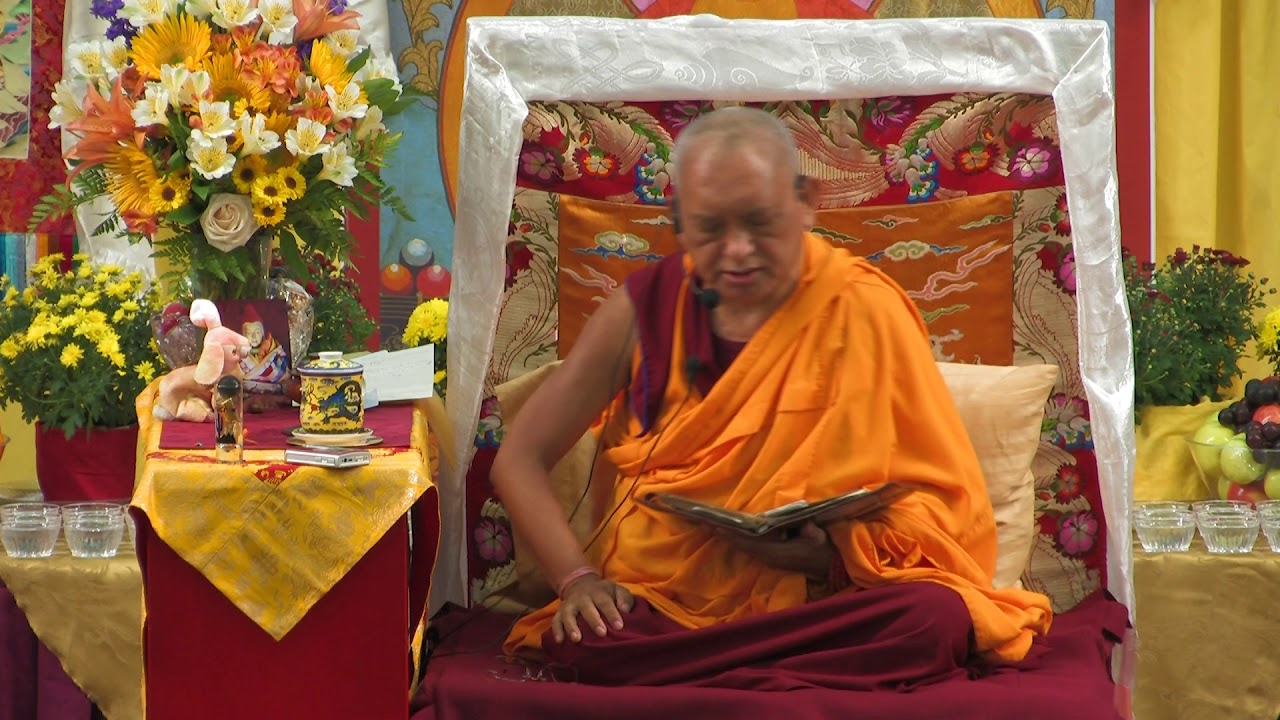
20090917 LZR LOP LamaChoepa Instructions on the tunes ENGLISH
So this is, so the chanting, usually the chanting is, came from, each monastery, sometimes their own, the one who founded the monastery, the great lama who founded the monastery, seems like that, sometimes like that, lineage comes from that. Anyway, usually some great lama like, for example, Pabongka, who’s not only a great bodhisattva, but who was a great yogi, I mean, actual living Heruka, like that, living Heruka, enlightened being.
So then, some of the chantings, like the, there is a special chanting of the Spring Queen. The usual chanting that we do, I’m not sure that’s from Pabongka, I’m not sure. But there’s one special chanting of the tsog, Ting dzin ngag dang chhag gya jin lab…, the tsog, and that’s from Pabongka.
It is said, the chanting was found between, coming to Lhasa, from Gaden Monastery to Lhasa, or, either from his monastery to Lhasa, or from Gaden Monastery to Lhasa, on the way, found, so it means some dakinis may have chanted or something like that, then, so it’s on the way found the chanting, that’s what’s said, maybe dakinis chanting, or something like that.
There’s a special chanting of Ting dzin ngag dang, the offering tsog. At Kopan Monastery, sometimes Lama Lhudrup does, because he started from the gekyö-la, the attendant of the Pabongka, the great Pabongka, in who, author of the Liberation in Palm of Your Hand.
Many monks, Geshe Jampa Tekchok, and who was ex-abbot, I mean abbot of Nalanda Monastery, France, not Nalanda in, this, many hundred years ago. Not that one. Nalanda, in France, which we created. Not that one. Nalanda, in France, which we created. So quite a number of monks, their chanting was learned from gekyö-la, who is the attendant of the great Pabongka Dechen Nyingpo, author of the, who did benefit to the teaching of Buddha and sentient beings like sun shining in this world, like that, unbelievable teaching?all the?time, not only sutra but tantra, from the, totally from the experiences, so that’s commonly used, those commentaries, deity, very commonly used, as I mentioned the other day.
So some of the chanting is from Pabongka, and some of it from, heard from dakinis, things like that, so there are quite, from great yogis. So, either they made it up, or they heard from dakinis chanting. So there’s a lineage of that. So by doing that, you receive the blessing of that lama, so that, daka-dakinis or the lama.
So you receive, there’s a lineage and you receive the blessings of that, so many of the chanting’s like that. So it’s kept exactly like that, try to keep like that. So then, of course, Lower Tantric College, Gyuto, Gyume, Lower Tantric College, Upper Tantric College, then, of course, they have their own lamas,?Jetsun Sherab Senge or Jetsun, that’s Gyume, but Gyuto, I don’t know, I’ve forgotten now,.
So anyway, there are different lamas, so found the monastery, and so they follow the, exact way of chant, the lama’s chanting. So I think there’s that. So it carries the bless-, so, of course the lama, of course they’re highly attained beings, so of course it comes from their bodhichitta to benefit for sentient beings, so of course it has great benefit to the sentient beings. So it’s not just a magician person made it up, not like that.
Chanting came with great qualities, bodhichitta, compassion, loving kindness, bodhichitta. So, with all these qualities, realization of emptiness. So it’s a great blessing. Then of course tantric realization, they have, so, to benefit for sentient beings.
So therefore, it’s a great benefit, by doing those chantings, so that, okay. So, okay, so it’s good that, some, kind of some valid, some references. So of the chantings follow according to Kyabje Song Rinpoche, basically, sort of like that, who, great, lineage of the perhaps with chantings, so that.
My root Guru, Kyabje Trijang Dorje Chang, then same, from Pabongka, like that. So much, Lama Chöpa that much already, so like that. After the tea offering, that chanting I’m not sure from where it came. I have no idea. Maybe my own chanting, I’m not sure.
After inner offering, tea offering, in the Lama Chöpa, that chanting, must be from some chanting, but I don’t remember the lineage, okay. So, basically, Kyabje Song Rinpoche, probably, from his guru, lineage from Pabongka, all that, okay. But different monasteries, so they have different, say, lama, the lama’s lineage, you have to understand that.
It doesn’t mean one chanting, that everybody have to chant like that, otherwise, if you don’t chant that, then it’s wrong, not like that. So okay, so it’s good, when the chanting’s done, you mark on the prayer book, voice go up and down, like that, you draw, like the rhythm of the music, go like that.
Then that helps, easy. Without knowing that, it’s a little bit difficult. So, however, so any sentient being hears your voice, Due to three-time merits collected by oneself, three-time merits collected by others, so then anybody who hear your voice chanting, then immediately become healing for them.
All their physical suffering, mental suffering, whatever it is, immediately get healed, okay. Then it purifies all the defilements, negative karma, collected from beginningless rebirth, okay, Then, especially, cause to develop Guru devotion, root of the path to enlightenment, then renunciation, bodhichitta, right view, immediately actualize that, and then two stages of tantra.
So, the chanting affect the mind, very deep, like that, okay, renunciation, bodhichitta, right view, then tantric realizations, to achieve enlightenment as quick as possible. The minute when they hear your prayers, internally, they get realizations, so we can dedicate like that.
That’s good to dedicate like that before chanting, okay. So according to Pabongka’s tradition you do the, you don’t do the, you don’t do the De chhen ngang la rang nyi la ma lha, even though normally, commonly, done that way, but here, Rab kar ge same chhen poi ngang nyi na…, the motivation for refuge, you start from there, that’s according to Pabongka’s tradition, His Holiness Song Rinpoche and His Holiness Trijang Rinpoche.
But very commonly, De chhen ngang la rang nyi la ma lha, start with that. So here’s, I try but my chanting is not very stable. It can change. There’s somebody who’s chanting very big then I, then, my chanting changes, because influenced by that. So the Guru Puja, okay.
So, according to His Holiness Song Rinpoche, so most of the chanting’s, you start with Oh, not Ah, not Ah, Oh, like this. Perhaps this is maybe not nun’s voice, this is maybe monk’s voice. I’m not sure. Not Ah. I mean, there might be some other times, Ah, but it’s Oh; it starts with Oh, not Ah.
So, a man’s voice bigger than nun’s. Woman’s voice is very fine and high. So, you don’t have to copy exactly woman’s voice, you don’t have to do that. You just keep your normal voice. So otherwise, it becomes a little bit strange. But woman’s voice, it fits to women; man’s voice fits to men.
So like this, okay, I try one more time. So what goes up and down, if you mark, then it’s good. So, ge-e sem, chen-ye-n. Then after dag dang kha nyam ma, ma-a gan. Deng na ji si jang chhub, so doing the same thing. Lama kon chhog sum, sum-oo la, so, after I mention then I chant again, then you get idea.
Then quicker way. That’s quick way of doing it. So now chanting. So you have to pay attention what goes up and down, okay. Na-a-m-o-o. So the between, you have to write down the between the tunes. So like that, okay. Yeah, that’s one you know. So you have to get, the chanting between the words, that, so write down, so then you get.
So, that chanting.
So where to stop, that’s kind of precise. So that. That’s it, anyway. So the elaborate way this, then, from Yamantaka, Yamantaka sadhana, this, before you meditate on dharmakaya, yourself, and the merit field, then deity, then other than that, all the phenomena, then because it’s merely imputed by depending on, depending on means depending on the base, it is, that is free from, it is devoid of four extremes,.
The extreme, nihilism, and so forth, four, say, ah lay, it’s not here. In the Yamantaka sadhana, written down there. So, say, not inherently existent, then not nihilism, not non-existent, then, not both, neither both, it doesn’t exist, which is both, like that.
Neither that nor, last one is labeled inherently existent, nor inherently existent, both; hts, neither both, the last two, truly existent, and then nihilism, both existing, devoid of that. And also devoid of neither both. So devoid of neither both, yeah, hts, neither both, nor neither. But the last one, because it is, last one is because nor, neither, hts, say, so that one, you have to add truly existent, last one you have to add the word “truly existent.” Otherwise, then it becomes complicated, truly existent.
The last one you have to add “truly existent.” I don’t remember now, so forgotten. But the last one you have to add, otherwise become complicated, you have to add “truly existent” to that. Neither truly existent nor, truly existent, non-eternalism, non-nihilism. So, truly existent eternalism, and nihilism.
It is non-truly existent, say, non-eternalism, non-nihilism. So, that’s just my, just memory, the last one you have to add that. So, then, you say that, then you do the mantra. If you’re doing elaborate way. This is, in the Yamantaka sadhana, the mantra comes first, then, OM SVABHAVA….
then then becomes, the I is not self, empty of the, no self, dag me?pai, then nature, empty. So you do that, in sadhana comes, mantra first, then after that. But His Holiness advised during commentary, you do the, you do this first, then do the mantra afterwards, OM SVABHAVA….HANG, then it’s more suitable for meditation, that’s what Rinpoche said.
So the idea of changing is that, His Holiness advised. So like that, okay. Then generate, by meditating on dharmakaya, then generate. Of course, what it contains is the, replica of Guru Shakyamuni Buddha absorbed into you, you become Buddha, and then, of course, from the pores, beams emitted, then carry buddha, above each sentient being’s, above each sentient being, purified, then they all become buddha, the?enlightened, then all the buddhas we transformed, absorbed back.
Then the merit field absorbed, the Lama Thubwang Dorje Chang, there’s no Lama Tsongkhapa, it’s Guru Shakyamuni Buddha, Vajradhara, then at the heart, there’s HUNG. So, absorbed to you, then from blue light _______, and then, become Yamantaka, you send beams, then everyone become Yamantaka, and then they absorbed to you, then you absorb that, then you twenty-five absorptions, then dharmakaya meditation, the HUNG absorbed, then gradually then dharmakaya meditation.
Then, then you arise from that, after you meditate dharmakaya, then there’s the sambhogakaya, then nirmanakaya, Yamantaka, like that. Then, you do De chen ngang lä…, then De chen ngang lä…, the elaborate way, do that. Then, the elaborate way, like that.
Short way, then, after you finish bodhichitta, the special bodhichitta, the second one, the special bodhichitta, to practice tantra, then after that you go to De chen ngang lä…, so that is the short way to do. But in the meditation it’s contained, so here.
Then, OM AH HUNG. So then after that, then you bless the inner offering, blessing the inner offering, that, then you do, then, you bless inner offering, then you bless the offerings: OM ARGHAM…., this, dispelled, and purify in emptiness, then generate offerings, like that. OM ARGHAM, PADYAM, PUSHPE, DHUPE, OM ARGHAM, PADYAM HUNG PHAT, hts OM ARGHAM AH HUNG, OM PADYAM AH HUNG, OM DHUPE AH HUNG, OM ALOKE AH HUNG, OM GANDHE AH HUNG, OM NAIVEDYA AH HUNG, OM SHAPTA AH HUNG.
So the offering, OM ARGHAM AH HUNG, OM PADYAM AH HUNG, OM PUSPHE AH HUNG, OM DHUPE AH HUNG, whatever, or the short one, So the short way. So that. So OM ARGHAM AH HUNG, OM PADYAM AH HUNG, that is blessing the offerings, with the deity’s, the holy body, nature of the holy body, holy speech, holy mind, so it’s blessed with OM AH HUNG there.
So short, OM ARGHAM, PADYAM, GANDHE….SHAPTA SOHA. So, then, if you do that, then there’s at the end, RUPA, SHAPTA, there’s RUPA, SHAPTA, there might be RUPA, SHAPTA. Then GANDHE, RASA, SPARSHA HUNG. GANDHE, RASA, SPARSHA, there’s five objects of desire at the end, after the eight sets of offerings.
But one text, it says, but one text it says, here, say, only the, OM ARGHAM, PADYAM, GANDHE….SHAPTA AH HUNG, then RUPA, SHAPTA, didn’t have the rest. I saw one text like that. Anyway, so, so the, so basically, like that, elaborate way. Then, after that you do NGO WO YESHE LA…
Then De tong yer me lha lam yang par…, the second merit field. I’m not going to do the whole thing, just start, just the elaborate one.
So that. So, if going slow.
So there’s number of words, where you stop. So even though I didn’t recite all, but you get idea how many, after how many words: De tong, yer me, lha lam, yang par, so I think it’s de tong, yer me, lha lam, yang par, eight, then you stop there. Then Kun zang chho trin…u is just one.
Then Lo ma me tog…dze, stop there. So that is one thing to pay attention to that. So Kopan normally chants that, because the umdze does very very high voice, anyway, so that’s normally chanted at Kopan. So anyway,. I hope they’re not watching. Anyway, so, then there’s the middle one, His Holiness Song Rinpoche chant the middle one.
Usually, Song Rinpoche does that.
So the purpose of introducing this is, I think, because I think one center, I think, somebody asked Lama Chöpa to do, then somebody replied, oh, because I think, usually how long it takes? One and a half hour, or two hours? I think what time, what they have is one and a half hours, so, somebody asked to do Lama Chöpa, so they said, no, can’t do because it takes two hours.
So it’s very silly. because the person knows only one idea, the person has only one idea of chanting, so you can’t do longer time, you can’t do shorter chanting, so it’s very important to get an idea, according to the time you can do elaborate or you can do short, or you can do middle, short, so good to know that, so you can do the Lama Chöpa according to the time.
Thupten Jinpa, the translator for His Holiness the Dalai Lama, he finished Lama Chöpa within five minutes. I think it’s his commitment. I don’t mean public reading, I think it’s commitment, five minutes. So you can do that, too. Maybe you get lineage from him.
Okay, so now next one. The time, it’s okay, finish? Okay, so Phun tshog de leg jung na du sum gyi. So this one, the chanting’s from Ganden Shartse. This one is from His Holiness Song Rinpoche, Ganden Shartse, His Holiness Song Rinpoche’s, this particular chanting, that you don’t hear normally.
But, of course, I try to chant, but, of course, my chanting’s, of course, you have to know it’s not well, not right, but just trying. So, again, according to Pabongka Dechen Nyingpo, then, Cho nam rang zhin, you start from Cho nam rang zhin, the last stanza, the last one, but this according to Kyabje Pabongka’s instruction, like that, Cho nam rang zhin, you chant that, then Phun tshog….
So, we try. So, to fill up the, between, you have to fill up the between tunes, okay. So at the end, don’t stop, at the end goes finer. This last part,,
so you go slowly. You don’t go immediately higher. You go like this, slowly, then you go higher, then, there’s, go up, then, one curve, two curve, three curve, like that, go up, then one, two, three, like that.
So that’s it. Then, of course, then you can do the normal one.
Just to chant one, one stanza, that this one.
So that. So the short one. I mean the middle one,
Then quick one is: That means you’re hungry. Something, hungry or something. You need to go somewhere quickly. You need to go to bed quickly. Anyway, so, Kyab gon je tsun la ma…, then we’ll stop there, okay. The Gang gi thug je…, the first one like that. And then, second one, ring the bell, third one, turn], turn, like this.
So that has great meaning. So your Guru is guiding you to enlightenment, by, out of dharmakaya, manifesting sambhogakaya, nirmanakaya, so, it could be secret, but I’m not sure. Anyway, that means, it’s secret, the meaning the mudras. Anyway, so then Guru guides you like that.
Then you, I think, that meaning. But I think, also, then you also guide sentient beings, when you become enlightened, then out of dharmakaya, then, the sambhogakaya, then the nirmanakaya, you guide all the sentient beings, out of dharmakaya, like that.
Then sambhogakaya, nirmanakaya, so, these mudras have great meaning, that. So you remember, at the beginning, remember at the beginning, then that, yeah, probably, I’m not sure, maybe not something to reveal, perhaps who haven’t received Highest Tantra initiation, so maybe I’m born already in the lower realms.
So have to confess.. Then the middle one. Then quick. So we stop there, okay. Okay. Jang chhub sem chhog rin po chhe…. Ge wa di yi….
Sign in to keep private, timed notes on this talk. Only you can see them.
Public comments
Public: open to everyone signed in. Your private notes are in My notes.
Sign in to join the discussion.
Teachings from Light of the Path 2009. Kadampa Center, Black Mountain, North Carolina, USA. Transcript: https://fpmt.box.com/v/LOP2009
- Teacher
- Lama Zopa Rinpoche
- Centre
- Kadampa Center
- Recorded
- 17 September 2009
