 Free5:40:40
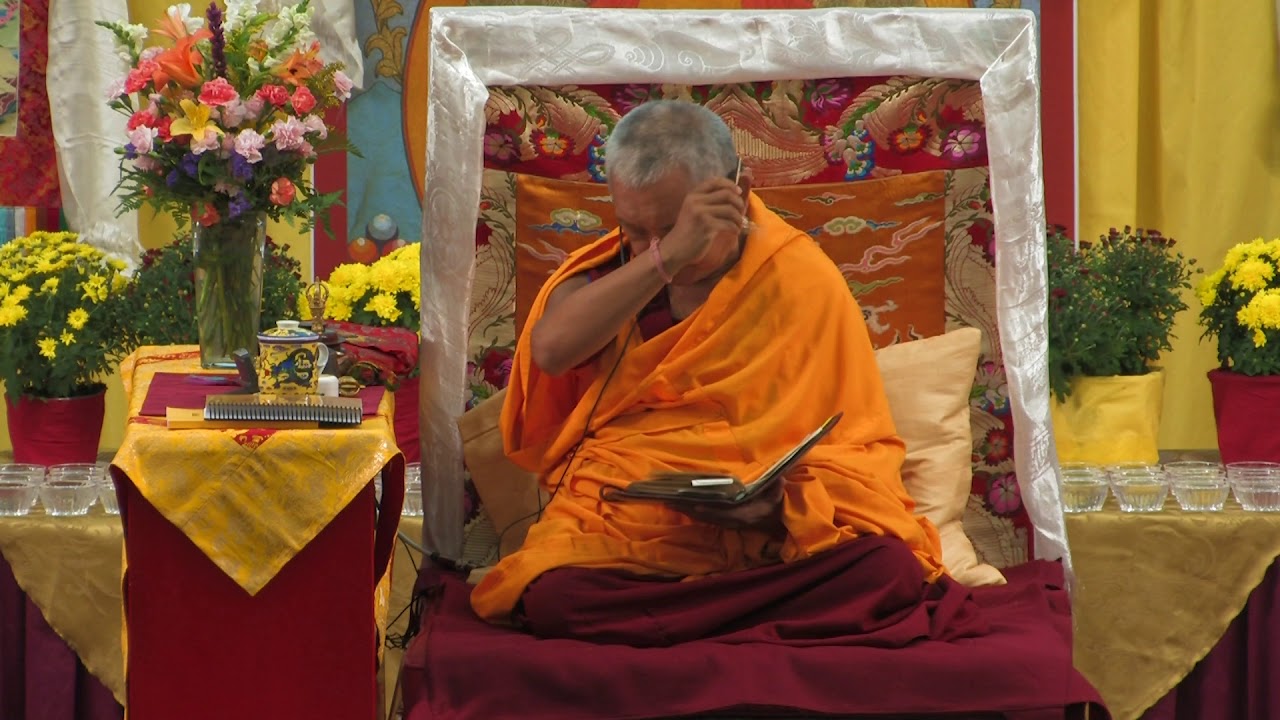
20090911 S2 and S3 LZR LOP How to start your day ENGLISH
So today the diabetes, I don't mean to threaten you, but just diabetes, went a little bit up. Trying to progress, instead of realizations, diabetes. What should be the realization increasing. So, say, myself didn't, in the, say past many, many years, we do so much Eight Mahayana Precepts, so many in the past, so they take, the teacher take and then give, so, today, I didn't do, I stopped doing that for last few years since the diabetes happened.
Well, the idea is you're supposed to, after each four hours, well, you're supposed to eat a little food, and then break four hours, and then eat another small food, so it makes, that makes you extremely hungry, that makes soon hungry, so you have to eat small.
So I'm joking, anyway. So, I didn't do for last, I think, for quite some time. Then, I received the lineage from many lamas: His Holiness the Dalai Lama, then His Holiness Kyabje Serkong Tsenshab Rinpoche, especially, Kyabje Serkong Tsenshab Rinpoche, could be also from Kyabje Song Rinpoche, I'm not sure.
But I received many, so, lineage is there, say, but didn't take the actual, myself, the vow, so, so this, so, may not be perfect, so, so then lineage there, but to be more perfect, then you?do that day. So, did fasting in the past, in the past, in the early times, for a long time, did at Lawudo and Kopan, normal fasting did.
So this, also the Eight Mahayana Precepts, I did Eight Mahayana Precepts taken, lots in the past. But since I got diabetes, didn't have much. So that's the news. I'm not sure it's BBC or CNN. I think Sherpa News. from Namche Bazaar! So trying to finish some preliminary, that was the idea.
So, many people has this idea already, but, but some may not have learned this,
just to finish some preliminaries, what you do in the morning, daily, normally, what you do in the morning, so in the beginning. So, I hope everybody understood that, the other day I read some Bodhicharyavatara quotation. So that's a little bit longer version, then the last, the short version, which includes everything.
So that is to, after the bodhichitta, after the first thing, morning bodhichitta motivation, then, that's to be joined at the end, to dedicate your life, to live your life for sentient beings, others, who are numberless, and who do not want suffering, who want happiness, just exactly as yourself.
I want to mention again, that maybe did not become very clear, by giving up the, admiring samsara and entering, engaging in that, and thinking, looking at samsara good, and samsaric happiness, real happiness, then, not looking at suffering, then, samsaric perfections, all the enjoyments, everything, so there remember from the, what Guru Puja, the quotation, bring there, looking at it beautiful, a happy park.
So because of that, being attached to that, then you have been suffering from beginningless rebirth, from beginningless rebirth up to now. Why still we're suffering? is because of that, from, to, did that from beginningless rebirth up to now. And, that, nothing new, this suffering is nothing new, any problem is nothing new, this is not the first time, this is numberless one, this is numberless, this is nothing new, and any pleasure is nothing new, so, remember that, any samsaric happiness is nothing new, this is numberless, one, this is one, say, experienced from beginningless rebirth, any samsaric pleasure, so any pleasure is nothing new.
But something you didn't have in this life, maybe new in this life, according to this life, maybe new, but not new, for you, whether you have that experience or not and in the past, you had that numberless times, whether it's suffering of samsara, whether it's a problem, or whether it's pleasure, so that.
So the, say, I don't know what. Anyway, whatever pleasure it is, I tried to think some examples, but I couldn't, not because I see it is suffering, I'm not talking that, I'm not advertising that, I'm not saying that. Anyway, whatever you think, whatever each individual what you think, pleasure, okay, that you like, samsaric pleasure, so nothing new, it's not the first time, this is not the first time, numberless experience from, so whether it's a relationship, whether it's anything, whether it's going to the moon, anything, by, through the rocket, going to the moon, without machine, or with machine, going to the moon, okay.
So, anyway, I don't know what else, so, whatever each individual think, pleasure one, say, samsaric pleasure. So anyway, so like that. So the problem is that, because being attached to that, looking at it real happiness, being attached to that, then so far die and reborn, experience suffering of that realm, so like this numberless times.
So, most of us we don't remember, and those some, those some who developed clairvoyance, more reliable one, developed clairvoyance, well, through shamatha, or through, the, I mean also through tantric realizations, the Six Yogas of Naropa, achieving those, however, whose mind become more, through purification, more you purify the mind then, like Dromtönpa, as you remember, so, like when Lama Atisha took aspect, the sick and diarrhea, the pee-pee, ka-ka, say, the holy pee-pee, ka-ka, the Tibetan has an honorific word, I don't whether you have honorific word in English, but Tibetan has?so gya, anyway, it doesn't matter, well, for urine, I'm not sure.
I don't remember for the urine, but ka-ka's?so gya, in the, the language. So, anyway, holy pee-pee and holy ka-ka, okay. So, on the bed, and then took aspect like that, then Dromtönpa, who was embodiment of Compassion Buddha and the first incarnation of His Holiness the Dalai Lama, so in spite of, without the slightest thought of it, that's dirty, without slightest thought of, that's dirty, then with full devotion, Lama Atisha, see Buddha, then cleaned with the hand, so like that, so offer service like that, And then, I think, offer service like that.
So, during that time, then Dromtönpa, holy mind, is, has the, anyway, so it is said in the guru devotion teachings, mentioned that doing, offering service like this, then, suddenly able to see, able, can read, even the ants, the creatures, not only human beings, even the creatures, their mind can read, up to eighteen days for eagle, when the eagle flies, it takes eighteen days, so up to that, all the creatures, even ants, all the small insects, creatures, whoever there, distance, up to eighteen, which takes eighteen days for the eagle to fly, so could see their mind very clearly, could read everyone's mind, very clearly, so like that.
So the, by doing service, so there are many other stories like that, not only Dromtönpa but others. So, say, so, not only seeing past, future, but even like that, others, for eagle, which takes eighteen days, then all those living beings, even insects, everyone's mind can read very clearly, so that. So, by purifying the mind, then you're able to see.
So of course, with the guru it's the most powerful one, so, yeah, so can see, can remember past and future, many hundreds, thousands, so more, I mean, more and more, then, as you also proceed in the path, so, and then as you actualize the bhumis, the five paths, ten bhumis, the bhumis, it's most amazing.
So anyway, so what I'm saying is can remember, the past, so much, thousands, billions, zillions of life, whatever, with all the experiences. So, you can remember, then, being in the lower realm, even in the human realm, the most unbearable sufferings, I mean, so much.
It's something you can remember, wow, can't stand even one second to be in samsara, can't stand, can't bear, even one second being in the samsara. It's like being in the center of the fire, being in the very center of the fire you want to get rid of right this second, you don't want, right in this second, don't delay even one second, being out of the fire, so like that.
So it's, but we do not remember. Our minds are so blocked, so obscured, don't see, so can't remember past, can't see the past life, those unimaginable sufferings. Then also, that's one thing, but then also, if you're able to see the future, future life, future lives, not just future life, but future lives, then again, same, all the sufferings, wow, the sufferings of six realms you have to go through, can't imagine, can't imagine, totally. Again, same thing, can't wait, being in samsara is totally scary.
So to reincarnate again in samsara is totally, that's totally scary, unbelievable, most terrifying, to be born, to reincarnate again in samsara. So don't want even one second to be in samsara, so, like a prisoner caught in prison, so don't want to be even one minute, second in the prison, unbelievable, unbelievable sad, want to get out, so that. Anyway, so these are in the, we have also the FPMT, International Office, the Prayer Book: So, reciting this seven times, then you blow over, you recite this seven times, so that whatever virtue is done, then it increases one hundred thousand times. So, it is mentioned from the Sutra the Complete Dedicated Chakra, so that.
Then the, OM RUCHIRA MANI PRAVARYATA HUNG, this recite seven times, and then you blow over the mala. So, if you do that, then the, whatever mantra you recite, talking about buddhas, tathagatas, so then, it increases, they increase, then how much they increases?
Ten millions, ten million. Then, that ten million then becomes, one hundred billion traktrig, I already mentioned two times, already. First, ten million, then ten million increases traktrig, the ten times or one hundred million, one trebum, then, ten trebum is a great trebum, ten great trebum is one traktrig. So I don't know what you call, so, is that one hundred billion, a billion or one hundred billion?
Ten million? Ten million. Huh? It doesn't matter. So you can figure it out. I think one hundred billion or something, so, anyway, you can figure it out. Because always caught in that. So ten million increases, traktrig, then even the traktrig becomes, traktrig increases a hundred times, traktrig also increases a hundred times.
Then, that increases a thousand times, something like that. It is taught from the?Nor Gaiwai Shel _____ Kang, Sutra,?Nor Gaiwai Shel _____ Kang N_, A Celestial, hts, Unfathomable Shel Mai Kang, Unfathomable House, say, Unfathomable Celestial Mansion Developing the Jewel, from that sutra.
So these are things, these are kind of things that Buddha, so compassionate, so compassionate to us sentient beings, so Buddha taught these, from compassion, these powerful mantras that, how to make our merits, us sentient beings' merits, to increase.
Then even recitation of mantra, even you recite one, how it become so many number, so out of Buddha's compassion, basically to liberate us from oceans of samsaric suffering quicker and bring us to enlightenment. And then OM KHRECHA RAGHANA HUM HRI SVAHA.
So by, if you recite, say, there's some texts say seven times, here it says three times in the morning. Then if you blow under your heel, you spit, not only blow but spit, you spit, after you chant it, then spit, and then that day, then any animal, any insects that died under your heel, under your feet, they all will be born in the Thirty-Three Deva Realm, the sura realm, Thirty-Three Deva Realm.
So which sutra, then here, here in the prayer it doesn't mention from which text, that's very important to mention which, so it has pure references, to quote to a sutra text. So, found, from other texts, it says from root, from Tantra, root Tantra, Manjughosha Root Tantra, Jampel Tsai Gyu.
So this is very good that, say, if you are walking in the forest, if you're walking in the forest or if you're walking at the beach, when you're walking at the beach, where, on the sand, there's a lot of insects, there's a lot of crabs, there's a lot of small crabs, those small tiny crabs, wow, so many at the beach, so many.
So, well, if you're walking over the grass, if you're walking over the grass. So it depends on the land, if you're walking over the grass, say, forest, so in these places where, if you're walking over, there's just so many insects, unbelievable insects, they jump when you're walking.
So, anyway, can you imagine, in the road, when there's sunlight, you see so many tiny, when there's sunlight,?here, the sunlight come through, so many tiny insects, but then when you're beyond from the sunlight, you see nothing. Did you notice that?
huh? Yeah. So when the sunlight's there, a little bit of sunlight, so many, but then when you cross that, when there's no sunlight, nothing you see, oh, like that, can imagine? There is there, but you don't see it. So, like that, amazing, unimaginable.
So, when you walk, they will be so many insects. So many places I have seen, Italy or somewhere, so when there's sunlight, or even here, somewhere, recently I saw, where there's some sunlight, you see so many, but when you're beyond, then you don't see, because sunlight's not there, so you don't see.
So, so that's amazing, that really reminds how your human body is so precious, how your human body is so precious, that you have received now. So that shows, this is so rare, that's uncountable number, uncountable number, even relating to those tiny insects in the grass. So shows this, your human body is extremely rare.
Then this, I mean the opportunity what it has, what your human body has, gives to you, wow, can you imagine? You can achieve all the happiness, say, happiness of future, all the happiness of future lives, you can achieve, can't imagine. To be born in a pure land, Amitabha Buddha's Pure Land, or Lama Tsongkhapa's, Maitreya Buddha's Pure Land, or Vajrayogini's Pure Land, however, all those deities, Tara, Tara's Pure Land, Tara.
However, then to be in a pure land where you can become enlightened, then, where you can be free from the lower realms forever. Then, you receive the, wow, eight ripening qualities, the human body which has eight ripening qualities, that Lama Tsongkhapa very much advised, emphasized that you can have very easy, quick, say, development of, say, achieve realizations, if you achieve these eight ripening qualities.
That, then the human body which has seven qualities to practice Dharma, to have result, to achieve the realizations, easy. Then you have the Four Mahayana Dharma Wheels, future lives, Four Mahayana Dharma Wheels, that: Relying upon, able to find a Mahayana virtuous friend, and able to rely on that.
Then able to be in right conditions, born in a family, a Buddhist family, or however, the family that harmonizes you, and don't interfere, harmonizes your practice, Dharma practice, support, so harmonized to that, and then place, place where you meditate, harmonized to that, nothing harmful, so like that, support, very helpful.
Then having collected merits, and having done prayers, collect merits, to achieve realizations, so like that. So anyway, then perfect human rebirth, eight freedoms, ten endowments or ten richness, so, like that. So any, whatever happiness of future life one wish, oh, say, can achieve that.
Then liberation from samsara, then full enlightenment. Then you're able to, also to cause to other sentient beings happiness of this life, with this human body, this, say, incredible the intelligence of the human, say, what can be developed, what you can do, skies of benefit, happiness, you can cause to other sentient beings, happiness of this life, then happiness of future lives, to the sentient beings, then the numberless sentient beings, happiness of future lives, then liberation from samsara, then full enlightenment, can you imagine, can't imagine, what you can do with this perfect human rebirth, wow, so like this.
So this, so this is really, so, as I mentioned the other days, most precious than whole sky filled with, not only diamond, gold, but wish-granting jewel, filled the whole sky with wish-granting jewel, okay, so that. That much wish-granting jewel and your, this precious human body is much more precious than all that.
value is nothing when it's compared to your precious human body, which you can't, can't achieve just by having even sky filled with wish-granting jewel you cannot achieve, can't achieve all this, this, just having that. So, all this happiness of future lives, liberation from samsara, then enlightenment, you cannot achieve, you can't achieve those realizations just by having that.
So anyway, so to not, so therefore, to not waste, to, so what Lama Tsongkhapa mentioned in The Foundation of Good Qualities, taking the essence all day and all night, that's what we have to do. Lan chig nye pai dal wai ten zang di, Lan chig nye pai, the one time found, one time found, dal wai ten zang, this good body, this good body of freedom, or this good body which has freedom, Lan chig nye pai dal wai ten zang di, this time, while one has this.
Shin tu nye ka don chhen she gyur na, By realizing how this is extremely difficult to find, how this is extremely difficult, to find, and that this is, say, extremely difficult to find this again. Then when it it's found, it's?don chhen she gyur, it has great meaning, it has great meaning, so, extremely difficult to find and has great meaning, by realizing this.
Nyin tshan kun tu nying po len pai lo, Gyun chha me par kye war jin gyi lob, So please grant blessings, that refers also to know what I just now mentioned, to know all those things, how this is special. So then, last one, Nyin tshan kun tu nying po len pai lo, Gyun chha me par kye war jin gyi lob, To rise, say, to arise unceasingly the thought taking essence all day and night, It doesn't say only when you're happy, only, doesn't say, only when you feel good, or when you're in a good mood, doesn't say that.
It says all day and night, so must pick up the all, this, pay attention to that, so to arise the thought, unceasingly, the taking essence all day and night, okay, so that. So the, taking Eight Mahayana Precepts is, this is another one, this is how to make life meaningful, if you want to know how to make life meaningful, taking the essence, all day and night, oh, taking Eight Mahayana, taking this, taking vow, example, the Eight Mahayana Precepts, which we did today, and this is so sim-, it's so easy just for one day, just for one day, makes it so easy, not lifetimes. So, of course you can take Eight Mahayana Precepts lifetime, okay, you can take, of course, lifetime, if somebody wishes.
So, this, as a lay, living in the five lay vows, until deathtime, and if not five, then four, if then not three, then two, if not just one, that's for the lay vows. Then the taking the Eight Mahayana Precepts, we have this unbelievable fortune to take the Eight Mahayana Precepts, which is for one day, which has skies of benefit, collecting merits, unbelievable purification, so that's mentioned in the benefits of the Eight Mahayana Precepts.
I mentioned yesterday the, last night mentioned the quotation from?Do Ting Ni Dzin Kyi Gyalpo, The King of the Concentration, Sutra of the King of the Concentration,?Do Ting Ni Dzin Kyi Gyalpo, the quotation I mentioned last night, keeping one vow in one day, how much merit, can't imagine, good karma you collect, I mentioned last night.
So don't disregard that, Buddha's quotation is very important, so I said last night to write down in your prayer book or in your notebook, I mentioned, in your "diarrhea book,", so anyway, to remind you, to remind you. Otherwise, even the lama said, that's it, you heard, but didn't understand completely, or, so didn't, not made it useful, what the lama said, didn't make it useful, so even didn't get the whole idea.
So that's so precious that quotation. Kyabje Ribur Rinpoche kept this, he kept this quotation in his prayer book, he showed. One time we did Vajrayogini self-initiation at the Aptos House, so at the end, when it's finished, then so at the end, when it's finished, then Rinpoche showed us this quotation.
There were a few of us, I think, yeah, a few of us who were here, I think. So Rinpoche show us, so like that. Of course, himself, doesn't need to keep this, he's beyond, doesn't need, buddha doesn't need, buddha doesn't need vows, buddha doesn't need discipline, there's no delusion, there's no delusion, there's no hallucinated mind, there's not even subtle defilements, there's not even subtle defilements, so buddha, so there's no harm to the sentient beings, him or her.
In English you have to say, him or her. In Tibetan you don't need, in Tibetan language you don't need to say that, you don't need to say her or him always. Anyway, so anyway, so, buddha doesn't need, so, so that. It's very important to keep it in the house, and even at the altar, or where you work, office, so to keep this.
So, anyway, I'm not going to repeat again tonight. Then somebody want to know, you get it from somebody who wrote it down, okay. So, you nicely write down with your good handwriting, whatever, so anyway, so put there at the altar, or, I mean dining room, or wherever.
So, it is very good to have those instructions, Dharma messages, instructions, to put around the house, so it's good for reminding, or in your prayer book. So anyway, so this is one, say, so one thing is, then especially Eight Mahayana Precepts, like that, for lay and for ordained person.
so normally the vows, taken until, pratimoksha vows until death time; bodhisattva vow is taken up to enlightenment, then the tantric vow. However, so, those who have taken pratimoksha vows, like nun or monk, taken lifetime, then the but all the, even one is able to keep the major ones, major vow, basic vow, but the branches unable to keep pure in the whole lifetime, so, but when you take Eight Mahayana Precepts, it's just for one day, or a few days, so however, so then that day, then you must keep very purely, as much as possible very purely, not half and half, not half and half, or taking the vow but then not sure that every single that is practiced or not, kind of not like soup or a salad, not like soup, soup and salad, soup and salad, okay, not make soup or salad, then,
I don't know what other one. So anyway, make sure everything kept pure, that. So that day, that helps also the normal vow, also to keep pure in that day, because by taking Eight Mahayana Precepts, fasting, all that thing, so it helps also the other vows that, the daily vow, usual vow that is taken, so it helps for that, anyway, also helps that to be pure.
So when we think about making life meaningful, one extremely important one, that, one extremely important one, so must, say, the key things must be write down, make sure you get done that, so don't miss. Otherwise, sooner or later, life is distracted this and that, goes on like this, of course, there's so many distraction in the life, I mean depending on how much distraction we have in the life, depends on, depends way of thinking, depends on how one think, depends how much worldly concern one has, how much you have worldly concern one has, so depends on that.
Depending how much you become friend, you become friend to the worldly concern, depends on that, so, how much distraction in the life, not allowing to practice Dharma, so that, unable to practice Dharma. So I think, then, sooner or later, one day, sooner or later death came.
Sooner or later, then, all your, like ____ and distraction, empty, and suddenly death came, finished. Life totally change, total change at the house, total change, like something else, total change. So anyway, then about to die, then, no time, so how much you regret, "Oh, I should have done that, I should not have done this, I shouldn't have done that," then that time all the sadness, I should have done that, I should have done many retreats, I should have done, then, abandoned this, lived in pure Dharma, and so then thought comes, ____ _____ no time, so only sad, then feel so unbelievable sadness, then worry about the lower realms, what's going to happen after this.
Expresses, because karma, the karma expresses, so the feeling. As I mentioned, even a non-believer, non-believer, who doesn't believe in reincarnation and karma, intellectually, doesn't believe, but when the time, but there's, near the time of death, however, there's a feeling that something very terrible thing is going to happen to me, so there's fear.
Even though intellectually you don't believe in reincarnation, karma, so I see people like that. That, that happens also when, not only when the death comes to you, but when you see somebody, your family members, family member died, the parents, or somebody, relatives, living together, somebody died, then that makes you discover, that makes you think of life, that makes you think of your life, this is what happened, the person, suddenly it all changed, so then now that makes you to see your life, even that makes you to think, now I should not be engaged in this negative karma and distraction.
So I should be purely living in Dharma, so even that makes you to think that. When you see a family member die in the house, so it reminds you of pure Dharma. So, however, if you can become enlightened in this life, to be liberated from samsara in this life, well, all this depends on the root, foundation, higher training of morality, the basic thing is special insight, lhag-tong then the higher training of wisdom, that depends on higher training of the shamatha, higher training of the concentration,, then that depends on higher training of the morality. So So that's the very basic, the foundation.
so that in the, might be sutra. Maybe from sutra. I'm not sure. So the morality is basis, means morality is like the earth, earth, the living beings, who are moving, living beings, and the non-living things, and living things, movable and immovable, okay, then the earth is the foundation for that, morality is like this.
so one should hold, one should keep it, this foundation for aaaaaaaaall the qualities, from where you achieve, on the basis, then you achieve all the qualities up to enlightenment. So, hold it, keep it, firmly. So, that, so therefore, what makes life most productive, say, yeah, most meaningful, okay.
So, I think it's, I mean there's so many, just the Eight Mahayana Precepts there's unbelievable benefits, anyway, so I think we have been extremely fortunate in the Organization. Started from Kopan, started from Kopan, in the early times, I think from early courses, from very early courses.
I don't remember Eight Mahayana Precepts were taken in the first course, it's a five days' course, the very first Kopan course, I don't remember exactly, but later started. Maybe the second course, I think, so the Eight Mahayana Precepts, those times I was taking the Eight Mahayana Precepts many times, so it started, with the course, Eight Mahayana Precepts. So, in one-month course, two weeks, Eight Mahayana Precepts.
So that was fantastic. So that was really, I think that, I think that offer, able to offer that chance to the sentient beings, to the people who come for the course. Not only just sitting meditating, not only sitting cross-leg, sitting, not only that, but, that's, just sitting happens many times, many parts of the world it happen, many parts of the world, yeah, happen, many people do that, that external one.
Anyway this, so two weeks, one month, two weeks doing this, wow, and very strict, say, I mean, that's even one meal. So I think it's fantastic, wow, what, there's so much what to enjoy the next lives, this life and next lives up to enlightenment, wow, can imagine?
Hundred, thousand, thousand lifetimes happiness to enjoy, I mean deva, human realm, pure land, well, and up to enlightenment. And all the result, it's all cause to achieve enlightenment. Each vow that is taken with bodhichitta, cause to achieve enlightenment.
I think that's, the way we have been doing this, that we have been giving this opportunity to sentient beings, to people, from Kopan, from early times, from early times, that's fantastic, that's really yum-yum, that's yum-yum, yummy-yummy or yum-yum?
Huh? What you say? Yum-yum. So, so that's, I think, a really wonderful thing, wow, best gift, best gift, best gift to the sentient beings. I mean that, that we've been doing that, wow, that's most fantastic thing, making the life meaningful, unbelievable, unbelievable cause to achieve realizations of the path, nirvana, to liberation, to enlightenment, wow, up to enlightenment, what you achieve all the Buddha's qualities, limitless skies of qualities of Buddha's holy body, holy speech, holy mind, just really, so, due to Lama's kindness, Lama Yeshe, kinder than all the three-time buddhas.
Then, I think, Kyabje Serkong Rinpoche is the one who inspired nyung-na's, nyung-na, and the Eight Mahayana Precepts, who, say, inspired to do, so Rinpoche. So say, Rinpoche tried to explain the mandala, Chenrezig mandala, at Dharamsala, and, so to inspiring to do nyung-na, nyung-na. Then, Rinpoche gave a text, whole entire text, Kriya Tantra, the text, Cha Gyu?Don Shag Pema Karpo, a huge text, so that's extensive teachings on the Kriya Tantra vows, all the things about path, different meditations, and then the elaborate commentary on the nyung-na, so which I thought to translate.
Now I have received all the lineage, the oral transmission from Kyabje Khyongla Rato Rinpoche, a few years ago, so lineage received now. So anyway, so I think this is, so able to cause, make the life, everyone who come in the course make the life unbelievable meaningful, and the happiness, wow, up to enlightenment, wow, all the qualities of Buddha to achieve, can you imagine, sooner or later, and then, the benefit to the world, each person, by taking this vow, brings so much benefit to the world.
So as you remember, the Four Harmonious Brothers. So in India, the Kashika, I'm not sure, so there has been great success in the economy, rains come at the right time and crops grew, so plenty, everything is plenty. So then, everybody wonder, then, so king thought, "I did it," the minister thought, "I did it," many people, many of the leaders thought, "I did it." So then, one day they gathered, and then, so, one minister suggest, "Oh, we should go to ask sage,?tang song, who has clairvoyance.
Then they went to see the sage, and then asked, "Who, who did this," you know, "the development in the country. The king or minister, which?" Then the sage said, "No one of you, no one of you. It's because there's four harmonious brother animals living in the mountain, so this country developed because of them.
"So there's elephant, the elephant spread the five vows to other elephants, and then the monkey spread the five vows to other monkeys, the rabbit spread the five vows to other rabbits, then the bird, I don't know whether particular bird or not, spread five precepts to others, to other birds.
So they respect each other. Then the younger ones respect the elder, so that, and then living in the five vows, then by spreading to others in the forest." So because of that, then the country developed, unbelievable, unbelievable, so economic, so like that.
So actually they are embodiment of, I think the bird is Guru Shakyamuni Buddha, I'm not sure the, might be bird. But the three others, I think Guru Shakyamuni Buddha's, the, Gawo, I think the brother or something that, Gawo, Chung Gawo, I think, something, Ananda, so the Buddha's relatives and the attendant, so like this, like that.
So that's, say, one story that gives an idea how it helps the world, for peace, and then it grow economic, so that, like that. So there's incredible peace and happiness others in the world receive, and devas, nagas, other beings, besides human beings, there are other beings, they receive so much peace and happiness from that.
That, it happened a few times, my notice, in the Sera, one time, when I was there. I mean, it was foggy, it was foggy, but the monks are going together for sojong, confession, Vinaya practice, confession, the purifying and restoring, to make their vows pure again.
So, I mean, it was foggy, but the minute when they rang the gandhi, the wooden, this wooden thing, something might be, so maybe they, the monk carried on the top of the first floor, and go around, carry this, and then ring, this wooden thing. The very first sound, ting, oh, rain came.
The very first one, ting, then suddenly a shower of rain came. The minute it made sound. And then also I think it happened at Kopan, I noticed two times. So that means the devas, nagas, so happy, they're making their vows pure, so that, the monks, see.
So, it is, there's benefits of gandhi explained in the sutra. Yeah, I don't remember now, how even this one, sound, benefit in the area, so much benefit to the nagas and devas, other beings, so brings so much peace and happiness. So that means that they're happy, so the nagas, they're so happy so the rain comes.
So, anyway, so should never regard, should never think, so should think important in your heart. So, of course I mean here, old, I mean, met Buddhadharma so many years ago, many old students, but I'm saying, those who don't value much of that, I'm asking that must hold it, how it's so important.
This is one most important thing to make your life meaningful. So I'm just making emphasize on that, okay. Sorry, I'm not going, so anyway, this, don't just, in the text it says this, or this mantra, then you never use, don't do, don't do like that. So must take advantage.
Buddha make, Buddha's helping us make the life very easy, to purify, very easy to achieve enlightenment, very easy to achieve enlightenment, to purify all the negative karma, to have quick, easy to have quick realization, so must, think that, must take the opportunity, not just leaving in the prayer book, always say that, make that, then you never get done.
Then you never take the advantage in the life, then nothing happens, then die, So this, remember, depends on where you're walking. If you are walking over grass, grass field, something, must remember this mantra, blow under your shoes, it says under your feet, but I think under your shoes, then in case if they died, they get reborn in higher realm, so like that.
So, or any other places where there are many insects. But I'm not saying that you should step over, if you see there's worms, rain worms, or the mouse, or the rats, or the crickets or something, spiders, then you step over. You chant mantra under shoes, your heavy shoes, put on top of that, I'm not saying that, very heavily, I'm not saying that way, I'm not advertising that way.
So the, so here I suggest also the, same thing when we drive, I mentioned this in the past, when we drive car, I mean, in the road there are many ants, especially ants on the road, so many ants, and other sentient beings, so, so if you chant this mantra, so under the car wheel, if you chant mantra and spit, spit on the car wheel, so, not this side, but the car, wheel that touches on the ground, so, or you chant over the, some water, you chant and blow, then that water sprinkle on the wheel.
So you're going, you're driving some car, you're going somewhere, then, also, definitely there are many insects on the road, so then so it helps them, they get killed but they get a higher rebirth, so that. You don't have to think only the shoes, only your feet, you can similarize various.
Okay, then here, there are many other mantras for blessing the mala, from different texts. So this way?now. The OM RUCHIRA MANI PRAVARTAYA HUM, this. So, so the, instruction of great Yogi?Kyongpo, the blessing the speech, okay.
So this is another method that makes one's own speech perfect. Then whatever recitation of mantra is done, it increases a million times, ten million, ten million times. Kyabje Trijang Rinpoche said, that sometimes, in Tibetan, sometimes there's ga tong thre bum, ga a hundred, tong a thousand, thri ten thousand¸ bum is one thousand.
Then, sometimes, chewa comes first, saya comes after. Sometimes comes saya first, then chewa, after. So normally, say, that what Rinpoche said. But anyway, so saya, saya is, ten times one hundred thousand is saya. So ten sayas or one chewa, ten times one hundred thousand is saya.
Then ten saya is one chewa. How many, million? Chewa is ten million. So the mantra, whatever you recite, increase that many, ten million, okay. Then the, by doing the blessing of speech, or the particular the, particular advantage, of course, making the speech perfect, that's one thing.
But, I mean, there's other mantras which makes to increase the million, ten million, like that, so the?original mantra is much more. But another benefit, particular benefit it is, the power of mantra, by eating black food, or by eating those certain food, it takes away the power of your speech, it takes away power of your speech, the power of then mantra, it takes away.
Then, the other one is whatever you talk, whatever you talk, in day, in daytime, then all the gossiping, it becomes recitation of mantra. Somehow the power, all those become recitation of mantra. Probably, my guess, probably means virtue, becomes virtue, I'm not sure, could be possibility like that, it becomes recitation of mantra.
So there are specific benefits, why, if you're doing the blessing of speech, you understand, so that. So it is said that, until the mantra finishes, then recitation of mantra finishes, before it finishes, if it happened, talking between, then, so your mantra words got phurba, say, stabbed by phurba, the tantric, say the implements for wrathful actions, so it takes the power of the mantra away, mentioned by Lama Atisha, then that.
So, I think probably it means, if you do the blessing, speech, maybe that doesn't happen, I don't know, maybe mean that. Mentioned in Kadampa's teaching, called Tenrim. Then also, according to lower Tantra, that if you eat garlic, then it takes away the power of speech, degenerates, seven days, then onion for five days, radish, this might be the strong radish which produce strong gas, and strong poo-poo, not poo-poo, fart, fart,, then anyway, so, then, nine days, it takes away the power of speech.
Then if you eat nettles, half year, half year. Then if you eat animal, if you eat sheep tongue, I don't know, serpa, I'm not sure, serpa, what it is, then, if you eat then, the whole lifetime, power of mantra is taken away, so it harms. So the animals who are extremely fool, and so those, like sheep, animal sheep or so forth, so then their nature like that, so then when you eat their meat, it says even the lower part of the sheep, so tongue is the worst, but even lower parts like that, it mentioned.
Then due to that, it says also harms wisdom if you eat their heart or, if you eat their heart, then, it harms the wisdom, to develop wisdom, yeah, it degenerates wisdom, I think. So then by practicing this blessing speech, then stops all that, so eating all those different food, like onion, garlic, and so forth, all those things, then it cannot harm, it cannot take away the power of you speech, the mantra.
Then, I go for refuge to Buddha, Dharma, Sangha, so go for refuge to three sublime preciousness, in order to benefit for the transmigratory being, may I achieve enlightenment. So three times. Then, the, yeah, refuge, bodhichitta, then.... Yeah. I think, maybe I should quickly go, then we finish.
Okay, or maybe stop? Maybe do both! Yeah, maybe stop there, okay. Dag gi ji nye.... Well, can do tomorrow, Idam, you know, finish. Or we leave it for next year.
Rinpoche: Is there one question? Maybe there's one question? I have one question. Rinpoche: Yeah. Rinpoche, yesterday you mentioned the I, that there were different I's: the merely labeled I, the inherently existent I, and the general I. I didn't understand the different I's.
Like yesterday, or this morning, I don't remember, you mentioned that, regarding the I's, there are three different aspect of the I, or three different I's. You can talk of the I in a general way or the merely labeled I and the inherently existent I. If you can clarify the difference between the general I, and the merely labeled I?
Rinpoche: The general I and what? The merely labeled I. Rinpoche: Oh, I see. Ah lay. I think, my guess, this is my guess, okay. So, somebody by, particularly chepa jawa, the merely labeled, I mean, it is merely labeled, but particularly specifying that, putting that label, merely labeled I, particularly specifying that, and then looking for, that.
Then the other one is, you have no idea of merely labeled. You have no idea, the recognition that merely labeled, just I, just I, I mean, just a view of, just the mind. And then there's a real I, what you feel, the real I, what normally believe that's inside this body, existing from its own side, something very truly existent from its own side, so like that.
So the other one, general I, my guess is you don't say merely labeled I, you don't specify with that title. You're not looking in that way, merely labeled. So, general, say, so the general I, so that's my guess, something might be like that, but I'm not very clear, I'm not sure but something to do with the, so merely labeled is that actually, as it's merely labeled you think in that way, you think in that way, according to the reality, then looking for that, okay. So like that, that's what I think.
I don't know, there might be some other example. Example. Yeah, that's what I would think, like that, something. You don't think that this the real I, truly existing from its own side, you don't think that. Then, not specifying merely labeled, by putting the special,?kyepa jawa, say, particular, specific, by putting the special,?kyepa jawa, say, particular, specific, without specifying that.
This, I'm not a hundred percent sure, I mean, say, the example, but it's mentioned in the text. It is mentioned. Uh? Uh? So Geshe Gelek thinks the I that which covers all the past, future life, that which covers, covers all the past, past life, present life, future life, covers all, so the general I is that, okay.
Here, when you think the I, from beginningless rebirth, now, then, to enlightenment, I mean, to future lives, to enlightenment, I that covers all the lives. So, I think, basically, how the individual person, when you talk about the I. So, that. Yeah, that's it!
Anyway, I think it's how it's viewed by the individual person, so still can think, still can debate. So, I mean, still, anything that appears has to be for us sentient beings, everything, whatever appears, it has to be truly existent, whatever appears to us sentient beings, because, except when we are in the equipoise meditation, you have wisdom directly perceiving emptiness in equipoise meditation, that time, there's no hallucination that time, truly existent appearance, there's no hallucination that time.
So, otherwise, when you rise up from that, then again you have hallucination. So, until you remove the subtle, until you remove the, so the, say, truly existent view ceases when the subtle defilements of the ignorance, concept of truly existence, so, when that is ceased, then the truly existent view is ceased, you don't have any more.
So buddhas do not have that dualistic view, the truly existent view, so that. So, I think, so because of that, then the truly existent I appears, it's always there, so, say, that appearance is always there to us sentient beings. Then, somebody who hasn't realized that it's empty, somebody who hasn't realized emptiness, then, would hold that as truly existent.
There's the appearance, so once after the appearance, then you hold that as true. So after realizing that it's empty, there wouldn't be concept holding that as truly existent. There is?den zin len gyai, the simultaneously born concept of true existence,?den zin len gyai will be there.
?Den zin len gyai is until you achieve the, even eighth bhumi has?den zin len gyai, the simultaneously born concept of truly existence. But, but clinging,?shenpa ngo gyai, clinging to true existence, so,?wouldn't be there, there's a difference between after you realize emptiness and before you realize emptiness, there should be sky and earth differences, way you're holding, way you're apprehending the object, I would think, after you realize emptiness.
It's like after you cross the, you come through the sand, the sand has sunlight, hits, you came through that, and when you look at it back, you have vision of water, you have mirage, a vision of water, as there's water, but you have understanding, discovery, there's no water there because you just came from there.
So there's appearance of water, but you, the mirage, but you have realization at the same time, there's no water there. So the shenpa or the totally, say, holding there's water wouldn't be there. So I don't know, that should be, so similar like that, then here, there should be, between sky and earth, differences. After realizing that's empty, no totally holding on that, truly existent, shouldn't be there.
But then, before that, then the shenpa, this strong clinging, holding true existence will be there. So, then, how that person who haven't realized emptiness of the I, how that person would think of, how the person would believe, think of, apprehend I, I think would be truly existent, so, I think it might be that.
So I would think it might be like that, shenpa, strongly clinging. Anyway, so analyze, we have to analyze, okay. Do you want to recite the short Six-Session Yoga or the very long one, the very, very long one? Too long one? The too long one? That goes all night?
The short Six-Session Yoga. Three times.
So when we, you should begin Refuge, Bodhichitta, and then, Four Immeasurables, the generating Four Immeasurable Thoughts, and then the motivation to practice the guru yoga.
I just remembered her question. So I think it might be this. So, by specifying,?den pa trub nga, truly existent I, by specifying that and by specifying merely labeled I, by specifying like that, then the general I, which doesn't have any particular specification, you don't say, truly existent I, like the Rang-gyu-pa doesn't believe, true, Rang-gyu-pa and Than-gyur-wa do not believe truly existent I.
But then, the schools that believe truly existent, Vaibhashika, the Cheta me wa, Do Depa,?Sem Sampa, of course, merely labeled?kundak non-truly existent, but then the?sha wa ngon drup, this under the control of cause and conditions, others, and then,?yong drub, the ultimate reality, dendrub.
So the school that, anyway, so Vaibhashika School, Sautrantika School,?Sem Sampa, Mind-Only School, so up to that, they believe truly existent. But then the Rang-gyu-pa, Than-gyur-wa, even though their meaning of truly existent is different, but, what Than-gyur-wa means truly existent, what Rang-gyu-pa means truly existent, different meaning.
But generally speaking, both do not believe true, truly existent. So specifying truly existent I, then specifying non-truly existent, merely labeled I, specifying that, putting those labels. Then there's I that hasn't put any of this specification, so I think might be that.
So?nga ____ means, so that. So, on this book, true, denpa drub wai na, you look for denpa drub wai na, truly existent book, or merely labeled book, so then there's a book, you don't specify any of those, then general book.
Sign in to keep private, timed notes on this talk. Only you can see them.
Public comments
Public: open to everyone signed in. Your private notes are in My notes.
Sign in to join the discussion.
Teachings from Light of the Path 2009. Kadampa Center, Black Mountain, North Carolina, USA. Transcript: https://fpmt.box.com/v/LOP2009
- Teacher
- Lama Zopa Rinpoche
- Centre
- Kadampa Center
- Recorded
- 11 September 2009
- Length
- 1 h 56 min
